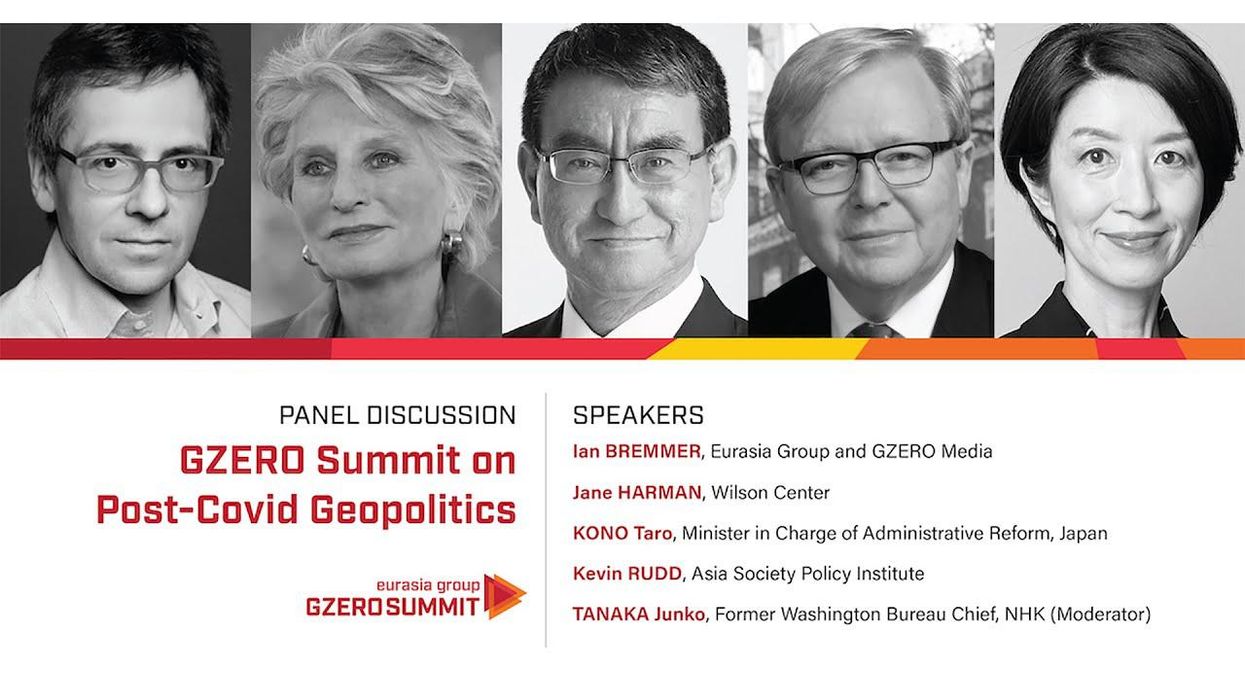
GZERO Summit: Geopolitics in a post-pandemic world
December 09, 2020
Explore GZERO’s past virtual conversations, featuring global experts on the world's urgent issues.
Presented by
What major geopolitical trends are in store for 2021, when a new US president takes over and will face not only the mammoth task of dealing with the coronavirus pandemic but also the fallout from the G-zero world that the Trump presidency accelerated? Who will most benefit and suffer from a leaderless global landscape?
It may be a bit too soon to see clear winners and losers, Eurasia Group President Ian Bremmer said during the panel discussion on post-COVID geopolitics at the 2020 GZERO Summit in Japan.
The US, he explained, stands to win by exercising its hard power on tech, banks and vaccine production, but so far it's been a loser on political division and overall management of the pandemic under Trump. China, for its part, has its economy growing again but is now mistrusted a lot more by the world.
In Asia, it's time to pay close attention to Japan, a reliable US ally and traditional China rival that is undergoing a political transition after the departure of Shinzo Abe as prime minister. Under new PM Yoshihide Suga, Japan will be closely monitoring the incoming Biden administration's initial moves on rebuilding the liberal international order that Trump shunned, noted Taro Kong, Japan's minister in charge of administrative reform.
The US-Japan alliance remains strong, he said, but the US has not been a reliable partner for the past four years, and a single alliance is not enough to ensure Asia's security amid an increasingly aggressive China.
For Jane Harman, head of the US-based Wilson Center think tank, the problem is that Biden's foreign policy ambitions may be hobbled by a Republican-controlled Senate if the Democrats don't win both races in Georgia's runoff election in early January. Biden, she said, can govern by executive order but the scope of what he can accomplish beyond that could be severely hampered without a Senate majority.
Moreover, she anticipated that Trump will continue to wield significant influence over the Republican Party, and probably prevent it from supporting Biden even if what he wants to do serves US foreign policy interests.
Indeed, the persistence of Trumpism will be a key constraint to more US globalism, said Bremmer, who added that Americans are now less supportive now of the US being the global policeman. With that in mind and with COVID recovery as Biden's top priority, the new president's success or failure may ultimately depend on whether the US is able to vaccinate its citizens fast enough to fend off possible vaccine competition from China in other parts of the world.
For Bremmer, Biden understands that the US must pivot again to Asia and that China is a clear rival. In that regard, his China policy won't be that different to Trump's except when it comes to climate change, where Biden thinks the US can both cooperate with China but also compete on green technology.
Right now, and despite US political divisions, the ball is in America's court on what it wants to do in Asia and with China, said Kevin Rudd, the former Australian prime minister and current president of the Asia Society Policy Institute. One positive development is that Biden will probably not mess with Taiwan, an immensely sensitive issue that Trump would often use to provoke Beijing's ire.
Beyond Taiwan and the South China Sea, Rudd commented that China is concerned about Biden because he will probably reverse four Trump trends that China was quite pleased with on democracy, allies, trade, and multilateralism. At the end of the day, China understands power, and knows that the US was less powerful with a president who stood up to China but on his own, without the allies that together have the combined power to really challenge China's regional superpower status.
Watch the above video to learn more insights from our panelists.






Keep up with what’s going on around the world - and why it matters.