Can the world learn lessons from vaccine inequity?
March 02, 2022
Global Stage LIVE from United Nations WATCH REPLAY
Explore GZERO’s past virtual conversations, featuring global experts on the world's urgent issues.
Presented by
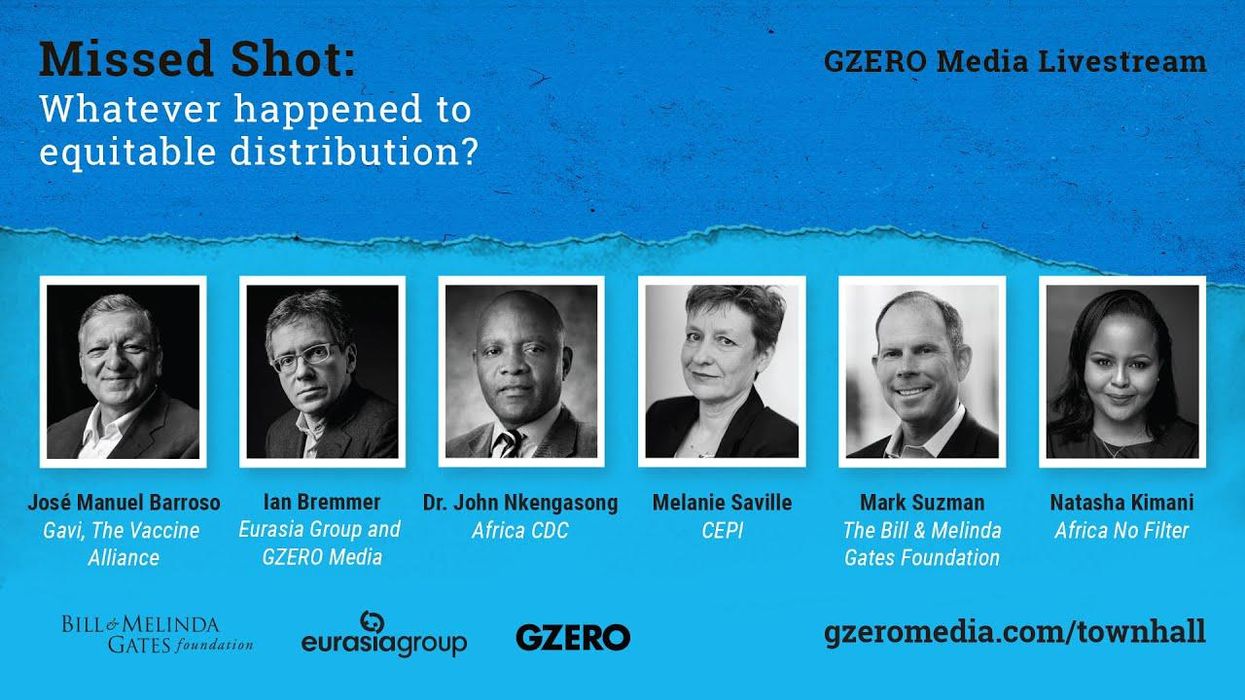
GZERO Media and the Bill & Melinda Gates Foundation convened leading experts in public health, research, development, and philanthropy on Thursday to discuss the uneven state of global recovery from health and economic perspectives. Participants included moderator Natasha Kimani of Africa No Filter; Eurasia Group President Ian Bremmer; José Manuel Barroso, chair of Gavi, The Vaccine Alliance; Dr. John Nkengasong, director of the Africa Centers for Disease Control; Melanie Saville, director of vaccine research and development for CEPI; and Mark Suzman, CEO of The Bill & Melinda Gates Foundation. They discussed vaccine equity and how we can end the COVID pandemic in a way that better equips the world for similar challenges in the future.
On many streets in the UK and US, it’s almost possible to forget that there’s an ongoing COVID-19 pandemic. With so many westerners double vaccinated and boosted, the threat of the omicron variant has eased. In fact, the CDC just lifted mask recommendations for much of the US. But that doesn’t mean the pandemic is over. For many countries, that’s far from the case.
Moderator Natasha Kimani, the research and media programs lead at Africa No Filter, kicked off the discussion by asking where things stand today as the world marks the second anniversary of the pandemic.
“It depends on where you sit,” says Dr. John N. Nkengasong, a virologist and director of Africa’s CDC. “If you’re sitting in Africa, the glass is half empty. If you’re sitting in the global north, the glass may be half full.”
There’s a reason for optimism in parts of the world that have managed to vaccinate a majority of their populations. But in Africa, says Nkengasong, there’s deep concern because the virus, and its effects remain “very unpredictable and very unsettled.” Optimism elsewhere, he warns, should be approached with caution and humility because more surprises may await us. “There’s still a lot we need to learn about the virus,” he says.
Nkengasong is optimistic the world will overcome the pandemic but is concerned by how long it will take. “We are dealing with a very determined enemy — let there not be doubt in anyone’s mind.”
Sadly, many low-income countries are still struggling to get vaccines and distribute them properly. With only 11 percent of the African continent vaccinated, according to the UN, much more needs to be done.
So, why have some countries fared so well while others have languished?
“The world has not provided equitable distribution,” says Mark Suzman, CEO of The Bill & Melinda Gates Foundation, which came at the cost of “lives lost that could’ve been saved.” Before a vaccine was available, countries agreed in principle to distribute a future jab to the most vulnerable. But once a vaccine was developed, Suzman explains, domestic political pressures in western countries led to a free-for-all instead.
Politics aside, the production of such a quick and effective vaccine is remarkable, and the technological innovation is worth heralding. “I think we've put 10 years of development into less than a year,” says Melanie Saville, director of vaccine research and development for CEPI.
But as for the lessons to be learned from their unequal distribution? Suzman points to two areas. First, we must finish addressing the current crisis and ensure effective delivery of vaccines to the unvaccinated. But, second, we must get ahead of future health threats by ensuring there’s enough volume of treatments available in both low- and higher-income countries. To be ready for the next pandemic, he says, we need to have all the tools and structures in place, including good surveillance, research and development, and manufacturing capabilities to respond to health threats within a couple of hundred days.
You would think that a global pandemic threatening millions of lives would pull the world together in search of a solution. Instead, we’ve witnessed political fragmentation in the US and vaccine inequity worldwide.
Russia’s invasion of Ukraine, meanwhile, has managed to take the pandemic off everyone’s radar. What’s a deadly virus compared to the threat of nuclear weapons? “Maybe we should give President Putin a Nobel prize of medicine because, apparently, he made COVID disappear,” quips Manuel Barroso, chair of Gavi, The Vaccine Alliance. Putin, of course, did nothing of the sort, and low oxygen supplies in Ukraine have spotlighted how COVID, as well as many other medical issues, are amplified during times of war.
But the Russian assault on Ukraine has managed to breathe new life into transatlantic cooperation. Could this newfound energy for a bolstered alliance help move the needle on other issues, such as health?
“I think the answer’s yes,” says Eurasia Group President Ian Bremmer. The pandemic wasn’t enough to shake up the dysfunctions in geopolitics, he explains, pointing to the politicization of health care at home and vaccine distribution inequity worldwide.
But the idea of a western collision with a nuclear-armed Russia?
That’s enough to shake up the allies and get them moving forward together, and Bremmer expects that cooperation to be long-lasting and to extend beyond the realms of defense and security (the wildcard being China and its future relationship with Russia), which will hopefully make it easier to help end the COVID pandemic and prepare for future health crises.
Looking back at the fight against COVID, Nkengasong likens the struggle in 2020 to one of fighting “a war with bare hands.” Last year, vaccines became the main tool for fighting back. This year, he says, we need to use every tool at our disposal — including self-testing, vaccines, boosting vaccine equity worldwide, ensuring access to new drugs — to prepare for the next variant, which “might cause severe disease.”
Only then, in late 2022, does he think there’s hope for “seeing the light at the end of the tunnel.”

Keep up with what’s going on around the world - and why it matters.