VIDEOSGZERO World with Ian BremmerQuick TakePUPPET REGIMEIan ExplainsGZERO ReportsAsk IanGlobal Stage
Site Navigation
Search
Human content,
AI powered search.
Latest Stories
Sign up for GZERO Daily.
Get our latest updates and insights delivered to your inbox.
Global Stage: Live from Munich
WATCH RECORDING
Quick Take
Ian Bremmer, political scientist and president of Eurasia Group and GZERO Media, shares insights on global political events.
Presented by

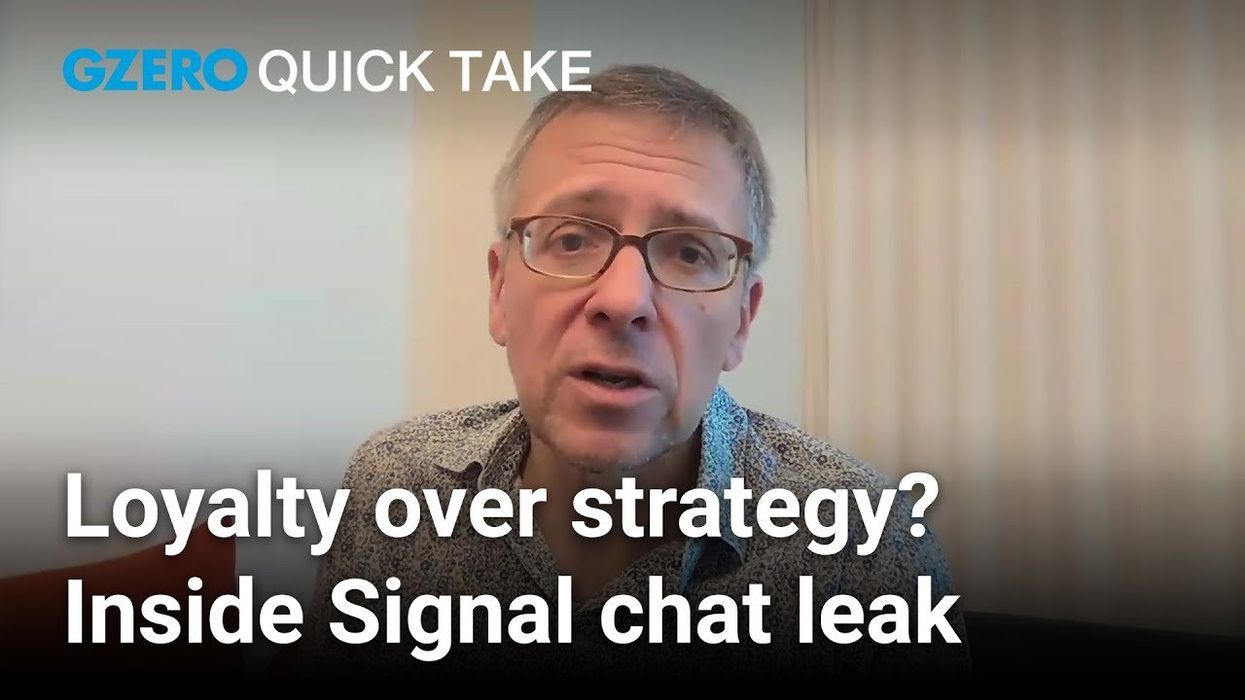
Ian Bremmer's Quick Take: A Quick Take on the back of the full transcript of these Signal chat that's going on about the bombing of the Houthis. A few things here. First of all, are we surprised that a journalist is actually publishing what is clearly classified data? And there's no question, it's classified data. I mean, you're talking about the targets, the exact timing in advance of US military strikes, incredibly sensitive information, against people that are described as terrorists in the chat. And clearly, if that information had gotten out in advance when Jeffrey Goldberg had received it in real time, it would have put the operation at risk. It would have prevented it from going on. It would have been denounced as leaking classified information, and he would be facing some legal charges from the administration. So I don't think it's credible to say that this is not classified.
But since Trump and members of administration have now said that it isn't classified, there was nothing classified in it, I guess that provides legal cover since it is ultimately in the charge of the president to be able to determine, as president, whether or not something is classified. That there's nothing illegal in Goldberg and the Atlantic Magazine now taking all of that information and putting it out to the public. So is that embarrassing for the US with its allies in terms of how they're handling such a chat? The answer is of course, yes. And I expect that we're going to see a significant amount of continued focus on this topic. A lot of people are going to be asking questions about how it was that this conversation could have been had on Signal and also how it was that Goldberg could have been brought on board. But say that as it may. I mean if you are the Trump administration here, it is age-old tactic, full denial responsibility is actually of your political adversaries so blame Goldberg. Imply that maybe he tried to get on the call through nefarious ways.
It's all his fault. It's overstated. He's a fake news, no news journalist. No one should pay attention to him. He's a bad guy. I mean all of that stuff. And I was particularly bemused by Elon Musk sharing a post from the Babylon Bee saying that, "If you wanted to ensure that nobody ever saw information you'd put it on page 2 of the Atlantic." And of course, that is true for Elon, and it's true for Trump supporters. And this is why the strategy works, is because the Atlantic and the people that read the Atlantic and support the Atlantic are all considered disinformation by those that are loyal to Trump. And vice versa. Fox, and Newsmax and all of the right-wing podcasts. Those are considered fake news by people that don't support, that dislike Trump. And that allows a strategy of full denial, not engaging with the facts and blaming those that are coming after you to be successful. Now, I still think that there are interesting pieces of information here.
Perhaps the most important is that the actual policy conversation, not the details of the war fighting itself, but rather whether or not it was a good idea to be attacking the Houthis, in a big way that was potentially going to increase energy prices. And that was much less of a fight of the Americans than it would be of those in the region that are engaged in the direct proxy war with Iran or the Europeans who have a lot more directly at stake, in terms of their trade in transit. And that was a very reasonable question, and it was strongly, in other words, Vice President Vance opposed these strikes and he's the most important person. He's the most senior ranking person in this chat. Trump isn't on the chat. And he's not saying the president is wrong. He's saying, "I don't believe the president is fully informed and this clearly is not in his interest, in his policy interest."
Now, the reason this is important is because in Trump's first term, I think you would have had a very similar conversation from people like Mike Pence and Mike Pompeo and others that would have been on this chat, but then they would have brought it to the president. And many, many instances in the first term of policy disagreements that then came up and said, "Mr. President. Respectfully, we think we've got additional information and we can better carry out your will by doing X, Y, and Z." And there were checks. There were internal checks on executive authority. What we see this time around is we see JD Vance, who's obviously a very smart guy saying, "I think this is a really bad idea. We shouldn't be doing it, but I'm prepared not to raise it to the president unless I have everybody around me supporting me because I can't do this by myself. I'm just going to get my head chopped off." And there's a little bit of back and forth.
And Stephen Miller, the deputy chief of staff for policy in the White House and a full-on Trump loyalist, says, "Nope, the president wants this. I'm ending the conversation." And that's the end of the conversation, and it never gets to Trump. And then they go ahead and they bomb. So whatever you think about whether this was a good or a bad decision, the challenge here is that we have a big cabinet, some of whom are very capable, some of whom are absolutely not capable. But first and foremost is not getting the best information to the president because he's extremely confident. He believes that his policies are always the right ones, and he is absolutely punishing anything that feels like disloyalty, inside or outside of his team. That's why Pompeo, for example, John Bolton, have had their security details stripped away. Even though the Iranian government has been trying to assassinate them, right? Why? Because they were disloyal to Trump. That's not why they're trying to assassinate him. That's why Trump took away their security detail and that is a very strong message to everybody that is on this chat.
And I do worry, I worry that the three most powerful men in power today around the world, all in their 70s, Trump, Putin, and Xi Jinping, are also men that are incredibly confident about the rightness of their views. That loyalty is the key to the most important currency of power that exists inside those systems. And increasingly, they're not getting good information from their own advisers. That's a dangerous place for the world to be. It's a dangerous place for the world to be heading, and that's frankly the most important thing that I took out of this chat. So that's it for me. I'll talk to you all real soon, thanks.
More from Quick Take
Trump’s State of the Union address
February 25, 2026
Has US–Iran diplomacy reached its end?
February 23, 2026
Supreme Court blocks Trump’s tariff power
February 20, 2026
Why Trump is pushing to take Greenland
January 18, 2026
US response to Iran protests
January 12, 2026
Maduro ousted in US raid, a major win for Trump
January 03, 2026
GZERO Series

© 2026 GZERO Media. All Rights Reserved | A Eurasia Group company.
GZERO Daily: our free newsletter about global politics
Keep up with what’s going on around the world - and why it matters.