Last week, my friend Alex Kliment wisely urged us to “Stop with the 1930s stuff,” current historical comparisons between what President Joe Biden has called a “ferocious surge” of antisemitism in response to the war in Gaza and the murderous anti-Jewish hatreds of the 1930s that led to the Holocaust.
Let’s pump the brakes on another distortion of history — that of today’s US political environment with the upheavals of 1968. (See here, here, and here for recent public examples.)
Here’s the argument some are making …
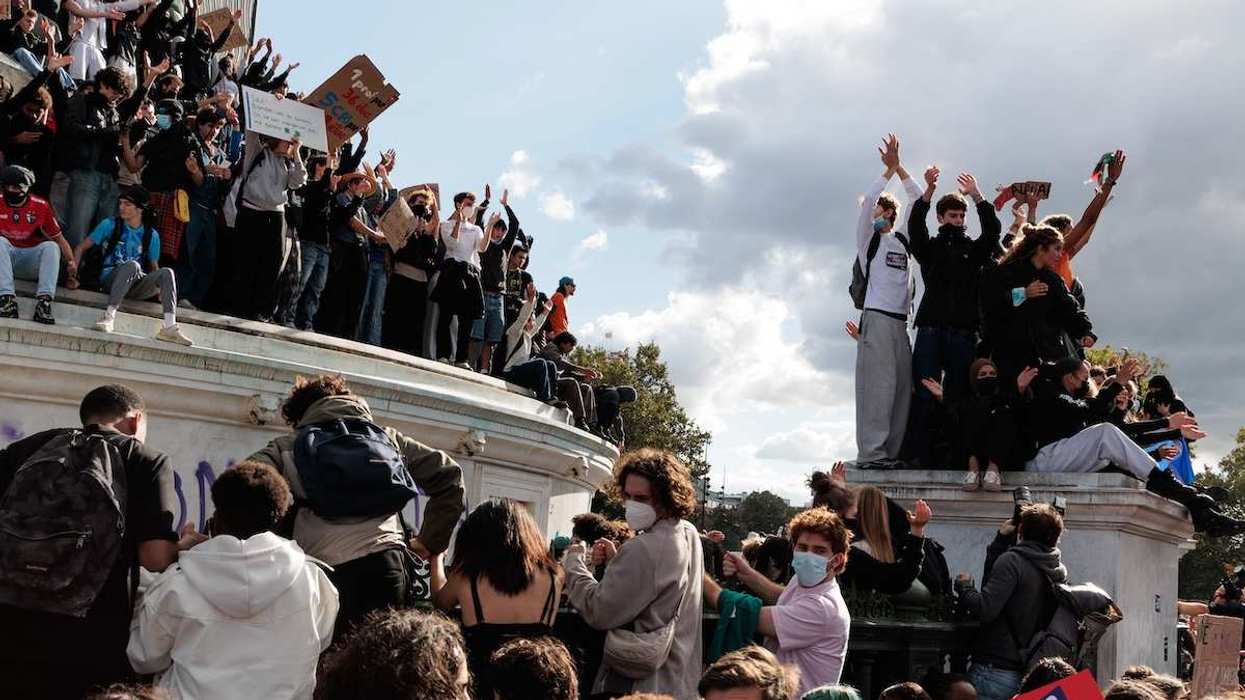
As in 1968, the Democratic Party, burdened with a weak incumbent, is fighting to keep the White House as a deeply unpopular war ignites angry student protests, provoking confrontations between students and police. The Democrats, preparing to nominate their candidate (in Chicago!) will face ugly demonstrations there that provoke yet more activist confrontations with police, adding to a sense that the nation is out of control and prompting centrist voters to favor a restoration of order.
Conclusion: The Dems lost in 1968, and Biden now faces defeat for the same reasons.
Not so fast. First, today’s student protesters are furious over the war in Gaza, the heavy civilian death toll among Palestinians with nowhere to go, and the seeming refusal of the US government and US institutions, including their schools, to make it stop.
But the students of 1968, angry over segregation in America and the war in Vietnam, faced the reality they might be drafted and sent to kill or be killed in Southeast Asia. The furies that fueled those students were far more personal.
Second, if today’s political environment feels chaotic, consider this … As of May 2024, hundreds of students have been arrested, and graduation ceremonies have been canceled. President Biden is unpopular.
By May 1968, a much larger number of protesters had been arrested, state troopers had killed three students and wounded 50 more at South Carolina State University, President Lyndon Johnson had announced he would not seek reelection, Martin Luther King Jr. had been assassinated, and Robert F. Kennedy would soon follow.
Third, this year’s election dynamic is very different. Polls say Biden is a weak leader for Democrats, but he is the incumbent. The advantages this confers on his reelection bid exceed anything 1968’s ill-fated Dem nominee, Vice President Hubert Humphrey, had on hand.
Biden has another advantage: Party convention organizers are already prepping for the worst in Chicago. In 1968, the Dems and Chicago PD weren’t ready for demonstrations of that scale, intensity, and sophistication of organization.
Further, in 1968, for voters who wanted a leader who could calm the raging passions of that moment, Richard Nixon could offer himself as an experienced statesman, a Cold War-era safe pair of hands — a man without the personal baggage that would permanently stain his legacy a few years later.
Donald Trump is a different political character. Love him or hate him, he will not be the choice of voters who crave a return to “normalcy.” Trump presents himself, and many of his devoted fans see him, as a political revolutionary, a Molotov cocktail to throw at the nation’s political elite.
In addition, while Nixon could win over persuadable voters as the “law-and-order candidate,” Trump now faces 91 felony charges in four separate criminal cases and is currently making headlines for defying a judge’s orders.
Finally, from the “tragedy-repeated-as-farce” department, 1968’s Robert F. Kennedy was a murdered martyr for social justice. His son, Robert Kennedy Jr., is a conspiracy theorist who says a doctor once told him that “a worm got into my brain and ate a portion of it and then died.” Nor is the younger Kennedy likely to win five states that had voted Democrat for decades, as third-party segregationist George Wallace did in 1968.
Biden faced an uphill reelection fight before the war and related protests erupted, and Trump might well beat him in November. If so, when seeking explanations, look to the problems Biden faced before Hamas attacked Israel.