
Podcast: Christine Lagarde is leading Europe’s united economic pandemic response
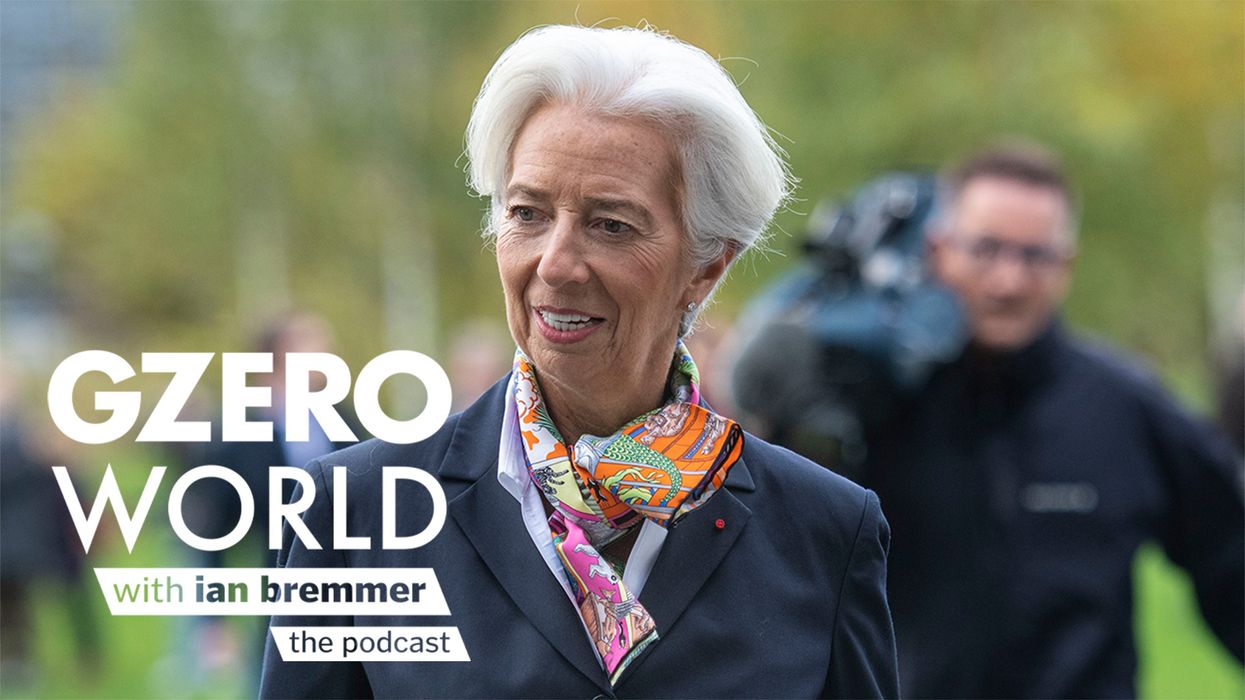
Listen: The coronavirus pandemic threatened to bring Europe's economy to its knees. Then something remarkable happened: 27 member states came together. On the latest episode of the GZERO World with Ian Bremmer podcast is the woman at the heart of that response, European Central Bank President Christine Lagarde. She'll explain how European nations were able to overcome political divisions and act quickly to prevent an all-out economic catastrophe on the continent.
TRANSCRIPT: Christine Lagarde is leading Europe’s united economic pandemic response
Christine Lagarde:
This crisis has proven that we are not in a national crisis. We are not in a regional crisis. We are in a crisis that knows of zero border, knows of zero differences in the color of your skin or in your sexual preference. It's going to hit you and me and anybody else for that matter, so it requires global responses that can be universal.
Ian Bremmer:
Hello and welcome to the GZERO World Podcast, where you'll find extended interviews from my show on public television. And today, I sit down with the president of the European Central Bank, Christine Lagarde. We talk about why Europe's economic response to the pandemic has been among the biggest international success stories in years, so far at least. Let's get to it.
Announcer:
This episode of the GZERO World Podcast was made possible by Lennar, America's largest and most innovative home builder and the number one destination for foreign residential real estate investment in the US. Learn more at www.lennargzero.com. That's L-E-N-N-A-R-G-Z-E-R-O.com.
Ian Bremmer:
Christine Lagarde, president of the European Central Bank. So good to be with you again.
Christine Lagarde:
So good too, Ian.
Ian Bremmer:
Christine, so many things to talk about on the global agenda right now, but perhaps the most interesting way to get into this is that this massive crisis, in many ways, the biggest of our lifetimes, the Europeans seem to be trying to make more of an opportunity from the crisis than others. You have a pretty unique seat on that. Tell me a little bit about what that means to you.
Christine Lagarde:
Well, as you said, Ian, the crisis is phenomenal, is monumental, it's unlike anything else that we've seen before, and as the saying goes, never waste a good crisis. And in very surprising ways, I think the Europeans have actually applied that to the letter. I'll give you a couple of examples. If you look at the way in which Europe was always criticized and was always regarded as this unfinished business that could not possibly organize itself, well, in the face of the crisis, all members of the European Union, 27 different member states, decided finally to jointly borrow on the markets in order to help those member states that were most severely hit by the crisis. And to help not in the form of cheap loans, if you will, but in the form of pure grants, which is something that was just not expected and that had been fiercely debated and objected against.
So this crisis was a catalyst to a move that is really a signal of solidarity, of understanding where it hurts and how we can all collect ourselves from this crisis in a better shape than when we entered into the crisis. So that's an example of how things can actually materially change, despite the unbelievable crisis that we've all gone through.
Ian Bremmer:
I think arguably, this is the biggest success of international governance and cooperation that we have seen since the pandemic has started, and you make the point that this was not something that you would've seen from the Europeans historically. If I think about 2008 and the financial crisis, if I think about the Greek crisis, the Eurozone crisis, a couple of years later, the response was very different and did not bring Europe together. Why so different this time?
Christine Lagarde:
I'm tempted to say because of COVID-19, because the triggering factor for the crisis was not the banks, was not finance, was not the bursting of a huge stock market bubble. It was not the bad behavior of some policymakers somewhere in the region. It was actually this teeny tiny little virus that went around from one country to the other in almost instant time. So the fact that everybody was in the same boat, that it was going to hit without distinction of behind which border you were, what your wealth was, I think created a sense of anxiety, vulnerability, the fear of the unknown, and the fact that at a narrow, small level, the defense would probably not be strong enough. So I think it really revealed to many of the Europeans the fact that all together and by operating together, we would be stronger against this teeny tiny little thing that was killing and creating so much havoc.
Ian Bremmer:
We saw of course a little bit of those fights still under the hood with the Dutch saying, "Well, wait a second. We can't send all of this money to these poor countries that are going to waste it." The Hungarians with a very different governance model that might require conditionality in the loans. The success in getting that relief passed, has that resolved in any way some of these underlying problems? Has it created more progress structurally in allowing Europe to come together in your view?
Christine Lagarde:
In any journey, it is the first step that is the hardest, so let's hope that this is the case as well. You are completely right, Ian. Those sort of cultural trends, those subtracts that underline all these unbelievable governance that the European Union has been, they remain, and the characteristics of countries, the political preferences, all of that is in place. But I think there was something that was just broader, bigger and more terrifying than all of that, which eventually brought all those at the table on the same agenda. Is it going to survive? Is it going to be structurally decisive for the construction of European Union going forward? We don't know yet, but at least it showed the world and it showed the Europeans themselves that they were capable in the face of that adversity to come together and to care for the weakest and to focus on where it would help most.
And for the first time actually, also in a while, the central banks were not the only game in town, and it was on those occasions that we could see that governments and central banks could actually work together and get a bigger bang for their buck.
Ian Bremmer:
Is that a big difference with what you see in the UK, in the United States, in other countries? Are the central banks the only game in town in responding in many of those countries?
Christine Lagarde:
No, I wouldn't say that. I would say that this pandemic crisis that eventually created this economic havoc brought all policy makers to the table, and around the world, we saw fiscal measures being taken, massive efforts in order to sustain credit, in order to make sure that money flew in the economy, in order to make sure that people either kept their jobs or kept their income if the jobs were suspended for a period of time, so I think the efforts was across the board and in many corners. Now, there are places where it took longer, it took different forms as well. The most fiscally capable countries put probably more on the table than others, but I think it was a pretty general effort.
Ian Bremmer:
Are you worrying that the sustainability of those efforts has a sell by date?
Christine Lagarde:
Yeah, very much so, because I like to say that the recovery is underway but that it is uncertain, incomplete and uneven. And the uncertainty around the recovery has to do predominantly with COVID-19. Is it going to go into a small or medium, a large, an oversized second wave? Will there be a third wave? How long will it take to find the right, very efficient testing methods? How long will it take to get the vaccine to market production at a fast pace? What kind of therapy will be available? That's a bucket of uncertainties that is out there.
But as part of the uncertainties, you also have those safety nets that have been put in place to support jobs and employees, to support credit and companies, to support debt and soverance. Is that going to disappear suddenly? Will there be a gradual phasing out? Is the phasing out going to be synchronized with the pickup of the economy? Those are the big more economic questions and financial questions that impair this recovery at the moment. So they are health and safety in the first place, but they're also economic and finance, and the courage that was deployed in the early days needs to now be really very carefully applied to phasing out while recovery picks up. And this very subtle synchronization that is needed will be the trigger to either success or a very slow-going recovery.
Ian Bremmer:
When you think about the European response, everyone of course is saying, well, Merkel is such a strong leader and she's managed to rebuild her legacy, and Macron is right now much more popular than he was a year ago. But you also have Lagarde, you have von der Leyen, you have a European superstructure which is a really big piece of this. How much does it matter, given that super structure, who Merkel's successor is going to be to the success of this European project? How much does it matter the individual governments and governance to ensure that the momentum is continued?
Christine Lagarde:
I think one of the reasons the crisis management has rapidly proved effective and efficient had to do with the corporation, the no nonsense approach that many of us, both in the super structure as you call it, whether it was Ursula von der Leyen or myself, or Angela Merkel and Macron, the way in which we approached this together I think played a great role in being fast to market and concerned about efficiency and implementation. But I think it's the combination of the two. To have strong political leaders matter a lot, to have reliable, solid and well driven institutions and a good governance in place matter a lot as well.
The fact that we were able to pick up the phone, send texts to each other, rally around a quick telephone conference or WebEx, just three or four of us, actually was critically important. I had many of those quick discussions, to the point, as I said, no nonsense discussions with Ursula, with Charles Michel as well, who is president of the European Council, that's at the European level, and obviously conversations with political leaders as well. So knowing each other well, connecting well, not being especially picky about who is going to get the credit at the end of the day but being focused on the outcome and the result of what we were doing I think has mattered enormously.
Ian Bremmer:
Clearly, the initial economic and monetary response in Europe has been strong, but as you say, we're in early innings here. Are we right now through the worst part of the economic challenges, or do you think next year when a lot of these companies continue to need state support to continue to exist, when a lot of these citizens continue to need support because their furloughed jobs are gone for good, do you think it gets worse before it gets better I guess I'm asking economically.
Christine Lagarde:
Ian, it's difficult to say. All I know is that it's going to be a journey and probably a long journey, because coupled with that, you also have factors that were there before the crisis but that have accelerated and will transform our societies. When you look at the digitalization of our economy and how so many things have been completely transformed because of the pandemic, I look just at payments at our modest level. Payment systems are currently going through massive transformation. Digital currencies that were this sort of somehow exotic, interesting object of research is clearly now at the forefront of many of central bank governors' radar screens. So if you couple the necessary transitioning that will happen in the months to come plus the transformation of our economy, plus the political determination to address climate change as a major risk, which will also impact the way in which we transport ourselves, the way in which we heat our houses, the way in which we eat, this is a massive transformation.
Ian Bremmer:
Does this crisis set us back in terms of global governance and the ability to respond to crises from what you're seeing so far? Not Europe, globally. Or is it really creating momentum for a better response?
Christine Lagarde:
I would hope that it triggers momentum. I can tell you that from this region of the world, it has certainly encouraged, supported a much more collective and better governed collective response, irrespective of noise on the line, if you will, and there will be. It's inevitable. At a global level, I would hope that international organizations that we have listened to the World Health Organization, my favorite former institution, the IMF, will come out of that hopefully stronger than they were when they went into the crisis. But the jury is out, we will see.
Ian Bremmer:
What needs to change that you think is plausible that'll make us feel more optimistic that the global trajectory has improved.
Christine Lagarde:
Confidence is going to be key.
Ian Bremmer:
Confidence in the economy? Confidence in your leaders? Your institutions?
Christine Lagarde:
Confidence in the institutions, confidence in the governance that we choose for ourselves. And if those governances need to be improved and need to be changed, then it's going to be for political leaders representing their constituents to actually address that issue. But if anything, this crisis has proven that we are not in a national crisis. We are not in a regional crisis. We are in a crisis that knows of zero border, knows of zero differences in the color of your skin or in your sexual preference. It's going to hit you and me and anybody else for that matter, so it requires global responses that can be universal.
Ian Bremmer:
And I wonder, the world's trajectory, what are you worried most about right now? I understand we're in this moment of coronavirus, which is rife with change and volatility. What are the things that give you the most pause as a leader of this fragile planet?
Christine Lagarde:
Hubris. There are things that are worse than what we are going through, and it's bad enough, and that is war, that is confrontation. And I think that what is conducive to war and confrontation where people suffer, where economies suffer, and from which it takes forever to get back to a healthier, safer environment, it's war.
Ian Bremmer:
When we talk about hubris, are we talking about that all the leaders are so much in their own head, in their own space and don't care about the collective? Or is it something deeper than that?
Christine Lagarde:
Well, hubris is very, very nicely shared around the world. I would say that, and the public interest is often forgotten and is often ignored. So I think one of our duties and one of your duties in the function that you have, Ian, is to remind all of us that there is public interest and that policy makers, governors, members of institutions need to constantly remind themselves that they're here to serve public interest.
Ian Bremmer:
How do we get the Europeans to recognize that they can actually punch more above their weight in making a difference for all of these crises that are creating more inequality and that are going to fall largely on the backs of those that are much less fortunate than you and I?
Christine Lagarde:
I think if you look at how Europe is now expressing itself, identifying a strategy, focusing resources, having a more collective approach, working hand in hands between the institutional level and the political level, between the fiscal authorities and the monetary authorities, I would say that at this point in time, Europe is transforming itself and I hope that the vision that people of the rest of the world have of Europe is a vision of transformation. It's not a surprise that the 750 billion fund that was agreed upon in July is actually called New Generation EU Fund. It's really intended for the future, not to address stories of the past.
Ian Bremmer:
Speaking of things that are making Europe stronger, is Brexit making Europe collectively stronger?
Christine Lagarde:
I don't think that many people would've bet money on 27 countries staying together to actually negotiate through one negotiator with the government of the United Kingdom. Many would've bet that there would have been dissension, fragmentation of the European group, little negotiations through the back door, bilateral approaches. None of that has taken place. All members of the European Union have stayed together throughout these last three years, and I don't see any trace of them coming apart and anybody trying to or succeeding in dividing them. That's pretty surprising and a bit of an achievement, I would say.
Ian Bremmer:
Christine Lagarde, thank you so much. See you soon.
Christine Lagarde:
Bye-Bye.
That's it for today's edition of the GZERO World Podcast. Like what you've heard? I hope so. Come check us out at gzeromedia.com and sign up for our newsletter, Signal.
Announcer:
This episode of the GZERO World Podcast was made possible by Lennar, America's largest and most innovative home builder and the number one destination for foreign residential real estate investment in the US. Learn more at www.lennargzero.com. That's L-E-N-N-A-R-G-Z-E-R-O.com.
Subscribe to the GZERO World Podcast on Apple Podcasts, Spotify, Stitcher, or your preferred podcast platform, to receive new episodes as soon as they're published.