
Podcast: The human tragedy of Yemen’s intractable civil war
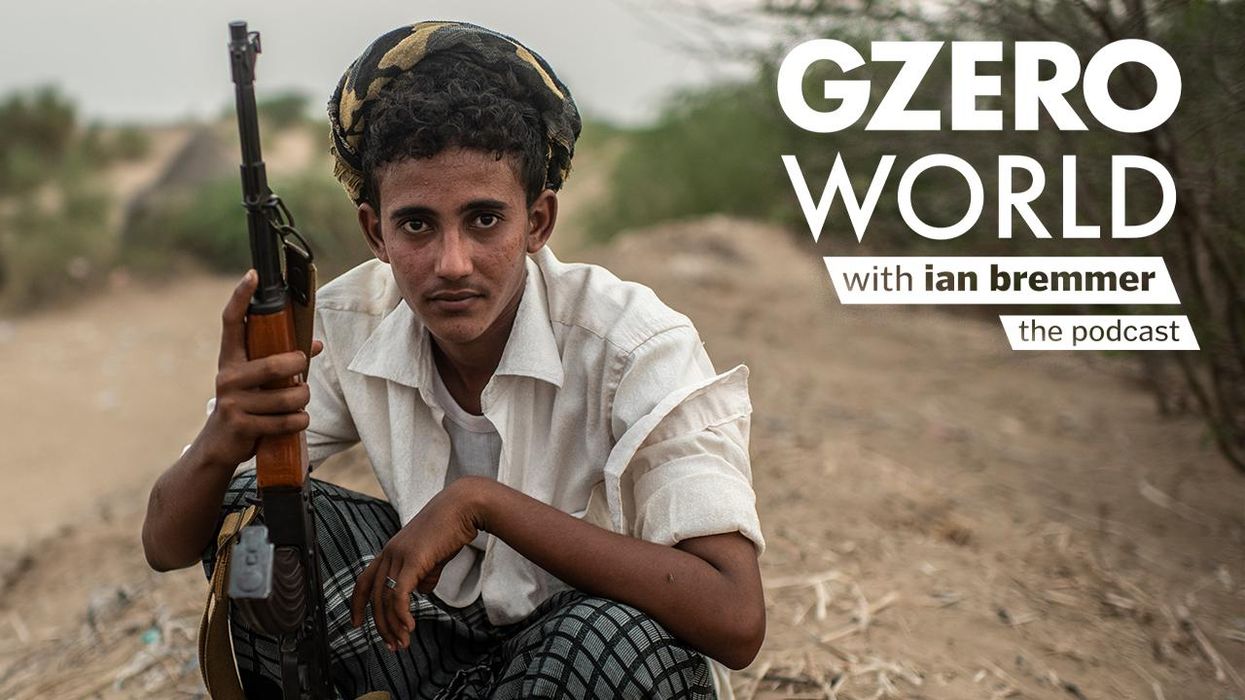
Listen: After 7 years of conflict, Yemen is often called the world’s worst humanitarian crisis. Ian Bremmer speaks with UN Resident Coordinator David Gressly about the dire situation in Yemen, where half of the population doesn’t know when they will eat their next meal. Seen as a proxy war between the Saudis and the Iranians, civilians are caught in the crosshairs.
TRANSCRIPT: The human tragedy of Yemen’s intractable civil war
David Gressly:
Keeping people alive is important, but creating an environment in which they can recover, that a new generation can learn and be prepared for a post-war situation is also important. We have to prepare for the future as well as keeping people alive today.
Ian Bremmer:
Hello and welcome to the GZERO World Podcast. This is where you'll find extended versions of my interviews on public television. I'm Ian Bremmer, and today as Afghanistan's plight made international headlines, another desperate conflict raged on in the background. After seven years of continuous war, Yemen is often called the world's worst humanitarian crisis. 80% of the population needs aid to survive. Two-thirds of all Yemenis are hungry. Nearly half don't know when they will eat their next meal. More than 10,000 children have been killed or maimed by fighting, and there's no end in sight.
I speak to David Gressly, he's the UN's resident coordinator in Yemen about how the world can end this horrible conflict. Let's get to it.
Announcer:
The GZERO World Podcast is brought to you by our founding sponsor, First Republic. First Republic, a private bank and wealth management company understands the value of service, safety and stability in today's uncertain world. Visit firstrepublic.com to learn more. GZERO World would also like to share a message from our friends at Foreign Policy, the Paris Climate Agreement, the Iran nuclear deal. You rarely hear what happens behind the closed doors of the world's biggest agreements until now. On the new podcast, The Negotiators, foreign policy is teaming up with DOHaD debates to put listeners in the room. Listen to new episodes every week on Apple, Spotify, or wherever you get your podcasts. David Gressly, thanks so much for joining us on GZERO World.
David Gressly:
It's a great pleasure. Thank you very much.
Ian Bremmer:
Tell us a little bit what life is just like day-to-day in Yemen right now.
David Gressly:
It's really hard frankly. I've had the privilege actually of traveling extensively inside Yemen, and I see every day the impact the war has had on people. I see it in the schools that have been destroyed. I see it in infrastructure, roads and bridges that are not functional, but more important, I see the people. I remember one trip up towards Hudaydah on the Red Sea coast and I was traveling in an area that very few people had been able to get into, and that was the whole purpose was to get there.
And just traveling and talking to people, they're worried about landmines in their fields, there're landmines in the schools, the unexplored ordinance that kills and maims people nearly every day. They don't have access to water because of the front lines. They can't cross over to where their fields are or where their schools are or where their health clinics are. And many people, particularly mothers, grab my arm physically and just say, basically they have a story they want to tell about what they're facing, trying to keep their children alive, to get their children an education, to get the medical attention that they need. It's just devastating and it's just every year the war goes on, it gets worse for all of these Yemeni people.
Ian Bremmer:
And what does government feel like for the average citizen on the ground? Who are they looking to for any relief at this point?
David Gressly:
Outside of the international assistance that's coming in, which is considerable over $2 billion of assistance a year, it's important to keep in mind that it's a civil war. So there's two governments. There's the recognized government headquartered in Aden right now, and then the controlling authority in the North based in Sana'a. And both are quite challenged frankly, to provide basic services. We do a lot of that. We provide the fuel, we provide for hospitals, for water systems. It's very hard to find the funding to keep these operations going. Those governments don't have the resources. In the southern part of the country you have a currency that continues to decline.
The rial has hit lows as much as 1700 to the dollar, and it was not so many years ago, about 2.50. Purchasing power has considerably declined. So the cost of food has gone up for everyone. The cost of transportation, distribution has all been complicated by the conflict, so it's very expensive to buy food. So these impediments combined with the loss of income for people means that their incomes have gone down. Prices have come up, and it's basically what's creating the food insecurity that we see throughout the country affecting 20 million people. So it's really hard to see how these two different governments that are currently fighting each other can significantly contribute to the social welfare of the people on either side of the front lines.
Ian Bremmer:
You've said that the UN is providing about $2 billion a year. How much can you not do? What is the most urgent that just can't in any way be provided given the resources you presently have?
David Gressly:
We're looking actually this year for $3.6 billion just for Yemen alone, of which we've got about 2.1 billion. So there is that gap of 1.5 billion. That means people do not get a full ration of food. We're having to do half or three-quarter rations. So that's a major problem. But the bigger problem really is on the healthcare side. There isn't sufficient money for keeping hospitals operating or clinics in rural areas operating. The hospitals are overrun now because most of the clinics are closed. We're only getting about 20% of the money that we are asking for for health. The same is true for water supplies, clean water. Between health and clean water, if you don't have adequate resources and we don't, only about 20%, that contributes as much to mortality as lack of food.
And then support for the internally displaced, 4 million people. We can't support 4 million people at this point in time with the resources that we have. We do as much as we can, but the shelter that they require, we don't have funding really for that. So simple things like the dignity that people have from a basic shelter or privacy for women, is missing. Education for the displaced, missing. Livelihoods for the displaced, missing. So there are big pieces that are missing. Keeping people alive is important, but creating an environment in which they can recover, a new generation can learn and be prepared for a post-war. We have to prepare for the future as well as keeping people alive today. All of that is missing right now.
Ian Bremmer:
Now, one of the stats I saw that quite surprised me was some 1.2 million civil servants in Yemen, they're not being paid, but they go to work every day.
David Gressly:
Yes.
Ian Bremmer:
Now, you are obviously working with a lot of these people. What's keeping them going?
David Gressly:
Many things keep them going actually. One is just a sense of responsibility. They know that they're the ones that are keeping people alive if they're working in a hospital or they're teachers educating a new generation. So they continue to try to do what they can, but there are limits to that. And bit by bit, people do stop coming to work. If we lose them, then our ability to support the population also collapses. So for multiple reasons, we need to work and we're looking to work with both the governments but also with international partners on how we can overcome that particular problem I see as one of the more serious problems that the country faces today. Because it has both short-term and long-term consequences.
Ian Bremmer:
So let me make you put your diplomat analyst hat on. This war's been going on for seven years, which doesn't sound like much in the context of Afghanistan, but for the Yemeni people it sure does. So I mean, we had some ceasefires, but we haven't had any breakthroughs. What do you think needs to happen for the reconciliation efforts, either from the UN or through the GCC to bear fruit?
David Gressly:
Well, what is playing out today on the ground is a really intense battle in the city of Marib, which is in the eastern part of the country. It's currently held by the internationally recognized government. The Ansar Allah is trying to capture it. Both sides desperately want to win this battle and it will continue until some sort of resolution comes through. And that's why we're seeing the level of displacement there. And that's why I think until some resolution comes there, we're likely to see a continuation of the conflict. But more medium-term, what's required is a peace process and a peace process that doesn't focus only on military and security issues.
It's extremely important if you want a sustained peace, to deal with the issues of reconciliation in a real way. And that has to be built into the process, whether it's in the ceasefire or in the ultimate peace settlement. But also, I think it's important to deal with the economic issues and to build into any peace settlement, a more equitable access to the economy for Yemeni citizens, because that was one of the factors that drove the initial conflict. So if you don't build those elements in, you're not likely to have a sustained peace. It's likely to revert back to conflict at some point in the future.
Ian Bremmer:
Now we are seeing some change from the US perspective under the Biden administration. The Houthi's have been delisted as a terrorist organization, makes it easier for the Americans to be seen as an honest broker, at least to some degree. And furthermore, the US no longer providing support in terms of offensive weapons to the Saudis in fighting the war in Yemen. Do either of those two things actually make a difference on the ground?
David Gressly:
Primarily looking at it from a humanitarian angle, from that point of view, yes, it's been very helpful. However, any honest observer of all initiatives to try to jumpstart a peace process would have to say that so far this has not worked. And it's not from a lack of trying, that's for sure. But it just shows you the underlying difficulty of addressing this problem. So the fact that it hasn't worked yet doesn't mean it won't ultimately work. And these things are difficult. I've been in, as I mentioned, several conflicts before, things really don't move forward until there's a will on all parties side to go forward to say, "Yeah, now is the time for peace." And so continued advocacy by those who have influence with the parties in conflict and the regional players, I think is necessary to continue to push for peace.
Secondly, I think there are things that can be done, and certainly we've been receiving support from member states, including the US on what can we do to open up the economy even during the conflict, to reduce the burden of the conflict on the people? Particularly opening up transport into the country for food supplies, opening the Port of Hudaydah. Reducing some of the restrictions linked to the conflict, the inspections regimes, which will still be necessary. But there may be ways to ease that in terms of delays and the cost that go in it. Because each time there's a delay, each time there's an impediment, it increases the cost of food to Yemeni people. Same thing for the business environment. There're very good businessmen throughout Yemen, but they are constrained to create business inside the country.
Actually, many have businesses outside because of the environment. And I think there are ways that we've put on the table an economic framework that would help businesses do better. They could do even better with peace, of course. But even in the context of the war, there are things that can be done to make the economy more effective so people have jobs and jobs equals food security. And like you mentioned earlier, the issue of salaries for the civil servants, that's another step that I think we can take that helps solidify economic wellbeing for people even in the midst of conflict and does lay the groundwork for an ultimate peace. So here we're getting really good support, I believe, but it's difficult discussions and negotiations to try to achieve that, but the evidence is clear. And I think we've been able to demonstrate that through economic analysis that the evidence is clear. So we should be able to make some more progress on that I hope in 2022.
Ian Bremmer:
I mean, I remember before the war broke out, reading about Yemen and hearing the incredible water scarcity, the idea that the capital wouldn't be sustainable for more than another decade or two, just on the basis of that. And the population explosion, of course, massive families and 20 million people as you say, and those numbers are only going up. I mean, if we were able to bring this war to an end, does the Yemeni economy have honest, sustainable prospects going forward?
David Gressly:
I think so. Very much so. In fact, UN Development Programme just issued a report to that effect of how a sustained peace would result in significant improvement in the lives of the Yemeni people. They're very talented people throughout Yemen. I've been struck by that. So the human capital part I think is actually there. The problem is the war itself in many ways. So I don't think it would be that difficult to regenerate an economy if there's a real peace. But that is always going to be the hardest part, is to get that real peace. There are many Yemeni businessmen that I've met, and they've described the constraints that they operate in. And as I mentioned earlier, they do have companies outside of Yemen that are quite prosperous, so they can bring that talent back into Yemen in peacetime.
Yemen may not be agriculturally self-sufficient, but it can generate enough income to pay for imports. And I think that a lot of success can be had. And there are certain industries like the fisheries industries. I mean, there's the Red Sea coast and the Arabian Coast that provide ample fishing opportunities. That used to be the third-largest export earner, in fact, for Yemen, was the fisheries sector. And that should be fairly straightforward also to resurrect in the context of peace. So I'm not at all pessimistic about Yemen. It has oil, it has untapped oil reserves and gas reserves as well as what it's currently exporting. So the potential I think is quite good.
Ian Bremmer:
Well, before we close, let me ask you a bit about that underlying issue as well. One place, I mean, the geopolitics of the region are changing, and I do see increasingly as the Iranians are unwilling to return to the nuclear deal, the Gulf Arab countries are increasingly saying, "Look, we're going to have to just work with the Iranians ourselves. We're going to have to cut deals with these guys." Is there hope, I mean, beyond the challenges of getting the two sides together inside Yemen, is there hope that we could see a real fundamental breakthrough between the Emirates and the Saudis on the one side, Iran on the other, and that just changes the ballgame?
David Gressly:
Well, I think if that were to happen, it certainly would change things on the ground. I do have to say, as a bit of a caveat, only a partial one, that the controlling authorities in Sana'a do try to demonstrate a degree of independence from Iran and do resist some of that pressure that I think you're implying. But nonetheless, that would change the situation on the ground. And I do think it's a way forward to find a way forward would be at least in part through the regional countries involved, but it also requires work internally if we're going to really see it to be successful in the long-term.
Ian Bremmer:
Well, 20 million Yemenis, certainly thankful that you're there and doing the good work that you are. I hope you get a little bit of downtime over the holidays as you go back in very short order. Thank you so much for joining us today.
David Gressly:
It's been great talking to you. Thank you very much.
Ian Bremmer:
That's it for today's edition of the GZERO World Podcast. Like what you've heard? Come check us out at gzeromedia.com and sign up for our newsletter Signal. The GZERO World Podcast is brought to you by our founding sponsor, First Republic. First Republic, a private bank and wealth management company understands the value of service, safety, and stability in today's uncertain world. Visit firstrepublic.com to learn more. GZERO World would also like to share a message from our friends at Foreign Policy, the Paris Climate Agreement, the Iran nuclear deal. You rarely hear what happens behind the closed doors of the world's biggest agreements until now. On the new podcast, The Negotiators, foreign policy is teaming up with DOHaD debates to put listeners in the room. Listen to new episodes every week on Apple, Spotify, or wherever you get your podcasts.
Subscribe to the GZERO World Podcast on Apple Podcasts, Spotify, Stitcher, or your preferred podcast platform to receive new episodes as soon as they're published.