VIDEOSGZERO World with Ian BremmerQuick TakePUPPET REGIMEIan ExplainsGZERO ReportsAsk IanGlobal Stage
Site Navigation
Search
Human content,
AI powered search.
Latest Stories
Sign up for GZERO Daily.
Get our latest updates and insights delivered to your inbox.
Global Stage: Live from Munich
WATCH RECORDING
Quick Take
Ian Bremmer, political scientist and president of Eurasia Group and GZERO Media, shares insights on global political events.
Presented by

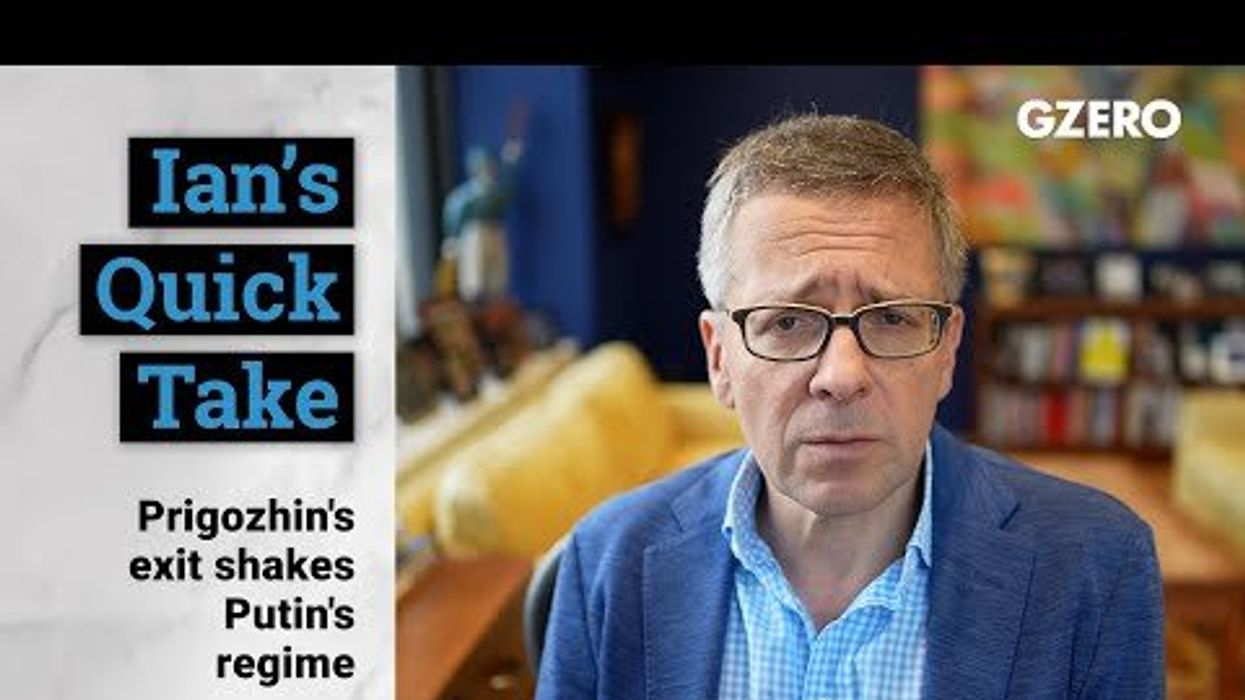
Ian Bremmer's Quick Take: Hi, everybody. Ian Bremmer here and quite a weekend.
We have just gotten through an unprecedented turn of events challenging President Putin in a way that he has not since he's taken power in that country. Mr. Prigozhin, the head of the Wagner Group, built up directly by President Putin, he is solely responsible for Prigozhin's success and power and wealth, and then essentially declaring war against the Kremlin, moving his forces to within dozens of kilometers of Moscow. And then, at the last moment, "cutting a deal" brokered by Belarus's President Aleksandr Lukashenko. He is today still, to the best of our knowledge, a free man. But for how long? It's hard to imagine that's sustainable.
This is a man who has done a lot of fighting for the Russians on the ground in Ukraine, sending his troops into a meat grinder, as it's been referred to in Bakhmut, some of the only territorial gains that the Russians have had in the last six months. Lionized for that by Russian state media on billboards across the country over the past months, but also increasingly insubordinate, both in his public willingness to go after the Ministry of Defense, the forces, the command structure on the ground, and, in particular, Minister of Defense, Sergei Shoigu. And then, over the last week, when Shoigu said that all Wagner forces and all paramilitary forces had to sign direct contracts with the Ministry of Defense, in other words, they'd be rolling up to their authority. And Prigozhin said no and then Putin directly said, reiterating that order, "Have to sign. Those orders have to become conscripted under contract under Shoigu."
Prigozhin again said no. Put him in an impossible situation. He was essentially dead man walking if he was going to say no. And he said no. Of course, he wasn't in much better of a situation if he said yes, because then those troops no longer report to him, and that is his power base. So he ended up turning around from Ukraine and sending his troops first into Rostov uncontested, head seat of the Southern Military District where the command center for the Ukrainian offensive has been for the Russians. And then up towards Moscow. So that explains why he did it, but much harder to explain why he suddenly backed down and why he's still alive today. Why he backed down I think has more to do with the fact that he didn't have any support inside the Kremlin. I mean, while this was all going on, there were no defections among Russia's military leadership. There were no defections inside the government. There were no defections among Russia's key oligarchs.
Prigozhin is not only a creation of Putin, but is also outside the power structure. So inside the power structure, you don't have a lot of people saying, "I'm with him. I'm with stupid." And so he marches towards Moscow in an utter move of desperation but doesn't have the ability to beat the forces, or doesn't think he does, that are loyal directly to Putin and are accountable directly to Putin defending Moscow. And so then when he is offered a deal, he takes the deal. But I mean, anyone that believes that a deal offered by Putin after this level of personal challenge and embarrassment to the Russian President. People have been assassinated and jailed for a lot less in what they do to the all powerful, or previously all powerful Russian President.
So why is he still alive? And there I think it's a matter of timing. It's the fact that the Russian government has been fighting against this Ukrainian counter offensive, and if they were to have a fight against Wagner right now, and keep in mind the Ukrainian counter offensive hasn't gone very well, but most of the troops aren't involved yet, they have 11 plus trained and equipped divisions, trained by the US, by the UK and allies, only two and a half of them are already involved in the fighting, which means that Putin knew a lot more was coming. And if Wagner's not available, and the Chechen Kadyrov group, another paramilitary that has declared full loyalty to the Ministry of Defense, was pulling back to fight against Wagner and the MOD forces are going to need to be used for that as well.
Suddenly, the Ukrainians might have a clear ability to retake all the territory. So this was the worst possible time for Putin to go to war against Wagner. And perhaps that is the best explanation for why it is that they cut a deal. But the deal that was cut is not a deal that can't be broken. And, of course, now that the Wagner Group, their headquarters have been raided, it has been announced that all of their forces are going to sign direct contracts with the Russian Ministry of Defense. Prigozhin is, at least we believe, either headed to or in Belarus, probably in Belarus. Not a sovereign state. Intelligence, military, really under the control of Russia, just as Lukashenko primarily is. And so that means if Putin wants to take him out, it's more a matter of time than it is a matter of capability.
And I personally can't imagine that he's going to be with us for all that much longer. But a lot of damage has been done. The fact that around the world everyone has seen that when Putin has been challenged and challenged hard that the Russian forces did not stand up to the Wagner forces until they got close to Moscow. And they also showed that, at the last moment, Putin didn't use his forces against him, but instead let him walk away. That's a weakness for Putin internally that is being seen by the Russian people. It's being seen by Russian military elites and others. It's also being seen by other countries around the world.
The Chinese, supposed to be Russia's best friend, they didn't provide any military support for Putin when he was at his moment of greatest need. The Kazakhs, Russia sent over 2,000 paramilitary forces, parachutists, and others into Kazakhstan over a year ago before the Ukraine war was launched, because a coup occurred against President Tokayev. He really appreciated that support. He's there today because of that support. His willingness to support Putin, he said it was an internal Russian matter. So I mean, you look around the world right now, we have a very strong NATO, we have enormous support from NATO into Ukraine, and we have Russia pretty isolated on the global stage.
That's good for the Ukrainians, there's no question, and it's good for NATO's strategy, but it also increasingly gives Putin no outs. Someone considered a war criminal internationally and someone that now has been tested in a way he never expected to be by his own loyal former chef, the caterer, Prigozhin, who at least for now is in Belarus. This story is not close to over. Russia's stability is now a significant question in a way that it really was not just 72 hours ago, and I'm sure we're going to be talking about it quite a bit.
You go back to January this year. Our top risks as we look forward over the course of every year in terms of likelihood, imminence, and impact, number one, and not even close in any other risk that we've seen over the course of the 25 years that we've had Eurasia Group, was the idea of a rogue Russia. A Russia that increasingly has been decoupled from, isolated from, the advanced industrial economies of the world, and is acting out of a sense of risk acceptance and impunity. That rogue Russia risk has gone up significantly over the weekend.
That's it for me. I'll talk to you all real soon.
Keep reading...Show less
More from Quick Take
Quick Take
Mar 03, 2026
Trump’s State of the Union address
February 25, 2026
Has US–Iran diplomacy reached its end?
February 23, 2026
Supreme Court blocks Trump’s tariff power
February 20, 2026
Why Trump is pushing to take Greenland
January 18, 2026
US response to Iran protests
January 12, 2026
Maduro ousted in US raid, a major win for Trump
January 03, 2026
GZERO Series

© 2026 GZERO Media. All Rights Reserved | A Eurasia Group company.
GZERO Daily: our free newsletter about global politics
Keep up with what’s going on around the world - and why it matters.