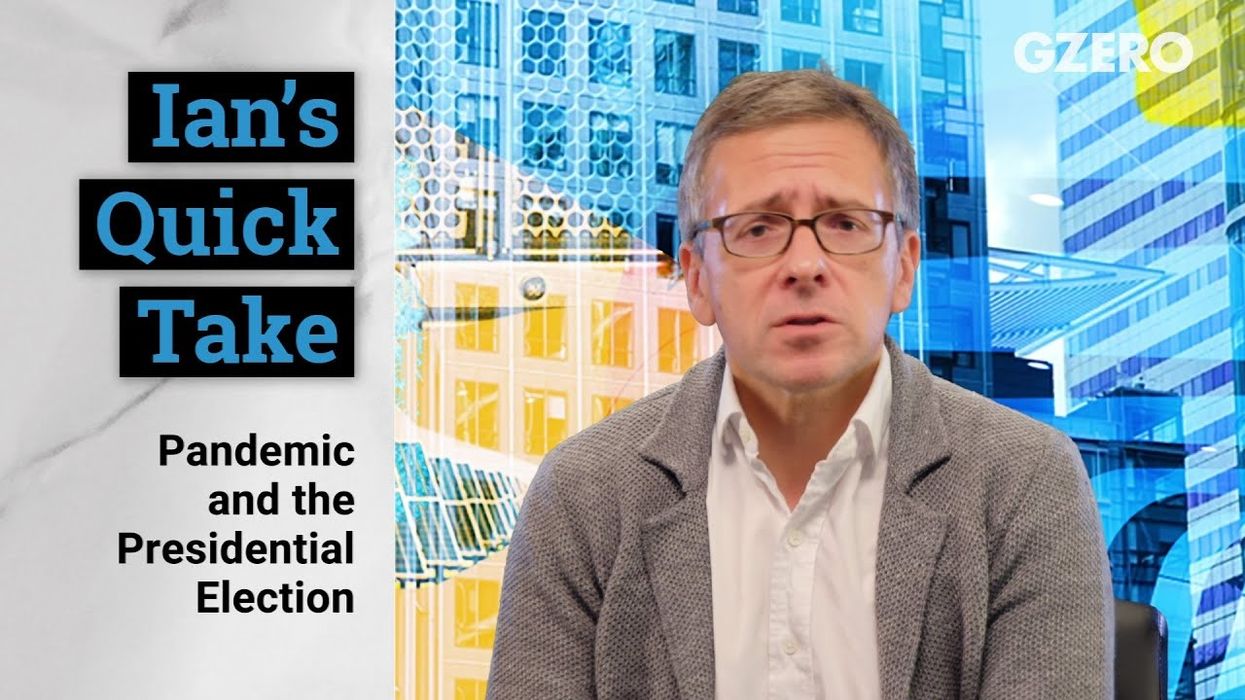
Quick Take: Pandemic and the presidential election
October 19, 2020
Global Stage LIVE from United Nations WATCH REPLAY
Ian Bremmer, political scientist and president of Eurasia Group and GZERO Media, shares insights on global political events.
Presented by

Ian Bremmer's Quick Take:
Hi, everybody. Ian Bremmer here. Yet another exciting week in the run-up to the US elections. Not the only thing going on, though, not at all. I mean, first of all, coronavirus continues to be by far the biggest story in the US, in Europe, as we have a major second wave, and indeed in many countries around the world. Also, we're seeing a lot more instability pop up. I mean, we've had every Sunday now for about three months massive unprecedented protests in Belarus. They're not slowing down at all. We see major demonstrations, including anti-royal demonstrations in Thailand, Pakistan. You've got significant instability right now, of course, we'd seen in Lebanon over the past months. Why is this all going on? Is this a GZERO phenomenon?
I would say not quite, but it is related in the sense that the reason you have a leaderless world today, the reason you have a GZERO world is because increasingly, political architecture and institutions have been weakening and they aren't aligned with the geopolitical order. Similarly, the reason why you're seeing so much more instability these days is because a lot of people feel like their own domestic governance has not been fit for purpose, certainly in the United States and the big social movements and the growing divide between red and blue on the back of an unprecedented economic crisis and pandemic in modern times that is hitting not just everyone together, but really those economics are on the back of the working class and the middle-class, what people are increasingly calling a K-shaped recovery, where Bezos is now worth almost $200 billion, anyone in the knowledge economy is doing pretty well.
You can socially distance. You can work at home. Your jobs are doing fine. Your 401ks are fine. The markets are popping. But what if you don't have any of that access? What if you're not in a job like that? What if you don't have stocks in a portfolio? Well, then your life has gotten a lot harder and you're feeling that support for those that say they're going to do better for you doesn't really make your life any better. I thought it was really interesting that we had these big rallies in the last couple of days from President Trump and we'll see them again every day for the next couple of weeks where he's saying, if you elect Biden, he's going to listen to the scientists.
If you're a PhD, you say, "Well, okay, that's a good thing, right? We want the experts being listened to." But if you're someone for whom life has been getting worse for them decades now, not just in the last four years, but for a long time, you feel like you've been lied to. That's not just political leaders from one party or another. That's the media, that's the scientists, that's everyone out there with their so-called facts and great education who may be really smart and they may be really smug, but they're not helping you, and in that regard, the fact that President Trump can still have a 40% approval rating and say the sorts of things he's saying and respond the way he is responding to this coronavirus shows you how deeply the system has eroded.
Whether Trump wins or whether Biden wins coming up, these problems are not going away. They're much more structural, and I do get the sense that a lot of people in the foreign policy establishment in the United States and the foreign policy establishment in the US, both left and right, is largely anti-Trump and they see how much Trump is disliked outside the United States in many, most countries around the world, America first as an overt strategy and tagline doesn't surprise you that it's not going to work very well if you don't happen to be American.
But I think there is a broad belief that if we just get rid of Trump, if Biden comes in, then everyone's going to flop to the United States as a leader again. Number one, that's just not the case. I mean, the erosion of American leadership was happening well before Trump. The feeling that the United States was increasingly hypocritical in the way that it led, I mean, you think about the war in Afghanistan, the war in Iraq, you think about Guantanamo, you think about failed promotion of democracy internationally at the same time that America's own democratic capabilities at home are increasingly seen by its own people as not fit for purpose, nevermind the way that the Canadians or the Germans or the Scandinavians or others who might look at the United States would increasingly see the United States is not such an effective model.
Well, you need to realize that it's not like everyone is just sort of gagging at the bit for anyone but Trump and now we're going to love the United States again. It's going to be much more fragmented. This GZERO world is not a product of Trump and it's going to persist beyond whether it's one or two Trump administrations. I guess, I've always thought that's more important. I mean, I do worry about the further acceleration of the erosion of American institutions happening under a president that doesn't care particularly for rule of law and doesn't really believe that in the strength of representative democracy or human rights, he's much more transactional his orientation. So certainly, I've seen that whether it's the executive or corruption in the civil service, or whether it's the effective functioning of the legislature in the US, all of those things have been eroding for some time, but they're eroding more quickly under the Trump administration.
But I mean, so too, is the media having its legitimacy erode in the last four years, and I would argue that's largely self-inflicted how they've chosen to respond to a very divided and commercially very enriching political landscape for them. How social media has chosen to ignore the importance of coexisting well with a civil society and fabric that supports it because they'd rather ensure that they can maximize eyeballs, advertising and revenue, and the business models are not particularly aligned.
So I think it's important for us to understand that these issues are much more structural than the election that we're going to have in the next couple of weeks. Also, because lots of other countries continue to experience these things challenges, and the next two years are still, irrespective of who's leading the United States, largely going to be defined by how humanity both collectively and the deeply fragmented are responding to this continued coronavirus. We now have caseload in many countries across Europe that is higher than it was during their first wave. Deaths are certainly going down. In the United States, deaths are going up from a month ago, but they're down from where they were in the early wave.
Science is responding more effectively to the crisis, but we are nowhere close to out of this and we won't be until we have a vastly more effective and broader testing regime, until we have much better political leadership and until we have vaccines that are distributed and across the world in sufficient amounts with education that people are going to take them. we're talking about still another couple of years where that's defining the way that the global political environment and economic environment actually works, and in that regard, I think irrespective of how this us election turns out, you're still going to be in this period of extraordinary crisis of headlines on a daily basis, whip-sawing you from issue to issue.
Yes, if Trump is gone, Twitter will drive you a little less crazy and there won't be as many headlines driven by it. But the country I think is going to be every bit as divided, in fact, in many ways more so in part because the election will be seen as illegitimate by many, and in part more importantly, because the economic impact of this crisis is going to be so much harder for people.
Final thing I would say is that in 2020, the healthcare response to coronavirus has been radically mixed and differentiated around the world. Some have done very well in response on the healthcare side. We know who those countries are. It's Japan, it's South Korea, it's Germany, it's Canada, it's others. Some have done a poor job on the healthcare side, frankly, including our own United States, the United Kingdom and many others, Brazil. But economically, almost every major economy in the world has done a really good job in the first year of this crisis, responding to it. All the central bank governors, almost all the ministers of finance, the US Secretary of Treasury, almost all the major legislatures in the world have responded adequately or more than adequately to the nature of the economic crisis.
In 2021, the primary issue is not going to be the healthcare fallout. That will be better, in part because we've learned a lot. The death rate is going to go down, in part because the effectiveness is going to be better. You'll have more treatments, you'll start to have vaccine, all those things, but the economic impact is going to be much worse and I fear the economic response is going to be much more differentiated and haphazard, and that is one of the reasons why we need to pay a lot more attention to coronavirus in 2021, even as there's going to be such fatigue from talking about and dealing with the pandemic, but most human beings around the world are still going to be experiencing it and that's that bottom of the K.
Keep in mind that the one thing the K-shape recovery really doesn't teach you is that when you hear about a K, you think, "Well, both legs of the K are actually equivalent." Not true. That top of the K only reflects about 10% of the population in the advanced industrial economies. The bottom of the K is pretty much everybody else. Going to have to address that in a serious way in the next year. Thanks everyone. Be safe. Avoid people. Talk to you soon.


Keep up with what’s going on around the world - and why it matters.