September 7 marked Brazil’s Independence Day, and President Jair Bolsonaro celebrated in decidedly Trumpian fashion: by railing against the deep state, proclaiming himself the only possible legitimate leader of the country, and inciting violence against his political opponents.
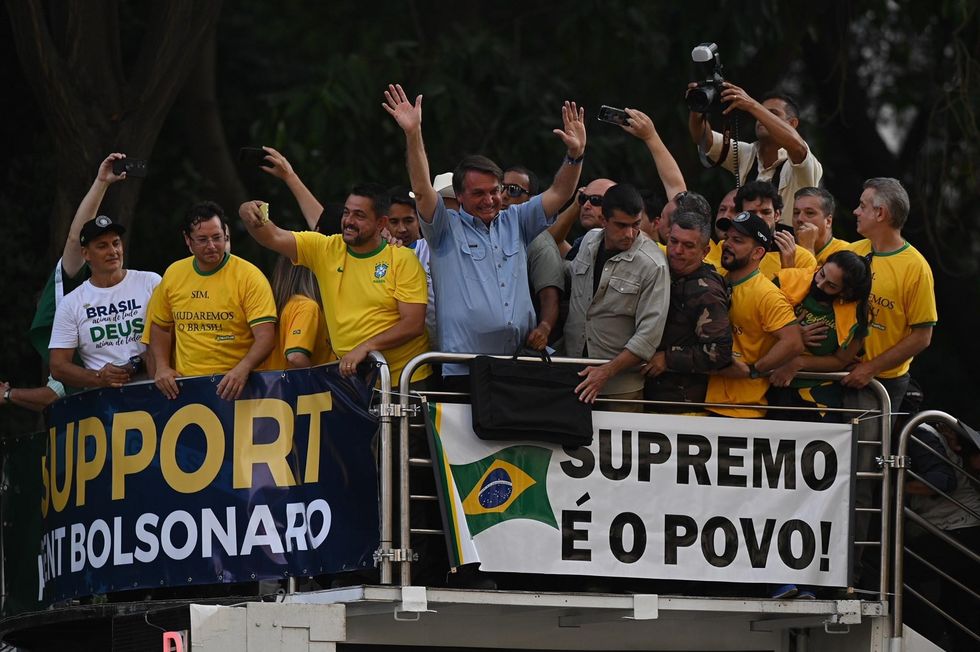 Jair Bolsonaro waves to supporters at September 7 rally. (Andre Borges/picture alliance via Getty Images)
Hundreds of thousands of Brazilians across the country took to the streets on Tuesday, after Bolsonaro summoned his supporters to arm themselves (the president recently said “everyone should buy rifles”) and defend his administration and the country’s “liberty” from institutions like the Supreme Court, which he claims is hostile to his agenda. The demonstrations came in the wake of a series of threats issued by the president, who has warned of an “institutional rupture” if Supreme Court judges fail to heed his “ultimatum” to cease their oversight of, and alleged opposition to, his administration.
Turnout was large by historical standards but smaller than expected, with an estimated 125,000 rallying in support of the president in Sao Paulo alone. Taking the stage in Brasilia and Sao Paulo, Bolsonaro declared all-out war on the high court, urging the Senate to impeach Justice Alexandre de Moraes and ominously warning that the court could “suffer what we don’t want” if it doesn’t toe the line. The demonstrations were largely free of violence, aside from an incident on Monday night when the police used tear gas to repel Bolsonaro backers who had overrun blockades guarding government buildings.
What’s going on?
Yesterday’s demonstrations foreshadow the potential of January 6-like violence in the run-up of Brazil’s presidential election next year—but on a much larger scale. Brazil is the fourth largest democracy in the world, so this will be the most consequential—and troubled—national election anywhere in 2022.
Bolsonaro’s popularity is currently at its lowest since taking office. His approval ratings have plummeted from around 50% to under 30%, owing to his mishandling of COVID-19, a deteriorating economic outlook, an energy crisis, and a series of corruption scandals.
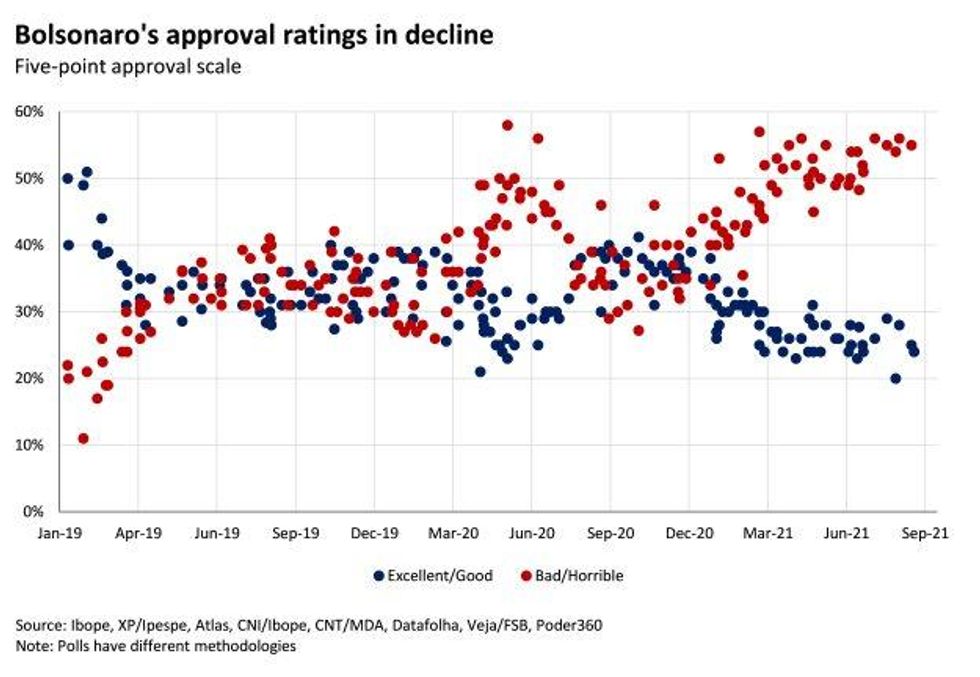 Bolsonaro's approval ratings in declineIbope, XP/Ipespe
His opponent is his biggest nemesis, former president Luiz Inácio Lula da Silva (aka Lula), a popular leftist who was recently freed from prison after serving 2 years on a now-overturned graft conviction. Recent polls show Bolsonaro trailing Lula by as much as 25 percentage points in a head-to-head match-up. One could hardly imagine two more opposite candidates.
Following months of less-than-subtle subtle attempts to undermine trust in the electoral system, Bolsonaro made his most explicit pronouncement last week: he will either win the 2022 election, or he will be arrested or killed. Losing is out of the question. Inconceivable. That is, unless the other side cheats. (Remind you of someone?)
Want to understand the world a little better? Subscribe to GZERO Daily by Ian Bremmer for free and get new posts delivered to your inbox every week.
In reality, Bolsonaro is increasingly likely to lose, and he knows it. He’s not blind to his sliding poll numbers and less-than-solid fundamentals (namely, COVID-19 and the economy). Further, he doesn’t have the backing of a strong political party, and can only watch idly as business leaders who had previously supported his agenda abandon him in droves, alienated by his rhetoric. The Supreme Court and legislators from even his own coalition have checked his most extreme moves.
That is precisely why he’s choosing to campaign not against Lula, who remains broadly popular, but against the Supreme Court, legislatures, and other members of the “deep state.” He can claim that the only world in which he loses the election is a world where all the institutions are stacked against him. Yesterday’s demonstrations served three purposes for Brazil's president:
- To test the effectiveness of his anti-establishment messaging in the run-up to the campaign.
- To make a show of force to intimidate independent institutions, especially the Supreme Court.
- To further delegitimize the Supreme Court and other independent institutions in the eyes of his base, paving the way for an outright refusal to accept a negative electoral outcome.
Goal #1 was a success as measured by the high turnout mobilized, but the win could prove short-lived if a significant number of centrist and pragmatic voters are put off by Bolsonaro’s inflammatory tone. Goal #2 will almost surely fail, given Brazil’s robust institutional design. It is goal #3 that poses the most serious risks. If Bolsonaro’s supporters believe that the election will be rigged against the duly elected president by the powers that be, many will also believe that violence is justified as a means to protecting democracy. In their minds, that’s patriotism, not insurrection. (Sound familiar?)
How likely is Bolsonaro to succeed?
Just as Trump never posed an existential threat to US democracy, Bolsonaro’s ability to actually rig the election is limited.
As in the US, the Brazilian judiciary and electoral court are politically independent (even if they do have a history of overreach). Unlike in the US where elections are overseen by states, Brazilian elections are federal, making them harder to subvert. Also unlike the US, Brazil has a multi-party system where congressional majorities are hard to build. Last but not least, given Brazil’s history with military dictatorship (the last one ended in 1985), military leaders are unlikely to support a coup—even if the next president would be a committed leftist who they dislike and mistrust. Without the military, the courts, or the legislature on his side, Bolsonaro has no chance of overturning an electoral loss.
Having said that, this doesn’t mean his efforts will go without consequences.
A former military man himself, Bolsonaro has overwhelming support among rank-and-file soldiers and state military police. The potential for these heavily armed supporters to cause extended violence is much greater than it ever was in the US, where the vast majority of military and law enforcement defended the rule of law. This risk alone could make January 6 look like a peaceful protest in comparison.
But that’s not the most important danger. Like the US, Brazil has a highly polarized electorate. This means not only that Bolsonaro has a fairly high floor of unconditional support, but also that a large minority of Brazilians believes whatever set of “facts” he peddles. Already, 34% of all Brazilians say that their country’s electoral system has low to zero credibility. By throwing the electoral system into question and amplifying distrust in democratic institutions, Bolsonaro is delegitimizing Brazilian democracy itself. Trust in state and non-state institutions like Congress, the Supreme Court, and the media will be eroded further. No less than 30% of Brazil’s population will be poised to believe the election was stolen. The electorate will become even more divided and dug in than before. Political violence will become more common. Future administrations will have a harder time governing.
The bottom line
There will be a successful presidential transition in Brazil—even if not a peaceful one. Democracy will live to see another day. However, trust in institutions will be eroded and polarization will intensify. The social fabric will be weakened. South America’s largest democracy, the world’s fourth largest, will become more vulnerable.
🔔 And if you haven't already, don't forget to subscribe to my free newsletter, GZERO Daily by Ian Bremmer, to get new posts delivered to your inbox.