I had a quiet moment at breakfast on Sunday and came across a fascinating study as the Olympics closing ceremony played in the background. From the abstract:
This paper investigates the effects of competition outcomes on health by using U.S. Olympic medalists' lifespans and medal colors as a natural experiment. Whereas the life expectancies of gold and bronze medalists do not differ significantly, life expectancy of silver medalists is about 2.4 and 3.9 years less than these former, respectively. These findings are readily explainable by insights from behavioral economics, psychology, and human biology, which suggest that (perceived) dissatisfactory competition outcomes may adversely affect health.
The authors find that Olympic silver medalists on average live significantly shorter lives than gold and bronze medalists. Gold is not too surprising, but bronze?
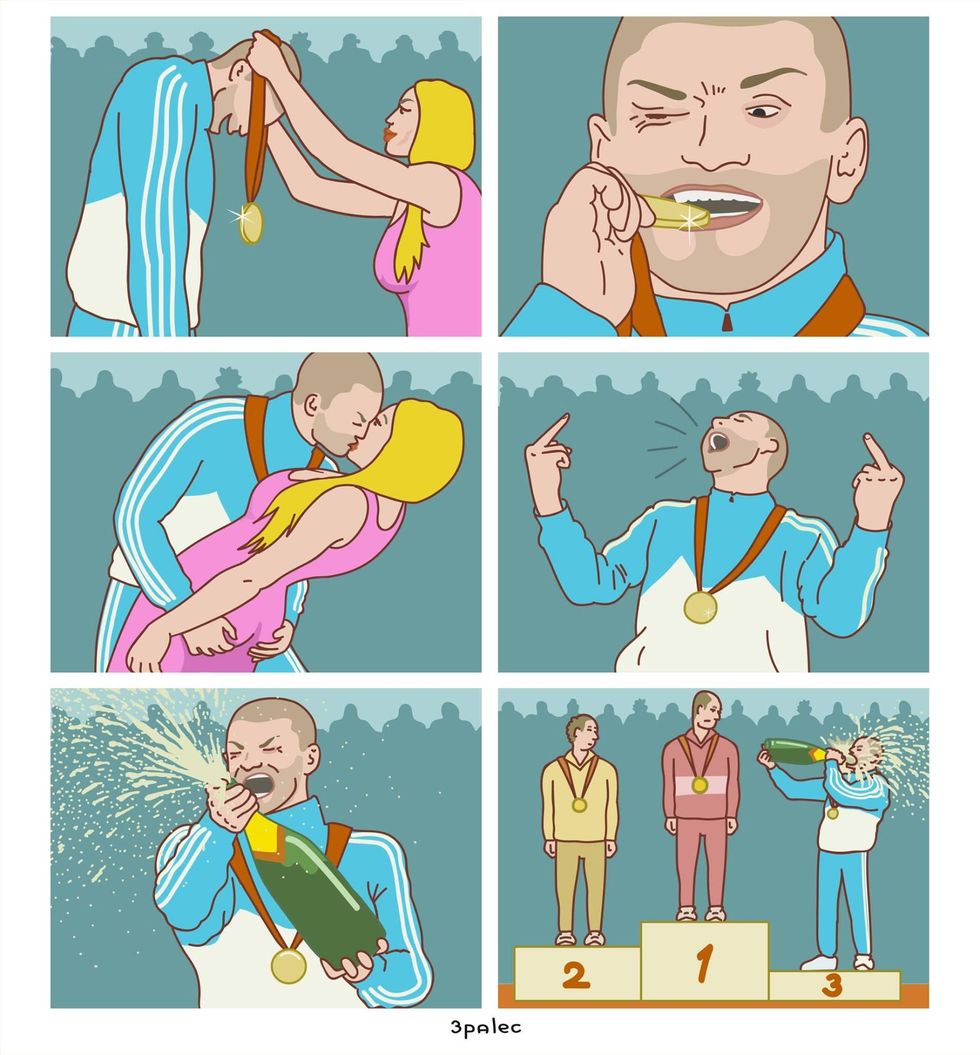
The reason is well understood by experts: Happier people live longer—that’s a fact. Silver medalists consider their performance to be a loss and are therefore disappointed, while bronze and gold medalists perceive it as a win and are elated. When they think about what could have been, the counterfactual for silver medalists is “I almost won gold,” whereas for bronze it’s “At least I won a medal.” Cue this meme.
Want to understand the world a little better? Subscribe to GZERO Daily by Ian Bremmer for free and get new posts delivered to your inbox every week.
If winning an Olympic silver medal seems like a hard-to-relate problem, you’re right, it is. But I suspect the psychology at work applies beyond Olympians to comparatively normal folks like you and me, and maybe even to whole societies.
After all, aren’t most of us taught to treat life as a race? Competitive drive is core to the American ethos, as American as baseball/NASCAR (politics is ruining our metaphors!) and apple pie. The American dream promises that with enough hard work and determination, there is nothing you can’t achieve. No mountain high enough. No Joneses you can’t keep up with. But this promise has its peril. For someone to be successful at something, there must be someone (even slightly) less successful than them. We can’t all be winners. In the words of Ricky Bobby, “If you ain’t first, you’re last!”
Silver medalists look back and think that gold was within reach. Anything but gold is a failure. It doesn’t matter that they just beat every single human being except one. Second place is the first loser—an even bigger loser than third place. I grew up with plenty of people who feel that way. Sure, they’re still better off than most of the world population. But the gap used to be so much wider. And they thought they would do so much better.
They’re not alone. Over the last 20 years, a large minority of Americans—non-Hispanic white men without college degrees—have seen their relative living standards stagnate. Their parents had been better off than their grandparents, and they were sure the same would happen to them. Suddenly, the march of progress came to a halt. For some, it even reversed. Importantly, other people—other groups of people—were getting ahead. That was certainly not supposed to happen.
Can this mismatch between expectations and reality explain the stark rise in deaths of despair among middle-aged white men? Can it account for the rise of Trump and Trumpian politics? I don’t know, but it seems plausible.
Let me stretch the analogy further. Is it possible that America’s perceived relative decline on the global stage over the last 20 years has taken a toll on our national psyche? Did we fail to adjust our expectations for America’s role in the world after the fall of the Berlin Wall and the end of the unipolar moment? We have been trying to defend a lead that feels to many like it’s slipping (even though it’s really not). We have everything to lose and little to gain, except not losing. Playing not to lose sure feels more stressful, and risky, than playing to win. Heavy is the head and all that. The question for you, readers, is can the US afford to continue aiming for gold – and expecting to win it every time – in a GZERO world?
🔔 And if you haven't already, don't forget to subscribe to my free newsletter, GZERO Daily by Ian Bremmer, to get new posts delivered to your inbox.