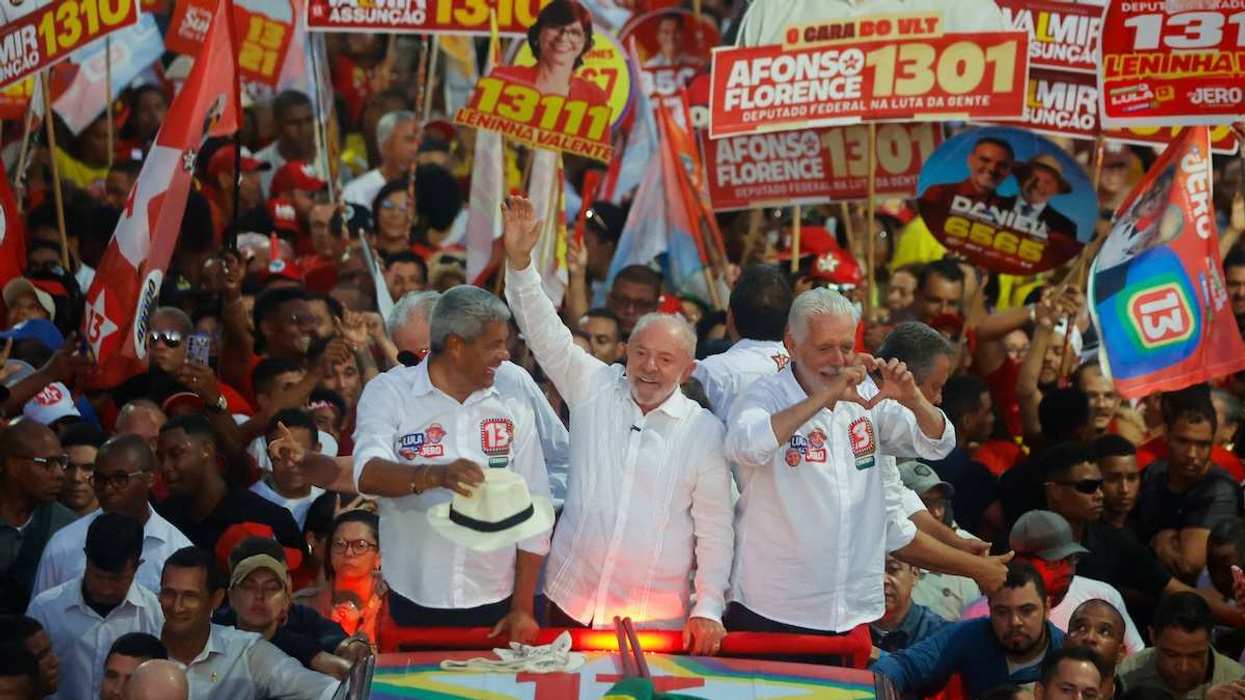
Following the defeat of right-wing nationalist Jair Bolsonaro to Luiz Inácio Lula da Silva last year, many in the West were hopeful that Latin America's most populous nation would become a likeminded partner in promoting democratic norms, upholding the rules-based order, and confronting authoritarian governments.
Yet in his first four months in office, Brazil's President Lula has refused to unequivocally condemn Russia's invasion of Ukraine and chided the United States and Europe for not doing enough to end the war. He’s deepened ties to Moscow and Beijing. He’s dispatched a high-level delegation to meet with Venezuela's dictator Nicolas Maduro. He’s even allowed Iranian warships to dock in Rio de Janeiro.
Just last week, Lula traveled to China with 240 business executives and nearly 40 senior officials – the largest delegation he's taken abroad in three terms – to bolster ties with Brazil's largest trading partner. There, he met with Chinese leader Xi Jinping and inked 15 agreements in strategic areas like agriculture, tech research and development, and deforestation.
The three-day visit differed starkly from his trip to the US in February, when he met with President Joe Biden but was joined only by select cabinet officials and held no meetings with the private sector. China surpassed the US as Brazil's largest trading partner in 2009, and it has been steadily expanding foreign direct investment in the country.
During the trip, Lula made several remarks that echoed positions taken by Moscow and Beijing and put him at odds with the West. The president backed Beijing's call for countries to ditch the US dollar and made a point of touring the Shanghai research center of Huawei, the telecommunications giant that has been placed under US sanctions, where he stated that "no one will prohibit Brazil from developing the relationships it wants."
Not for the first time, Lula also cast blame on Ukraine for Russia's illegal invasion and accused the US and Europe of "encouraging" the fighting and standing in the way of peace, all the while refusing to call for a Russian withdrawal from Ukrainian territory. Brazil has not joined Western countries in imposing sanctions on Russia and has rebuffed pleas from President Biden, German Chancellor Olaf Scholz, and French President Emmanuel Macron to provide military support to Ukraine. Lula has denounced the impact of sanctions on the world's poorest countries and charged US and European military aid with prolonging the war.
Lula has been pitching himself as a neutral peace broker in the conflict, proposing a club of non-aligned nations (including Brazil, China, India, and Indonesia) to mediate negotiations. Kyiv and its Western allies view any proposals for an immediate ceasefire – whether from China or Brazil – as an opportunity for Russia to entrench its unlawful territorial gains and regroup its forces for a new offensive.
Fresh off his visit to China, Lula hosted Russian Foreign Minister Sergey Lavrov in Brasilia on Monday to discuss bilateral trade and the war in Ukraine. Lavrov thanked Brazil for refusing to blame Russia for the war and pushing to end hostilities on Moscow's terms. Lavrov's trip to Brazil comes after Lula's top foreign policy adviser, Celso Amorim, met with Russian President Vladimir Putin at the Kremlin in March to discuss opening peace talks. Brasilia and Kyiv, meanwhile, have thus far only spoken by phone.
Lula's remarks and Lavrov's visit drew condemnation from the West. The White House rejected Brazil's suggestion that "the United States and Europe are somehow not interested in peace or that we share responsibility for the war," blasting Lula for "parroting Russian and Chinese propaganda." Brussels and Kyiv reacted equally poorly to Lula's both-sidesism of Russia's invasion.
Under fire, on Tuesday the president clarified that he condemns Russia's "violation of Ukraine's territorial integrity." But it was too little, too late. Lula’s statements had already sparked a flurry of commentary claiming the West has definitively lost Brazil to China.
Yet Lula's defiance of the Western consensus on Ukraine should come as no surprise given his skepticism of the US and longstanding ambition to carve out a "non-aligned" global leadership role in an increasingly multipolar world. Indeed, his recent decisions are very much in keeping with the doggedly independent and "south-south" foreign policy he pursued during his first two terms as president between 2003 and 2010, when he fostered close ties with China, Iran, and Venezuela and led the creation of the BRICS group – while also developing a fruitful relationship with US President George W. Bush.
What has changed since Lula's last stint in office is the international context. The West has fully decoupled from Russia in response to its invasion of Ukraine, and the US is locked in an intensifying geopolitical competition with China that threatens to divide the world into antagonistic blocs.
Brazil, like many developing countries that are reluctant to take sides in either conflict for ideological reasons, is caught in the middle. And it has a hard choice to make. Its economy has become hugely dependent on Chinese purchases of agricultural exports and Russian supplies of fertilizer, with bilateral trade with both China and Russia hitting record highs in 2022. But the United States remains Brazil's principal security, climate change, and investment partner – and its second-largest trading partner.
A closer relationship with Beijing and Moscow doesn't signal that Brazil has picked a side. In fact, Lula is betting that the right choice amid growing geopolitical fragmentation is to refuse to choose at all. He wants to deepen ties with China and Russia, enhance cooperation with the US and Europe, and reassert Brazil's role as a leader of the so-called "global South" – all at the same time.
The Lula administration is working hard to finalize the EU-Mercosur trade agreement before the end of the year, which would significantly deepen ties between the South American bloc and Europe. It is also seeking to bolster the bilateral relationship with Washington, especially around climate change, and it hopes to host Biden in Brasilia later this year.
Lula's hedging approach resonates deeply with most developing countries, which also have no desire to choose between relations with the West and relations with China and (to a lesser extent) Russia. The risk is that he overshoots and exhausts goodwill toward Brazil in Washington and Brussels, making these relationships entirely transactional and, therefore, more vulnerable to reversals.
The rest of the world is watching closely to see if he's able to pull it off.