Search
AI-powered search, human-powered content.
scroll to top arrow or icon

How can AI enhance human progress?

On the sidelines of the 81st United Nations General Assembly in New York, CNN Business reporter Rachel Siegel moderates a Global Stage conversation with Microsoft Vice Chair and President Brad Smith, Eurasia Group and GZERO Media President Ian Bremmer, United Nations Foundation President and CEO Elizabeth Cousens, and Rev. Daniel G. Groody, C.S.C., of the University of Notre Dame.

The panel examines the urgent questions surrounding AI governance, safety, trust, and inequality, while exploring how the technology could accelerate progress in healthcare, education, climate resilience, and the Sustainable Development Goals. The conversation also tackles a more fundamental question: As AI becomes increasingly capable, what must remain distinctly human?

This conversation is part of Global Stage, an award-winning series produced by GZERO Media in partnership with Microsoft exploring the intersection of technology, politics, and society.
More from Global Stage

The real risk of AI is how humans use it

As the US and China race to develop and deploy AI, the biggest risks may come not from the technology itself, but from how humans choose to use it. Speaking on a Global Stage panel during the 81st UN General Assembly, Ian Bremmer examines how the AI race is reshaping geopolitics and changing perceptions of the technology.

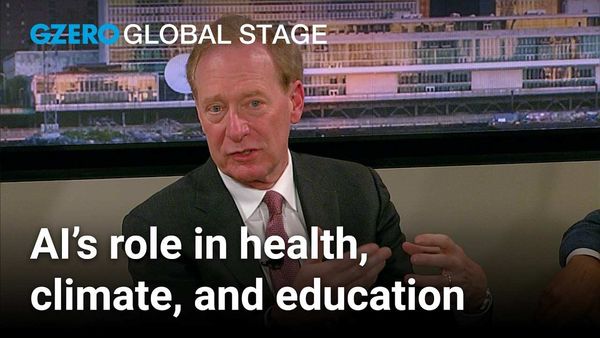
AI’s role in wildfire detection, healthcare, and education

From detecting wildfires before they spread to giving doctors more time with patients, AI is opening new possibilities for how technology can serve the public good. Speaking on a Global Stage panel during the 81st UN General Assembly, Microsoft Vice Chair and President Brad Smith explores how AI is being applied across climate, health care, and education.

Can AI work for everyone? ITU’s Fred Werner on closing the global AI gap

On the sidelines of the 81st United Nations General Assembly, GZERO Media’s Tony Maciulis sits down with Fred Werner of the International Telecommunication Union (ITU) to discuss the opportunities and risks shaping the next phase of artificial intelligence.

How AI speeds up disaster relief efforts

Artificial intelligence is becoming an increasingly powerful tool for disaster preparedness and emergency response. Speaking at the 2026 AI for Good Global Summit in Geneva, Microsoft Vice Chair and President Brad Smith explains how AI combines predictive modeling, satellite imagery, and public data to help governments identify vulnerable communities before disasters strike and respond more quickly when they do.

Can AI help solve global crises? Live from the AI for Good Global Summit 2026

As artificial intelligence rapidly reshapes the global economy, one question is becoming increasingly urgent: who will actually benefit? Recorded at the 2026 AI for Good Global Summit in Geneva, this special Global Stage conversation brings together leaders from the United Nations, Microsoft, and the scientific community to examine how AI can help tackle some of the world's biggest challenges, from disaster preparedness and climate resilience to humanitarian response and sustainable development.

Building a safer, more equitable AI future

At the 2026 AI for Good Global Summit in Geneva, ITU Secretary-General Doreen Bogdan-Martin says the future of artificial intelligence depends on putting the right guardrails in place to ensure AI is developed safely, responsibly, and equitably.