Donald Trump is set to impose across-the-board tariffs that will hit its major trading partner hard. Canada’s federal government is keeping up its efforts to avoid the duties with Foreign Minister Mélanie Joly and Resource Minister Jonathan Wilkinson in Washington this week to plead Ottawa’s case. But even they seem to expect the worst.
On Wednesday, Justin Trudeau met with Canada’s premiers to discuss the issue. He said Canada will keep its options in responding to Trump’s tariffs, but, aware of the need to balance regional interests, noted any response must be fair for every province and territory. Trudeau reportedly won’t “immediately” hit back with equivalent tariffs, but he has a plan to slap tariffs on up to CA$150 billion in American imports as a starter if needed.
This all comes at a chaotic time. With Trudeau set to resign in March and a new prime minister coming in just before a probable spring election, it’s not clear who’ll be governing the country and dealing with Trump when the dust settles.
Whoever’s in charge will have some options, but they may be costly.
What’s at stake?
Should Trump proceed with tariffs, Canada’s first line of defense could include some sort of retaliatory tariffs on US imports — a move that would cost both countries dearly. In 2024, the US exported $322 billion worth of goods to Canada.
The country also sends machinery, electrical and electronic equipment, fuels, and plastics north. Tariffs would hit those industries hard, particularly in Michigan, Illinois, California, New York, and Texas. But they wouldn’t be alone; Canada is the top export market for 36 US states.
In 2023, Canada’s exports to the US reached a whopping CA$593 billion, including CA$4.6 billion in electricity from Ontario and Quebec. Canada also sends billions in crude oil to the US. In 2023, 97% of its exported crude oil, worth CA$124 billion, went stateside.
And there’s more. Canada exports vehicles to the US — CA$27 billion worth in 2022 — along with agricultural products, gold, critical minerals, lumber, and dairy.
Experts are warning that Trump’s tariffs would drive Canada into a recession sometime this year, and the Canadian Chamber of Commerce says Canada’s GDP would contract 2.6% annually. Exports to the US would drop, including 60% in mining and quarrying alone, and 39% in vehicles, driving up prices for US consumers. Ontario is warning it could lose 500,000 jobs.
The addition of Canadian tariffs would inflict higher prices on domestic industry and consumers, though the federal and provincial governments are mulling a bailout plan should tariffs come to pass.
Tit-for-tat tariffs? Export freezes?
Despite reports that Canada won’t respond to Trump with tariffs right away, they could happen. Liberal leadership hopeful Chrystia Freeland, a likely contender to replace Trudeau as prime minister, is promising dollar-for-dollar tariffs on imports from the US if Trump goes ahead with his plan.
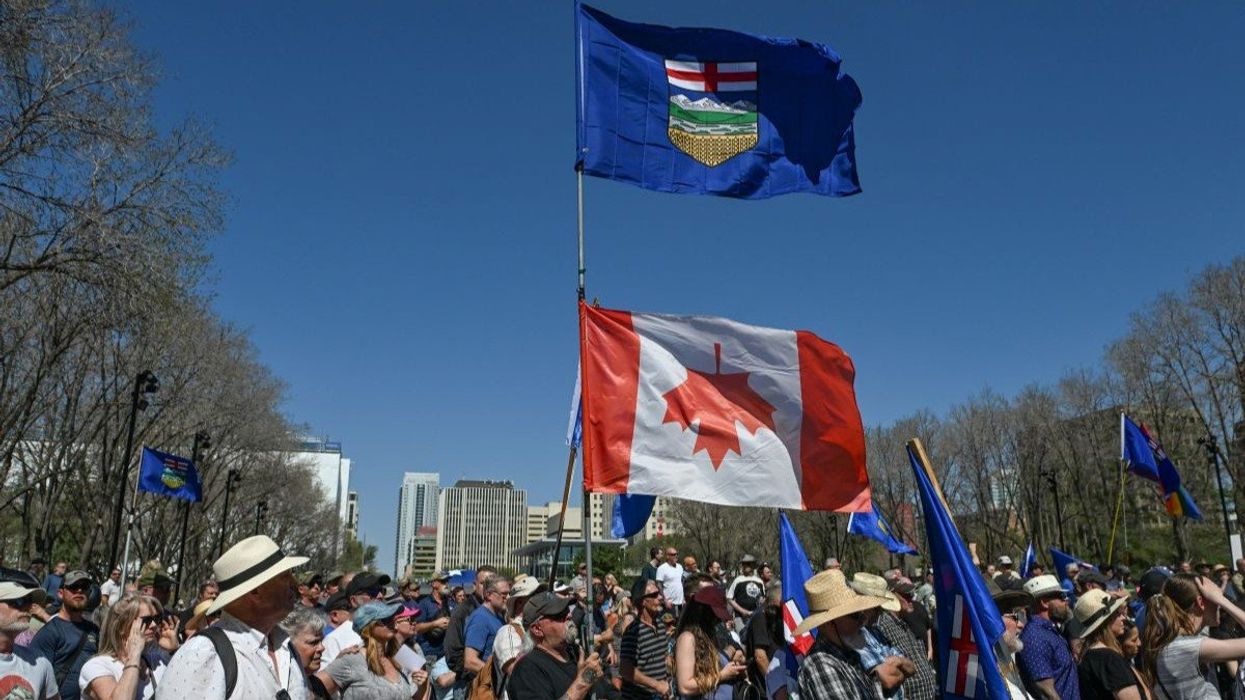
Alberta Premier Danielle Smith says an energy freeze is a nonstarter, as it would threaten Alberta’s energy economy — and, perhaps, national unity. The consequences of a freeze could be hefty, driving the already alienated province further away from Ottawa. Alberta and other energy-exporting provinces have a much easier time shipping north-south than overseas.
Smith visited Trump at Mar-a-Lago last week and concluded tariffs were inevitable. She’s advocating for carve-outs, particularly on oil and gas, to ease the pain for her province. She also opposes Canada retaliating with duties of its own, preferring instead to use this moment to expand natural resource development and export markets.
In Ontario, Premier Doug Ford, who supports retaliatory tariffs, is threatening to shut off electricity exports to Michigan, New York, and Wisconsin from his province as a last resort, a move that would affect millions. He’d rather not. He’d rather build “Fortress Am-Cam,” a joint US-Canada strategy that would include further cooperation on everything from border security, energy policy, and data sharing to the critical mineral trade, stemming illegal immigration, and shipbuilding.
But Ford is ready to play hardball. On Wednesday, he said Canada must “hit back with every single tool in our toolbox.” Washington, of course, could retaliate further if Ford shuts off the power – US electricity exports to Canada increased $454.5 million in 2023, reaching $1.2 billion.
New Democratic Party leader Jagmeet Singh wants Canada to halt critical mineral exports to the US – the top destination for them, coming in at roughly CA$38 billion last year. The minerals are called critical for a reason: They are used in electric vehicle batteries and for drones, satellites, mobile networks, and electronics. That means they’re necessary for consumer products, infrastructure, and national defense. British Columbia Premier David Eby, whose province is a source of critical minerals, is mulling the idea.
An Anglosphere alliance?
Canada could also pivot its diplomatic and defense strategy a bit, not abandoning links to the US so much as building deeper relationships with other English-speaking parliamentary democracies.
Graeme Thompson, a senior analyst with Eurasia Group's global macro-geopolitics practice, says one option for Canada is to look toward the Anglosophere on defense – “the other five eyes,” as he puts it.
Thompson says as things stand, Anglosphere militaries are “essentially interoperable” and “Canadian diplomats overseas work hand in glove with their UK, Australian, and New Zealander colleagues.” He points to similar “political systems, culture, most importantly, national interest” as ties that could bind Canadians to about 130 million people.
But for that, Canada would have to be in a position to be taken seriously around the world, which, currently, it’s not.
Will reality bite?
Canada has options to respond to Trump’s tariffs, but each comes at a cost – or at least with risk. And given the deep integration between the countries and geographical realities, Canada is left with few options but to work with the US on border and national security, resource management, and trade – even if that work becomes severely disrupted.
With effort and luck, Canada could manage tariff carve-outs, as Smith advocates, which would lessen the blow, but that’s not guaranteed. It could fight back, as Freeland, Ford, and Singh counsel, and hope to persuade the Trump administration to change its mind, perhaps aided by Trump-friendly states that would suffer from a trade war.
But the fight could prove costly. And if it persists, it could quickly become disruptive to not only the economy but also to national unity. That would leave Canada further diminished in its powers – a fate that, day by day, seems to get closer and closer – no matter who governs.