Skip to content
Search

Latest Stories

Israel

Rorschach ruling from ICJ on Gaza genocide charges

Pro-Palestinian protesters pose for a photo in front of the International Court of Justice.

Pro-Palestinian protesters pose for a photo in front of the International Court of Justice.

REUTERS/Piroschka van de Wouw

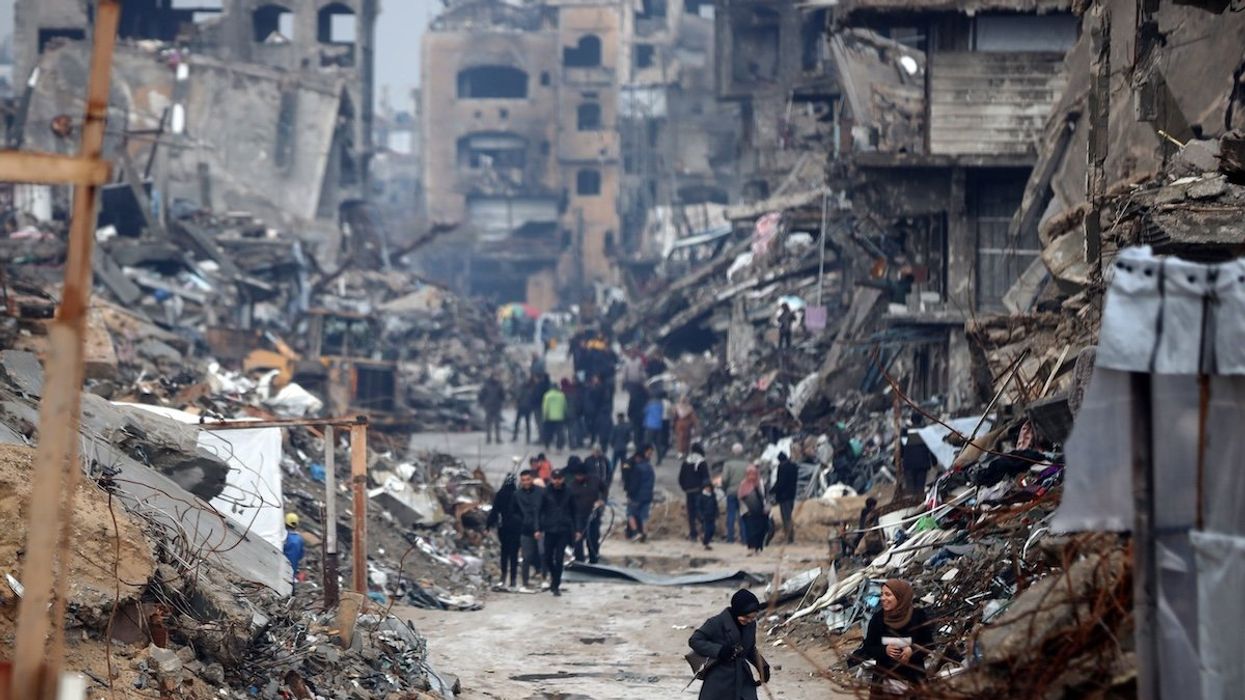
The International Court of Justice on Friday gave its preliminary opinion on the South African case which alleges Israel is carrying out a genocide in Gaza. As you might expect, everyone sees in it what they wish.

The raw facts: The court found that Israel’s actions in Gaza are at least “plausibly genocidal” which means the case can continue until a verdict is reached. That could take years and will require a higher standard of proof than the current ruling.

In the meantime, the court stopped short of calling for a ceasefire, which South Africa had sought. Instead, the court ordered Israel to observe several provisional measures to prevent genocidal acts, increase humanitarian aid, and preserve evidence for the ongoing investigation.


Incompatible realities. In the view of Israeli Prime Minister Benjamin Netanyahu, who has dismissed the ICJ case as an antisemitic attack on Israel, the ruling “rejected” the genocide charge. South Africa’s foreign ministry, meanwhile, said it was a “landmark ruling” and pointed out that it was “binding.”

Who’s gonna bind it? The ICJ has no means of enforcing the ruling, which requires Israel to provide an account of its efforts to uphold the provisions within one month. The US, Israel’s biggest financial and military backer, has previously called the South African case “unfounded”.

But does Biden face a symbolic dilemma? The White House has styled itself as the defender of a “rules-based international order” under attack by “rogue states” and their allies. Washington’s support for, say, Ukraine has been framed strongly in these terms — the US has even backed Kyiv’s genocide claims against Russia at the court. To ignore the ruling of a UN court would, as one seasoned observer put it, “be a middle finger” to the international order.

More For You

Israeli emergency services, security officials and residents gather at the missile impact site, after Iranian missile barrages were launched at Israel, amid the U.S.-Israel conflict with Iran, in the Arab city of Kafr Qassem in Israel, March 26, 2026. Picture taken using a mobile phone. ​

Israeli emergency services, security officials and residents gather at the missile impact site, after Iranian missile barrages were launched at Israel, amid the U.S.-Israel conflict with Iran, in the Arab city of Kafr Qassem in Israel, March 26, 2026. Picture taken using a mobile phone.

REUTERS/Rami Amichay
Pakistan the peace broker?As the Iran conflict continues to rage on, one country has emerged as a potential mediator. Pakistan said on Thursday it is relaying messages between the US and Iran, and Iranian officials suggested they’d consider meeting US negotiators in Islamabad over the next week, per The New York Times. Israel also reportedly took [...]
​Mette Frederiksen, Denmark's prime minister and Social Democrats party leader, in Copenhagen, Denmark, on March 25, 2026.

Mette Frederiksen, Denmark's prime minister and Social Democrats party leader, attends the party leaders' debate after parliamentary elections, in Copenhagen, Denmark, on March 25, 2026.

REUTERS/Leonhard Foeger
Danish Social Democrats suffer worst election result in a centuryAmid rising costs of living, Prime Minister Mette Frederiksen’s center-left party won just 22% of the vote in yesterday’s nationwide election, marking the Social Democrats’ worst result since 1903. The left-wing Socialist Party and right-wing Danish People’s Party were the [...]
How Americans feel about the war in Iran
- YouTube
In this "ask ian,” Ian Bremmer explains why the US–Israel war with Iran is posing a political risk for President Trump, whose political brand has long centered on ending America’s “forever wars.” [...]
Trump asks for $200B to fund Iran war
Trump asks for $200B to fund Iran war | Ian Bremmer's Quick Take
In this Quick Take, Ian Bremmer says the Trump administration’s push for $200 billion in supplemental funding for the war in Iran is a sign that the conflict is getting more expensive, more entrenched, and harder to contain. [...]