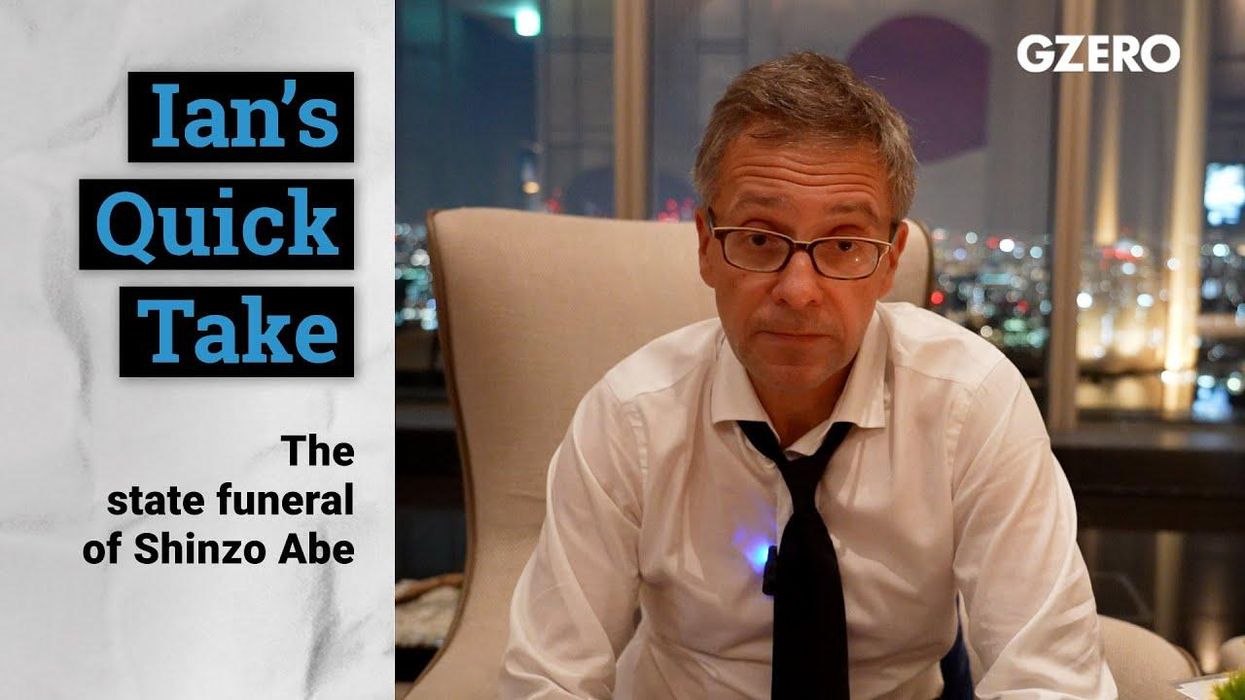
Grief & controversy in Japan for Shinzo Abe's state funeral
September 27, 2022
Ian Bremmer, political scientist and president of Eurasia Group and GZERO Media, shares insights on global political events.
Presented by

Ian Bremmer's Quick Take: Hi, everybody. Ian Bremmer here from Tokyo, Japan, where it has been a pretty intense day. The state funeral of Shinzo Abe, the prime minister who, of course, of Japan was assassinated some 80 days ago. In some ways just kind of an astonishing couple of weeks for the world. Beginning of last week, of course, you had the funeral for Queen Elizabeth, by far the most important figure for the United Kingdom in the post-war period. Then the United Nations, where the entire world comes together in New York, and now in Japan, the state funeral, the first state funeral that you've had in Japan, 55 years for Abe Shinzo, who is by far the most important figure in Japan in the post-war period.
And in both cases, an astonishing outpouring of emotion, of grief in both countries. In the United Kingdom, of course, because she had ruled for 70 years, through so many prime ministers, since Churchill. In Japan, because Prime Minister Abe was gunned down, was assassinated by a young man with homemade weapons in a country that has virtually no violence and certainly not gun attacks against a former prime minister in broad daylight.
Also, controversy in both cases. In the case of the United Kingdom, young people increasingly unhappy with the idea of a monarchy. They think it's something that's kind of, sort of out of date, no longer appropriate for the United Kingdom or the world in the way it projects its power internationally. And of course, King Charles not nearly as popular as Queen Elizabeth has been. In the case of Japan, you have a sitting Prime Minister Kishida, who was both a protege and enormous ally of former Prime Minister Abe, whose popularity has been crushed over the past months, in part because of a crashing yen and challenges in economy, but also in part because of opposition to holding this state funeral, which frankly was because the of a big scandal in across the entire Liberal Democratic party in Japan, the ruling party, because of connections with the unification church, the Moonies as they're called.
The person who assassinated Abe actually wanted to assassinate the head of the Unification Church and couldn't because COVID restrictions meant that he was no longer traveling to Japan. And so he decided, okay, I'm going to kill Prime Minister Abe instead. And then you have these revelations that so many members of the LDP in parliament, in the Diet in Japan, were receiving funds, were going to meetings of the Unification Church. And Kishida's not tried to whitewash it, but it has made the decision to host the state funeral unpopular.
Having said all of that, you saw very little of that today. 20,000 members of Japanese police coming out to ensure that there was no security breaches anywhere during the day, and certainly I didn't see any problems at all. There were some demonstrations. They were relatively small, a few thousand people. Frankly, 5,000 people showed up directly inside for the state funeral. And people I've spoken to in Tokyo today, on balance pretty happy with the fact this has all gone relatively smoothly. We can finally put this horrible act behind Japan, behind the nation.
I will say Japan, unlike so many other democracies in the world today, is a relatively well functioning country, relatively unified. You don't have the same level of populism and fragmentation and de-legitimization of the political system that you see so much in other advanced industrial economies. But this still was an episode, this assassination, that really did deeply shake the Japanese people. And there's still, there's going to be a hangover for that I think for a long time.
Final point for me, the ceremony itself was really quite moving. Kishida-san, the prime minister, gave a powerful opening speech that was really about his political alignment with Prime Minister Abe and everything that Abe had done, his legacy. But by far the most moving part of the ceremony was from Suga-san, who was basically, in addition to being a one of Abe's closest allies, was also perhaps his best political friend. And he spoke about how he was able to convince Abe, after stepping down the first time as PM because of a significant illness, to run again for PM, and that it was the most significant accomplishment he considered of his entire life, and that he would consider it such until he was no longer here with us. Again, it was a moving speech. I saw that Prime Minister Abe's wife was crying all the way through. There was a spontaneous outburst of applause after he gave the speech, which is very unusual in Japan. Certainly otherwise, it was all quiet and respectful all the way through.
Also, such a large number of international leaders that came out for the Abe funeral. Not surprising, Prime Minister Modi, Narendra Modi of India, who was really Abe's best friend on the international stage, a relationship that really initiated the Quad that we have today. It started with Japan and with Abe, not with the United States, the US then picked it up, and it continues to be perhaps the most robust new international grouping that we have in Asia right now. But also, presidents and prime ministers from all over the world, foreign ministers just showing that the longest standing prime minister of Japan in its post-war history didn't just make a mark on Japan inside the country, but also leaves the legacy internationally that we'll be talking about for generation to come.
So that's, anyway, it for me here from Tokyo, I hope everyone's doing well and I'll talk to you all very soon.
For more of Ian Bremmer's weekly analyses, subscribe to his GZERO World newsletter at ianbremmer.bulletin.com



Keep up with what’s going on around the world - and why it matters.