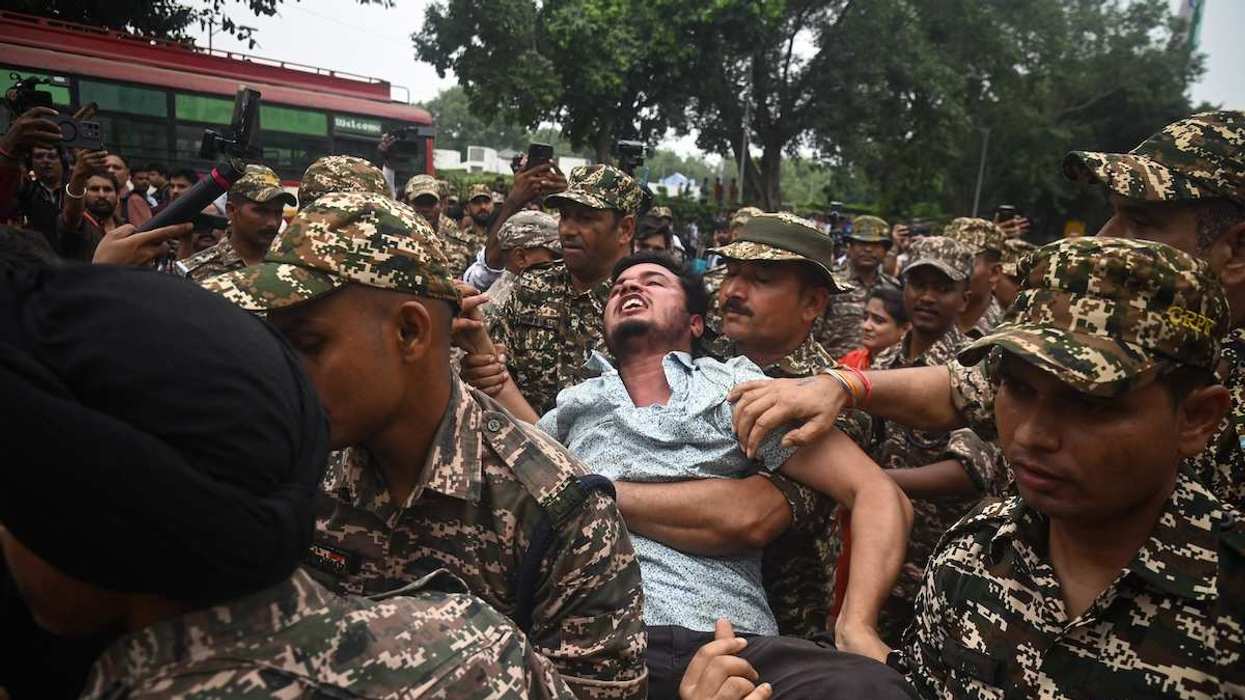
In just a few days, some four million people in India could find themselves without a country. If that happens, it would quickly become the largest crisis of stateless people on the planet.
This is happening in Assam, a hilly, landlocked state at the eastern edge of India along the Bangladeshi border. (The famous "Assam" tea comes from there.)
Back in the early 1970s, during Bangladesh's war of independence from Pakistan, millions of Bengali Muslims fled across the border into Assam, dramatically shifting the province's demographics and leading to tensions with Assam's Hindu majority. Nearly half a century later, Assam has the largest Muslim minority of any Indian state except Kashmir.
In the mid-1980's, India's government determined that any refugee who crossed the border into Assam after Bangladesh gained independence in 1971 should be a citizen of Bangladesh, not of India. Since then, successive Indian governments have tried to determine which Assam residents have paperwork that proves they lived in India before that date.
But for many people, finding the right documents – and reading them, in a state where a quarter of the population is illiterate – is challenging, if not impossible.
Last year, the Assam state government finally published a draft National Registry of Citizens (NRC) which lists everyone who is legally resident in Assam. Four million people, mostly Muslims who have been living in India for decades, were not on the list. Those people have until August 31 to prove a pre-1971 claim to residence or they will be deemed illegal.
The Indian government, like all governments, has the right and responsibility to know who is living on its territory and under what circumstances. But there are two big complications in the case of Assam.
First, what happens to these 4 million human beings if India officially marks them as illegal? Bangladesh has said it will not accept the deportation of millions of people who have been living in India for almost 50 years. Many of these 4 million people were born inside India after 1971. Should those people be "returned" to a country they've never known? Assam authorities are reportedly building detention camps that could constitute a horrific human rights violation.
Second, the Assam crackdown looks like the prelude to a broader bid by the national government of Prime Minister Narendra Modi's Hindu Nationalist Bharatiya Janata Party (BJP) to discriminate against India's Muslims.
This spring, the BJP announced that it wants to extend the citizenship registry to the whole country in a bid to remove anyone who isn't a "Buddhist, Hindu, or Sikh." Interior Minister Amit Shah, who headed the BJP in the runup to its sweeping (re)election victory last year, has called Bengali Muslims "termites" and pledged to throw them into the sea.
The BJP is flush with power after the last election – but seeking to marginalize India's 177 million Muslims from what it means to be "Indian" risks destabilizing a precarious balance among faiths and ethnicities in the world's largest democracy.