Blankets, tents, Palestinian flags, signs, and scores of tired students were strewn across the South Lawn of the university's Manhattan campus. The protesters were camped there to demand Columbia’s divestment from companies with ties to Israel – but they knew they were playing a game of chicken. The night before, university administrators had warned that remaining in their “Gaza Solidarity Encampment” would result in suspensions and possible arrests. Still, they decided to stay, and some 34 hours later, police in riot gear arrived. Organizers yelled “phones out” as NYPD officers reached for their zip ties.
“I remember the collective fear, like everyone was having the same thought: ‘We’re really on our own,’” says Izel Pineda, a Barnard senior who delivered supplies to the encampment minutes before police arrived.
_______
Chaos at Columbia University this past week started with the encampment being erected hours before President Nemat Shafik’s congressional testimony on antisemitism on Wednesday. Shafik told Congress about last autumn’s protests on campus following the Oct. 7 attack on Israel by Hamas militants and about the incidents of antisemitism that had left many Jewish students on campus afraid to leave their dorms or attend class. She explained that the school had made progress in disciplining students, enforcing stricter protest policies, and investigating some professors.
But as she spoke, that progress began to unravel, leading to the Thursday arrests of 108 students – all of whom have been suspended and kicked off campus – and subsequent protests by students and faculty across the ideological divide. Many of the young people, especially Jews, fear for their safety, while professors are wondering if their jobs are at risk. The growing demonstrations, and the threat of further arrests, have only worked to inflame tensions – so much so that the only thing all sides agree on is that the campus is unraveling into distrust, dysfunction, and fear.
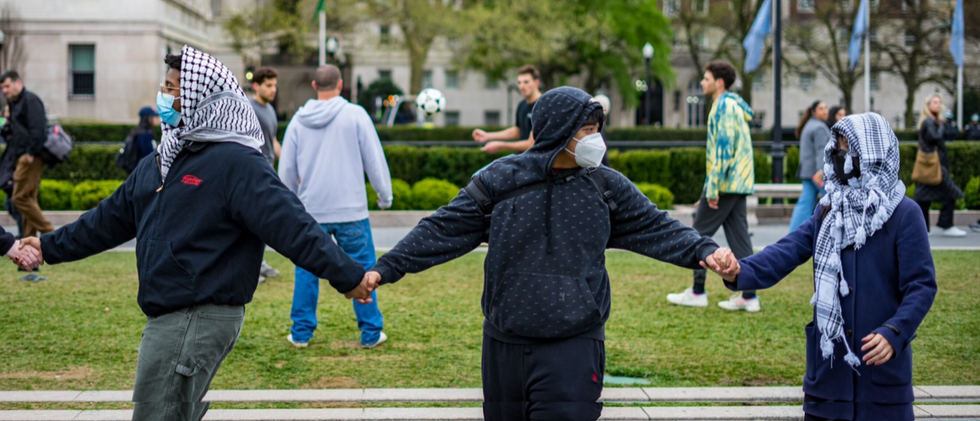 Students hold hands and circle the lawns in solidarity with the pro-Palestine protesters.Will Hull
Breeding mistrust and anxiety
On Wednesday, Shafik faced three hours of questioning before the Republican-led Committee on Education and the Workforce. Questions focused on how administrators were protecting Jewish and pro-Israel students on campus amid frequent pro-Palestinian protests.
Shafik focused her testimony on disciplinary matters, noting the increased police presence, stricter policies, and the November suspension of the campus’s two main pro-Palestine student groups for not following the rules.
The committee honed in on individual Columbia professors like Joseph Massad, who described Hamas’ temporary takeover of Israeli settlements as a “stunning victory” in a highly controversial article after the Oct. 7 attack. Shafik told Congress that Massad was under internal investigation – something the professor himself had not known.
Shafik’s answers seemed to satisfy the committee. But on campus, students and faculty are far from satisfied – and the resulting demonstrations, some in solidarity with the arrested students, and some pro-Israeli versus pro-Palestinian protests, are again making campus feel more like a battleground than a safe space for learning.
“[Jewish students] appreciate all the concern about our safety, but the congressional hearing only further cleaves apart our campus and escalates tensions,” says Alina Kreynovich, a junior at Columbia’s School of General Studies.
Defying to voice dissent
After police cleared the encampment with their arrests on Thursday, other protesters reorganized on the adjacent lawn, and over 100 students began a sit-in and prepared for a second round of arrests. Organizers told them what to do if detained, wrote lawyers’ phone numbers on their arms, and voted to expand their demands beyond divestment, adding amnesty for the suspended students to their list.
Presidential candidate and progressive activist Cornel West witnessed Thursday’s arrests as he sat cross-legged among the students nearby. “Shame on the Columbia University administrators,” he said. “It's very important to protect every student.”
Many students joined the demonstrations because of the police action. “I think a lot of us came out here because of the arrests,” said a junior at Columbia College who requested anonymity. “Students shouldn’t be arrested and suspended for peacefully protesting on campus.”
Pro-Israel protesters carrying Israeli and American flags gathered together nearby holding pictures of hostages taken by Hamas and singing “God Bless America.”
Fears of violence rise
Yoseph Haddad, an Arab-Israeli journalist who was scheduled to speak at Columbia’s chapter of Students Supporting Israel, was assaulted by a protester while trying to enter campus. A man was attacked as he held a ripped, red-stained, Israeli flag. Multiple Jewish students said they were disturbed to see protesters defacing posters of hostages on the street.
Danny Gold, a Ph.D. candidate at Columbia’s Jewish Theological Seminary, said he doesn’t feel like protesters recognize how many students at Columbia – where 22.5% of undergraduates and 15.5% of graduate students are Jewish – have connections to people who were killed or kidnapped by Hamas. “One of my students has two cousins who were hostages. How does that make him feel seeing these protests where people deface hostage posters?”
Another student told me he felt like many of the protest chants were intimidating for Jewish students. “A lot of us have family in Israel, and hearing a chant like ‘from the river to the sea’ – that doesn’t call for a regime change, which would be an acceptable criticism of Israel, but for the total annihilation of the state – is frankly terrifying to many students who feel like it is a safe place for them.”
Students on both sides say they are afraid — of the university, which they believe has done too much or too little to crack down on the protests, and above all, of each other.
“It was crazy how quickly the community just turned upside down in terms of how we treat each other,” said Noa Fey, who has been a victim of bullying, online and on campus, after sharing her thoughts about the right to self-determination of both Israel and Palestine. “I’ve lost friends,” she said. “I barely made it out of the semester academically and emotionally.”
Faculty members join the fray
Many professors fear that free speech and academic freedom are under attack on campus. They are also concerned about being investigated by the university without their knowledge.
On Thursday evening, faculty members held a press conference outside of the President’s House. “The attack on students today violates fundamentally a core component of academic life,” said Joseph Howley, a classics professor. “This has not happened since 1968. And in the last 50 years, Columbia has been extremely careful about these extreme measures, and that care was violated today.”
As of the weekend, the protests have only grown, faculty members are boycotting graduation, and Jewish students increasingly still feel unsafe on campus.
“This national attention has only fueled the fringes of Columbia’s community and invites the entire country into our emotionally exhausted campus. If anything, the campus is less safe than ever,” says Kreynovich.