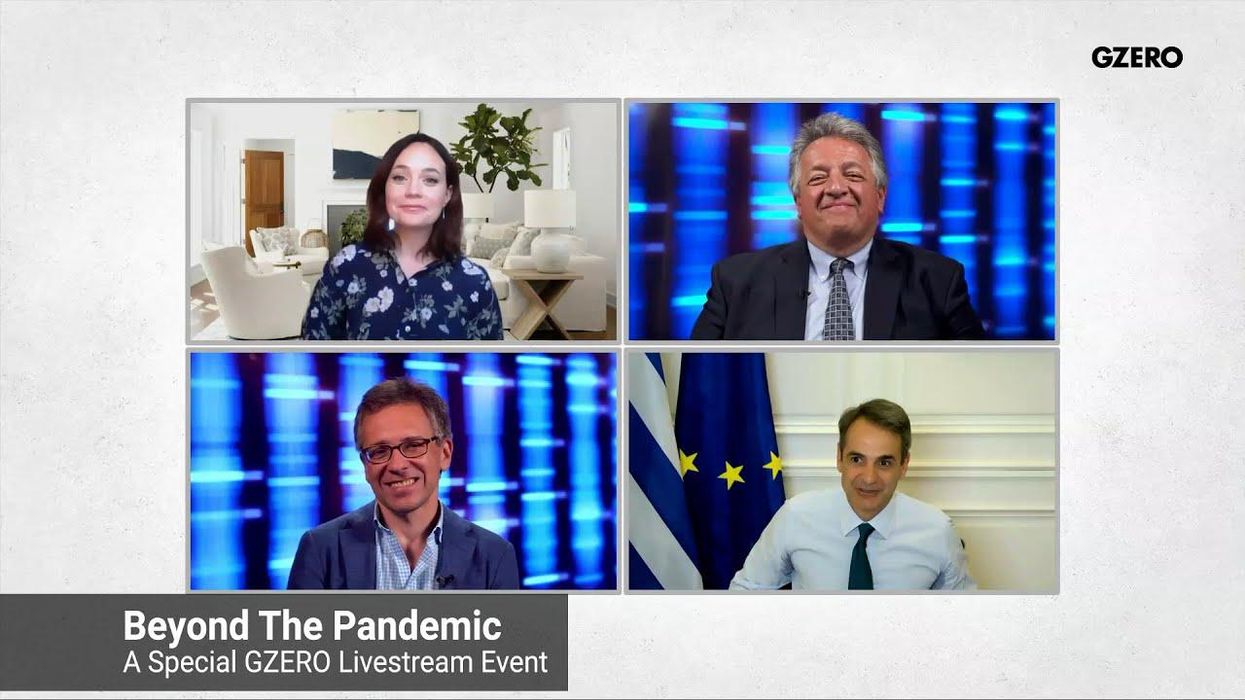
Let's learn from COVID to prevent the next pandemic
June 08, 2021
Explore GZERO’s past virtual conversations, featuring global experts on the world's urgent issues.
Presented by
Days before G7 leaders meet in the UK to talk about how to "build back better" after the pandemic, experts are warning them that they should not lose sight of the opportunity to learn from the experience of COVID to be more prepared when the next public crisis hits. Below are a few insights from a livestream discussion between political leaders, policy makers, health experts and scientists, entitled Beyond the Pandemic: A Radical New Approach to Health Security, hosted by GZERO Media in partnership with Flagship Pioneering.
It's time to not just move on, but rather think carefully about pre-empting future pandemics by bolstering health security, said Noubar Afeyan, co-founder of Modern and CEO of the Flagship Pioneering venture capital firm. That would be the best way, he explained, to do justice to the global calls for "never again." For Ian Bremmer, president of Eurasia Group and GZERO Media, the window of opportunity to rally the global cooperation that was virtually absent during the worst of the pandemic is closing fast.
Science journalist Laurie Garrett blasted global leadership, especially in countries like Brazil and India, for making the pandemic worse with their politicized responses, and for underplaying the importance of preventive public health. Many governments, she pointed out, obliterated their own public health capacity by putting politics first, for instance in the US by demonizing experts such as Dr. Anthony Fauci and weaponizing the probe into the origins of COVID to blame China.
Prime Minister Kyriakos Mitsotakis offered the lessons Greece has learned from dealing with a massive public health crisis barely after recovering from an economic depression. Mitsotakis also came out in support of the EU's decision to procure vaccines as a bloc over "solidarity," and anticipated that very soon people who still don't want to get vaccinated will realize their lives will become much easier when they agree to get the jab.
For his part, Pfizer CEO Albert Bourla defended his company's opposition to waiving vaccine patents because the doses are for all — rich or poor, east or west — and that the only reason they can't produce more is because not enough raw materials are now available. Pfizer, he added, is looking into expanding mRNA technology to develop better flu vaccines, those that can boost the immune system to fight non-communicable diseases like cancer, and illnesses that stem from genetic mutations.
Other key moments of the program:
This live event series was produced by GZERO Media in partnership with Flagship Pioneering. We thank our event partners, Partnership for a Healthier America and Medtronic.



Keep up with what’s going on around the world - and why it matters.