AI is moving fast, but not everyone is moving with it. Inside the UN, global leaders debate how to close the widening AI divide.
Artificial intelligence isn’t just about innovation. It’s about access, infrastructure, and whether the benefits of a transformative technology will be shared or concentrated.
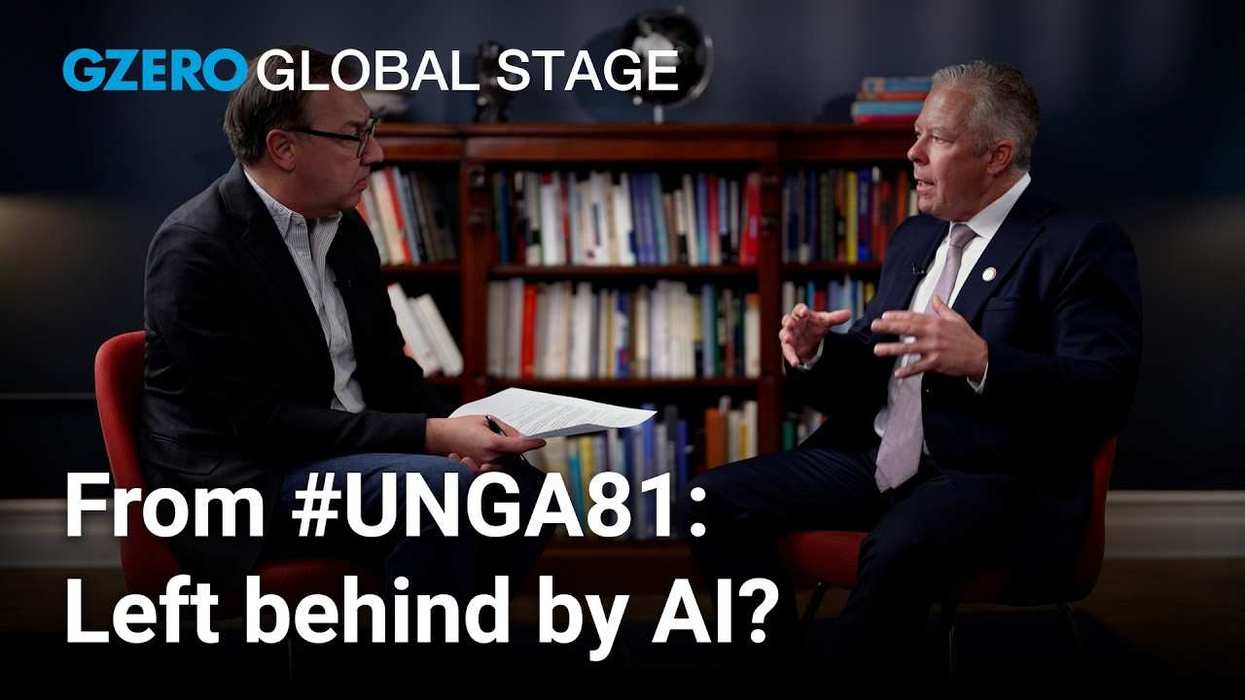
In a new Global Stage livestream from the United Nations Goals Lounge in New York, Tony Maciulis moderates a conversation with Lisa Monaco (President of Global Affairs, Microsoft), Doreen Bogdan-Martin (Secretary-General, International Telecommunication Union), and Ambassador Parvathaneni Harish (Permanent Representative of India to the UN) on the growing gap between the Global North and Global South in AI adoption, and what it will take to close it.
So what’s really driving the divide? Lisa Monaco points first to fundamentals: electricity and connectivity. More than 700 million people still lack access to power, and billions remain offline, placing them entirely outside the AI economy. Even among those connected, adoption rates are diverging fast, with AI usage growing roughly twice as quickly in the Global North as in the Global South.
Doreen Bogdan-Martin frames the issue even more starkly: if you’re not connected, you’re not part of the AI world. But connectivity alone isn’t enough. Affordability, devices, and skills all compound the gap. In many developing countries, internet access can cost a significant share of monthly income, far above global affordability targets, while lack of training leaves millions unable to translate access into real opportunity.
Ambassador Harish points to India as both a case study and a test bed. By dramatically lowering the cost of mobile data and building digital public infrastructure at scale, India has created a foundation for broader AI adoption. The next step is applying AI to real-world problems, such as helping farmers diagnose crops, expanding access to healthcare, and enabling services in multiple languages so technology works beyond English-speaking populations.
The conversation repeatedly returns to skilling as the critical unlock. Without widespread education and workforce training, AI risks reinforcing existing inequalities rather than reducing them. But skills alone won’t solve the problem. Infrastructure, investment, and trust must move in parallel to create what Monaco describes as a “flywheel” of adoption and growth.
Trust, in particular, emerges as a central fault line. From concerns about safety and governance to gaps in language accessibility, people will not use technology they don’t trust. Efforts like the Trusted Technology Alliance aim to establish shared principles around security, transparency, and reliability. But global alignment remains a work in progress.
Running through it all is a core question: can AI become an engine of inclusion, or will it deepen the divides already shaping the global economy?
The Global Stage series, presented by GZERO Media in partnership with Microsoft, convenes leaders at major international forums to examine how technology, politics, and society intersect in an era of accelerating change.
Watch the full conversation from the United Nations.