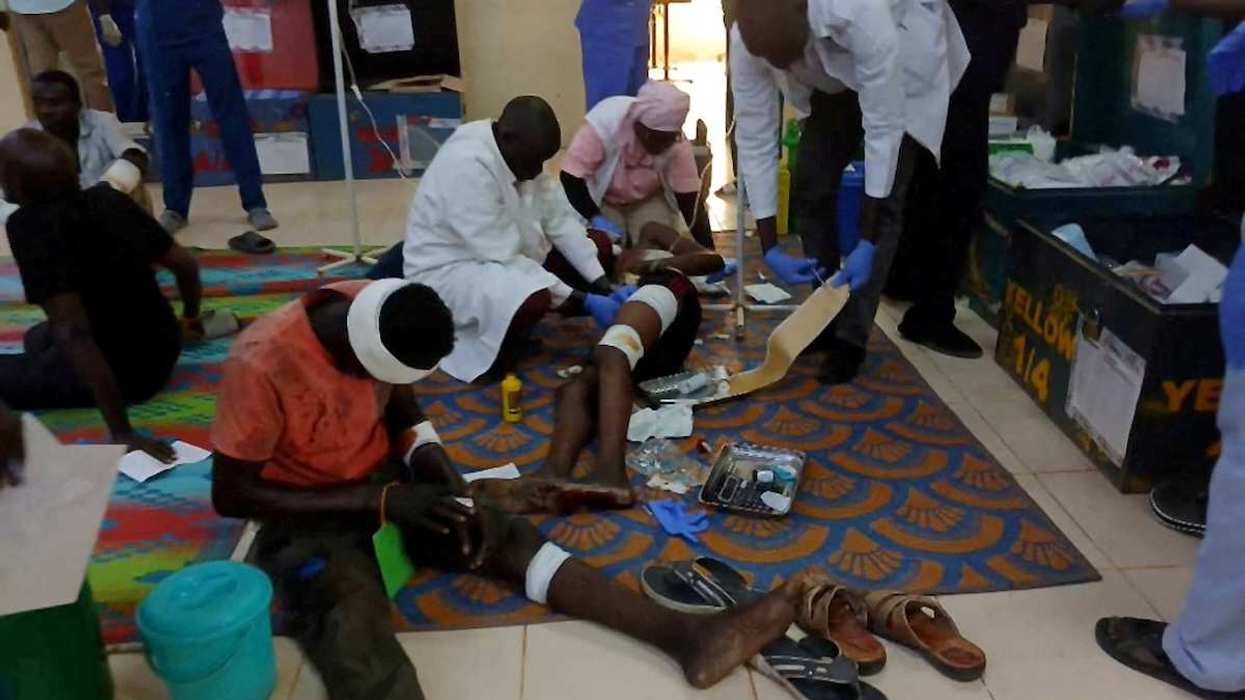
Wars tend to spread, infecting parts of the world far from the frontlines and the Ukraine conflict is no exception.
The global economic ripple effects of the war in Ukraine – from the world’s sharpest “hunger pains” since World War II to soaring inflation and energy crises – have been clear for months.
The news that Iran has now become deeply involved in Russia’s war effort, by supplying the Kremlin with “suicide drones” for the bombardment of Ukrainian targets, has ricocheted deep into the Middle East, raising tough questions for one state in particular: Israel.
Since the beginning of the war, the close US ally has tried to walk a fine line: supporting Ukraine in principle but without antagonizing Putin in ways that might upset Israel’s relationship with Russia. After all, the Israelis have long had a quiet understanding with the Kremlin over Syria, where Russia controls much of the airspace and has for years allowed Israel to conduct airstrikes on Iranian targets.
But now, with Russia openly using Iranian kit to bombard Ukrainian cities, Israel faces renewed pressure to send Kyiv its renowned advanced missile defense systems – particularly the Iron Dome. But Israel’s considerations are complicated. Here’s a look at the landscape that the Israeli government faces as it decides what to do next.
First off, why is Iran even involved in the Ukraine war?
Western sanctions might not be making as big a dent in Russia’s war chest as the US hoped, but they have made it harder for Russia’s arms industry to get its hands on key technologies.
That’s forced Moscow to turn to rogue states like North Korea and Iran to bolster its weapons stockpiles. In recent weeks, Iran has emerged as Moscow’s chief arms supplier, selling Russia drones and surface-to-surface missiles, and sending personnel to train Russian troops in their use.
While Iran’s current production capacity isn’t able to supply an endless stream of drones, Farzin Nadimi, an Iran expert at the Washington Institute, says the Islamic Republic can certainly increase output to meet Moscow's needs. After all, Putin is an attractive customer with a wad of cash: the Kremlin took in at least 158 billion euros ($154 billion) in energy export revenues in the first six months of the war.
Iran’s interest isn’t just money. Tehran has much to gain from deepening its strategic ties with Russia. Indeed, experts say that the regime will likely try to leverage the relationship to gain access to key Russian technologies, such as those it needs in order to develop intelligence-gathering satellites. “This would give Iran a lot of flexibility in the region,” says Nadimi, including being able to more reliably fire long-range missiles into Israel.
Some regional military experts even fear the once-unthinkable prospect of Russia giving Iran access to dual-use nuclear technology that could help Tehran further boost its nuclear program. (As part of a 2011 agreement, Moscow helped put Iran’s first nuclear plant online, but strict non-proliferation measures were put in place.)
Israel on the spot. For months, Israel, an ally of the West, has been criticized for refusing Ukraine’s repeated requests to send heavy weapons, particularly air defenses. As recently as Wednesday, Kyiv again formally asked for half a dozen different Israeli systems – some of which aren’t even operational yet. This comes amid reports that Israel has been feeding the Ukrainians intel on Iranian drones and providing satellite imagery of where Russian troops are stationed.
But why is Israel’s position so difficult? Because … Russia. The Kremlin is, in fact, a strategic partner for Israel not by choice but by necessity. In recent years, the Kremlin has allowed Israeli warplanes to target Iranian strategic assets in Syria, including convoys trying to deliver weapons to Hezbollah in Lebanon. Russia, for its part, has been willing to turn a blind eye to Israel on these aerial missions in part because it is competing with Tehran for dominance inside Syria.
Avi Scharf, national security editor at Haaretz, notes that there’s also a growing concern in Israeli national security circles that if Israel supplies advanced weapons to the Ukrainians, the equipment could fall into Russian hands and get passed on to Tehran. If that happened, it could undermine Israel’s qualitative military edge over the Iranians.
There is also a cultural dimension: Russia has a large Jewish population, many of whom are now trying to flee to Israel in the wake of the Russian mobilization. Moscow has already tried to shutter the Russian branch of the Jewish Agency, the main facilitator of immigration to Israel, and there is growing fear in Jerusalem that Israel must tread carefully lest the Kremlin shut the door entirely on Russian Jews trying to leave.
Lastly, there are domestic political considerations at home. A new poll published this week shows that 41% of Israelis oppose sending arms to Ukraine, compared to 21% who support it. Indeed, the last thing Prime Minister Yair Lapid wants is a head-to-head with Putin just weeks out from yet another general election on Nov 1.
So what is Israel going to do now? In response to the recent pressure, Israel’s Defense Minister Benny Gantz said that Israel would “change its policy” on weapons transfers to Ukraine. He then clarified that Jerusalem would not in fact send weapons but rather give Kyiv access to a warning system that alerts citizens – via phone and other telecoms – when rocket fire is incoming. This flip-flopping suggests Israel is still adapting its Ukraine policy in real time.
Still, while this is barely what the Ukrainians were hoping for, Scharf says it signifies “a big change of course," for Israel, adding that “it’s much more than we’ve seen in the past.”
As Iran props up Russia in Ukraine, Israel is clearly taking a cautious step towards greater involvement in the conflict. But it may need to take more decisive action in the coming months as the extent of Russia's impact on the Iranian arms industry becomes clearer.
This article comes to you from the Signal newsletter team of GZERO Media. Sign up today.