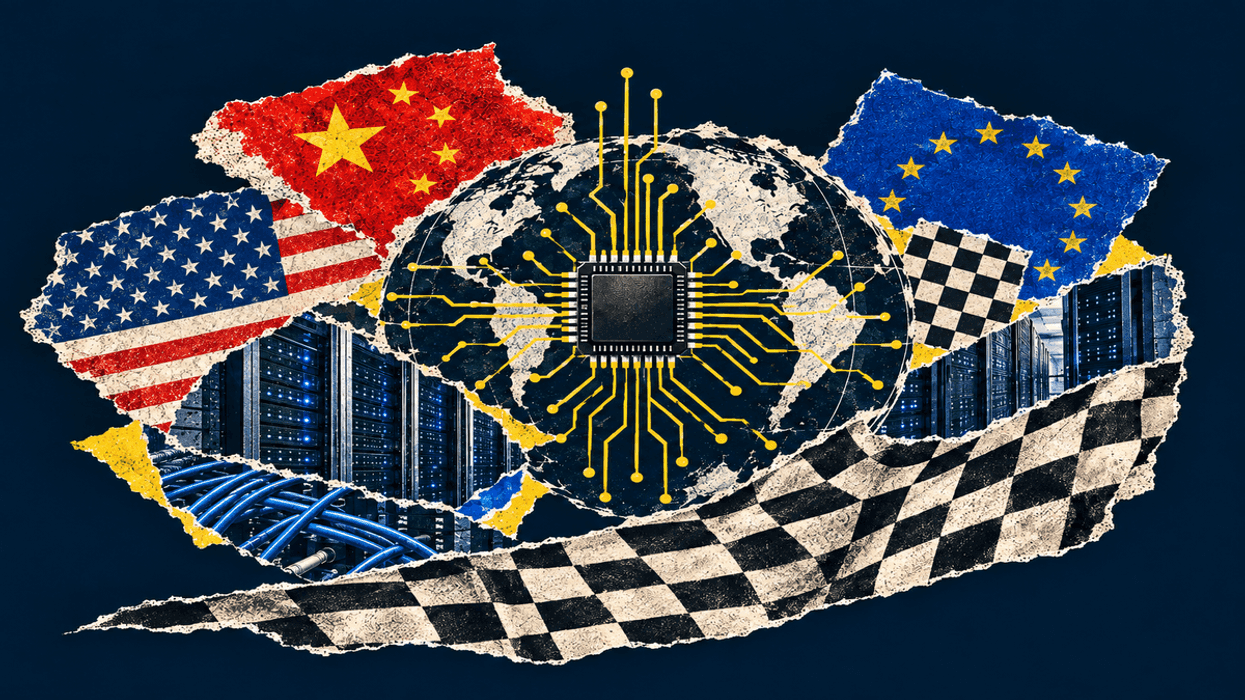
The model has become the center of a fierce debate in Washington and Silicon Valley over whether the “closed” approach America's leading AI companies take is protecting the US's lead, or helping China catch up.
American AI companies Anthropic and OpenAI guard their most powerful models as closely held products, earning revenue by selling developers access to systems only they control. In other words, they’re closed systems – their source code, inner workings, and training data are kept private by the company unless you pay a monthly subscription to use portions of it.
China has gone in the opposite direction, with companies releasing increasingly advanced open-weight models that anyone can download, study, and customize.
Open-weight systems are a bit like leaving the gym and handing out your workout plan, giving others enough detail to study it, tweak it, and improve on it. They are still more opaque than fully “open-source” ones, which provide total access to the underlying training code and data — the equivalent of sharing not just your routine, but exactly how you developed it.
China’s approach is partly born of necessity. Years of US export controls have limited access to the world’s most advanced computer chips, forcing Chinese companies to build models more cheaply and on less powerful hardware. Releasing those models publicly gives them access to a global talent pool of developers who can improve the technology and optimize its performance.
“The original company receives the benefit of an ecosystem it did not have to build entirely by itself,” according to Chinmayi Sharma, a law professor at Fordham University and expert on cybersecurity and AI. “That can be particularly useful for a company trying to catch or displace an incumbent.”
The strategy carries geopolitical benefits, too. As more developers and companies build on Chinese AI models, those systems become more deeply embedded across industries and countries, potentially giving Beijing greater technological influence abroad. Earlier this month, Chinese President Xi Jinping argued that China’s more open-weight AI approach offers a fairer alternative to closed American models.
That strategy is making US officials uneasy. The White House is reportedly considering restricting Chinese open-weight models by adding Chinese AI labs to its “Entity List,” effectively cutting off US access without a license. Last week, the Trump administration also accused Moonshot AI of “distilling” knowledge from American AI companies — a process in which developers use millions of interactions with existing models to train their own systems. Moonshot denied the allegations, and several AI researchers questioned whether the accusations were technically plausible.
The possibility of a ban on Chinese open-weight AI has exposed a split inside the US tech industry. On Friday, over 20 companies – including Microsoft and Nvidia, which benefit from open models to spur demand for their cloud computing services and chips – penned a letter urging the administration not to restrict them. The companies argue that a ban would dampen competition.
“It results in a small number of single points of failure, weakens competition, and leaves critical technology in the hands of a few providers,” the companies wrote. Notably absent was Anthropic, one of the leading AI companies and the only major AI lab to decline to sign.
Supporters of closed AI systems see things differently, particularly when it comes to cybersecurity. In a blog post on Monday, Anthropic CEO Dario Amodei argued that once an open-weight model is released, its creators lose the ability to revoke access, issue safeguards, or prevent misuse. Control passes to whoever downloads the model, making it much harder to ensure the technology is used responsibly.
“The public risk is not simply that outsiders can see the model. It is that outsiders can possess it,” Sharma explained. “Once weights are broadly distributed, those mechanisms lose much of their force. A user can alter the model privately and continue using an older version even after the developer discovers a serious vulnerability.”
The debate over open-weight AI is about more than software. As Sharma put it, it’s a struggle over who gets to supply the building blocks of global AI – and, ultimately, whose technology becomes indispensable.