Skip to content
Search

Latest Stories

Analysis

The Battle for Control of Tiananmen

The Battle for Control of Tiananmen
Make us preferred on Google

In the spring of 1989, Chinese students began gathering in Beijing's Tiananmen Square, at first to mourn the death of reformist leader Hu Yaobang and then in hopes of persuading their government to allow greater political freedom across the country.

Over a period of six weeks, the crowd swelled as older people joined and the list of demands broadened. The occupation of the square took on a life on its own, and some within the Communist Party leadership began to see a threat to their monopoly on political power.


The contest for control of the square soon became a battle for information. Protest leaders assigned lookouts to watch for any approach of troops. Any sign of movement by police or soldiers sent protesters scrambling to landline telephones in nearby buildings to call supporters to flood the square to make it more difficult for security forces to enter.

On June 4, 1989, under cover of darkness, Chinese tanks finally pushed into Tiananmen, crushing the protests and killing hundreds, perhaps thousands, of people.

On Tuesday of next week, many around the world will mark the 30-year anniversary of that event, a moment that changed China and the trajectory of world history. But, of course, the occasion will not be marked inside China, at least not publicly. That's because gaining access to the history of Tiananmen is, for most Chinese, still a battle for information, even if it's no longer a fight over landline phones or state-run TV and radio.
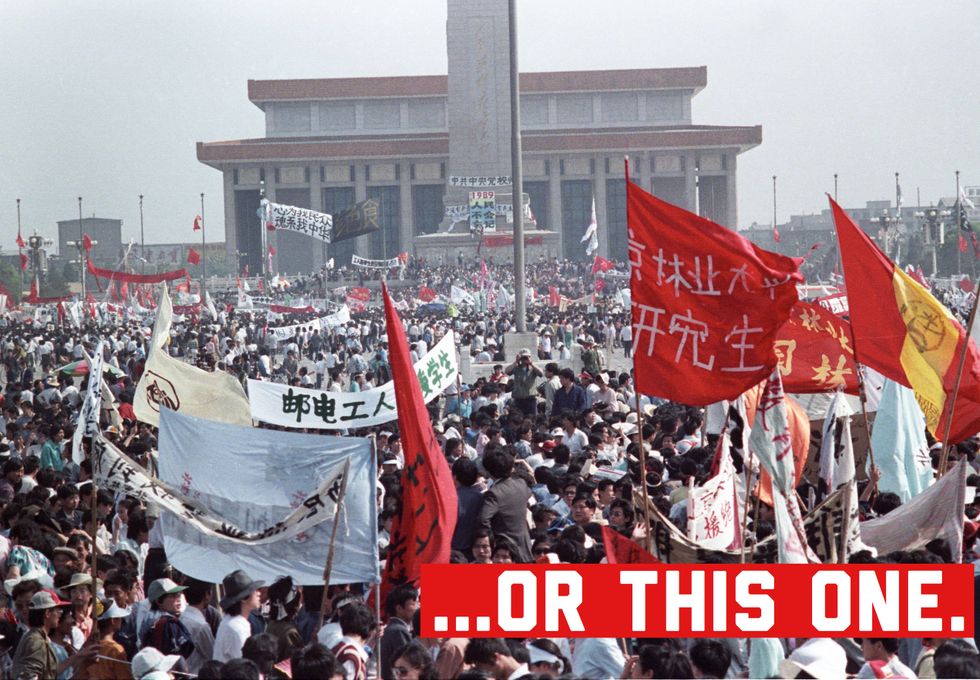
Hundreds of thousands of people fill Peking's central Tiananmen Square Reuters /Landov

Only those over the age of 35 have any personal memory of the event. And while today China's citizens can use digital and social media to speak directly with one another, the government still controls communications and access to information. Social media accounts in China must be registered to users' real names, and tech companies are required to give the government access to all of their users' information if asked to do so.

Beyond keeping Tiananmen references off the traditional airwaves, advances in artificial intelligence also allow government computers to patrol the Internet in search of any reference to the Tiananmen protests and crackdown. The numbers 46 and 64, potential references to June 4, are removed from online posts. In 2012, censors briefly blocked access to the search term "Shanghai Stock market" after the index coincidentally fell exactly 64.89 points on the anniversary of the massacre.

Terms even loosely associated with the protests and crackdown are diverted to unrelated results. Video recognition software is programmed to scrub away any photographic reference to the events.

Three decades later, it's clear that China's leaders still fear the Chinese people and what they might want more than they fear any threat from abroad.

More For You

Supporters of the Forever Canadian group, who want Alberta to remain in Canada, wave Canadian flags as they wait for the results of a non-binding referendum on Alberta sovereignty in Edmonton, Alberta, Canada October 19, 2026.

Supporters of the Forever Canadian group, who want Alberta to remain in Canada, wave Canadian flags as they wait for the results of a non-binding referendum on Alberta sovereignty in Edmonton, Alberta, Canada October 19, 2026.

REUTERS/Todd Korol
Alberta is staying in Canada. After a long night of ballot counting, with some polling stations open until 10:30 pm due to long lines and late starts, voters in the oil-rich western Canadian province decisively rejected taking steps toward independence. Seventy-six percent voted to remain part of Canada, while 24% voted to initiate a secession [...]
Washington’s controversial new approach to foreign aid
What do countries receiving US foreign aid owe Washington? Since returning to power in 2025, the Trump administration has drastically changed the answer to this question, pursuing an ‘America First’ philosophy that is dramatically more transactional: the US will give you money, but you must give the US something valuable in return.In the [...]
Refugees and migrants arrive on an overcrowded boat on the Greek island of Lesbos, November 10, 2015. Since the start of the year, over 590,000 people have crossed into Greece, the frontline of a massive westward population shift from war-ravaged Syria and beyond.

Refugees and migrants arrive on an overcrowded boat on the Greek island of Lesbos, November 10, 2015. Since the start of the year, over 590,000 people have crossed into Greece, the frontline of a massive westward population shift from war-ravaged Syria and beyond.

REUTERS/Alkis Konstantinidis
Anti-immigration political parties are making big gains across Europe these days. Germany’s Alternative for Germany (AfD) party just won two major state parliamentary elections, campaigning in part on mass deportations of undocumented immigrants. Spain’s far-right Vox party continues to grow in popularity, especially after a recent surge of [...]
MF Communications Officer Jose Luis De Haro, Director of the Research Department at the IMF Silvana Tenreyro, Deputy Director of the Research Department at the IMF Petya Koeva-Brooks and Division Chief at the Research Department of the IMF Deniz Igan attend a press briefing during the IMF/World Bank 2026 Annual Meetings at Queen Sirikit National Convention Center (QSNCC)

IMF Communications Officer Jose Luis De Haro, Director of the Research Department at the IMF Silvana Tenreyro, Deputy Director of the Research Department at the IMF Petya Koeva-Brooks and Division Chief at the Research Department of the IMF Deniz Igan attend a press briefing during the IMF/World Bank 2026 Annual Meetings at Queen Sirikit National Convention Center (QSNCC) in Bangkok, Thailand, October 13, 2026.

REUTERS/Patipat Janthong
The people tasked with safeguarding the world’s financial stability are gathering in Bangkok, Thailand, this week. Central bankers, finance and development ministers, private sector leaders, civil society representatives, and academics from nearly 200 countries are attending the IMF-World Bank’s annual meetings to discuss soaring public debt, the [...]