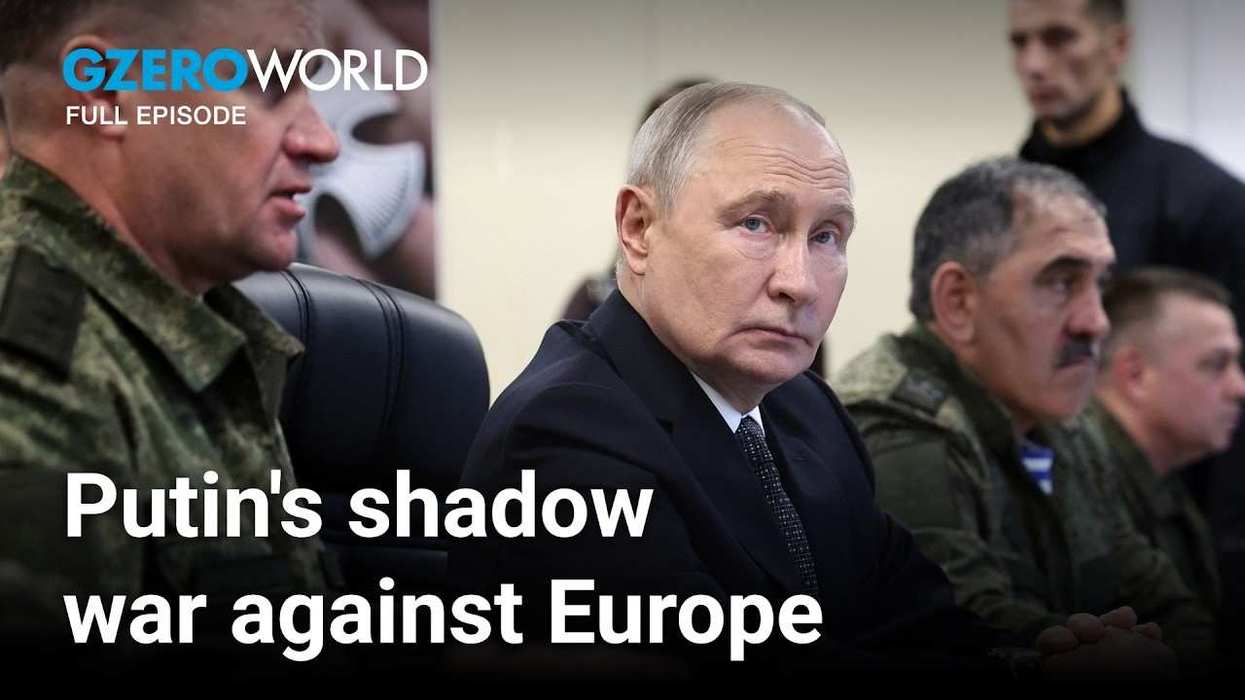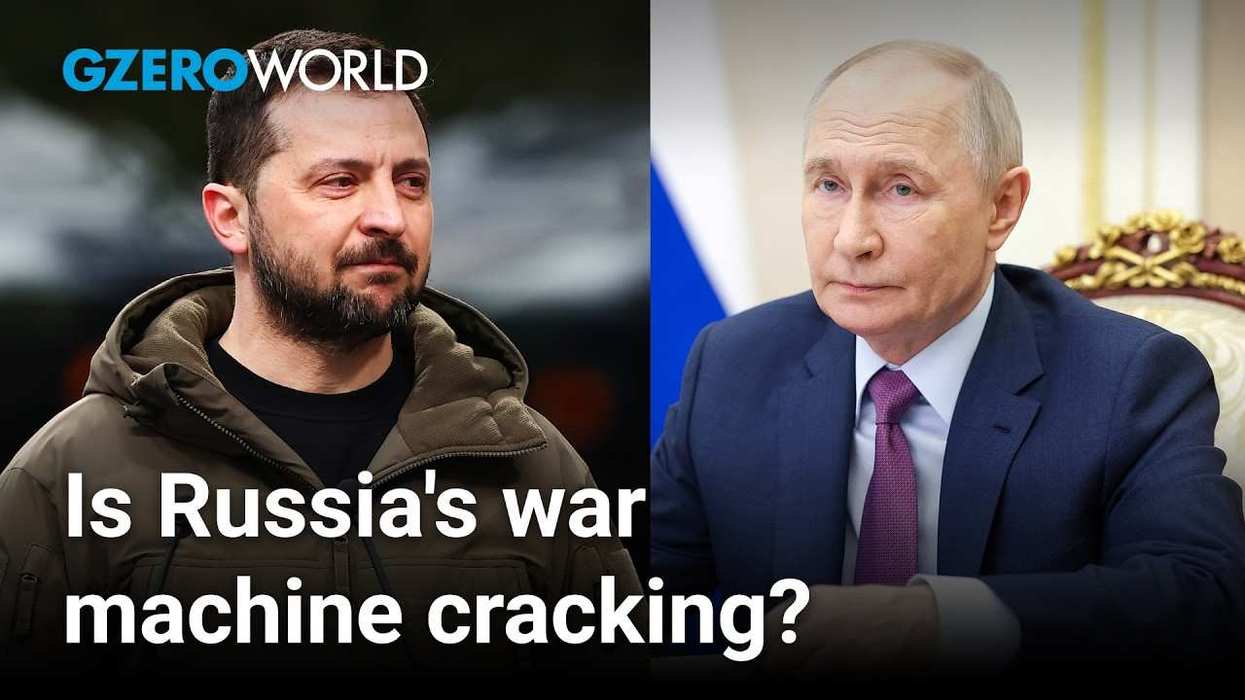
Two weeks ago, Russia unveiled a new fighter jet with stealth capabilities. It looks cool, and probably does lots of cool things. President Vladimir Putin himself unveiled it and made a speech about it. It's an interesting punctuation mark following the 5,000-word essay he published on July 12 in which he made the historical argument that Ukraine is part of Russia.
It's clear that the Russians have been making another play for attention in recent weeks. Last month, the mighty Russian military repelled hostile action by a British warship in the Black Sea, if you believe the Kremlin version of events. According to Moscow, its forces fired warning shots and dropped bombs in the path of the Royal Navy destroyer Defender. Russia’s foreign ministry said that if a British ship invades Russian waters again, Russian bombs will fall "not only in its path, but also on target."
The UK foreign ministry dismissed this story as “predictably inaccurate.” The British version of events is that its ship was passing peacefully from the Ukrainian port of Odessa to the Georgian port of Batumi. Russian planes, flying recklessly close to the Defender, fired shots as part of a gunnery exercise that posed no threat to the ship and dropped exactly zero bombs, according to the Brits. (While in Odessa, the UK signed an agreement with Ukraine to upgrade the Ukrainian navy.)
Want to understand the world a little better? Subscribe to GZERO Daily by Ian Bremmer for free and get new posts delivered to your inbox every week.
You can decide which version of the story you believe.
This dust-up reminded me of a strange incident seven years ago and half a world away. In 2014, after Russia’s invasion of Crimea and the controversy over the downing of a commercial plane by Russian-backed Ukrainian rebels, Vladimir Putin was attending a G20 summit meeting in Brisbane, Australia. Also in attendance in waters just north of Australia was a group of Russian warships, ringing alarm bells in Western capitals and newsrooms.
In a sense, both stories are ridiculous. There was no risk that Russian ships would launch a surprise attack on Australia, and Russia isn’t going to drop bombs on a destroyer operated by NATO-member Britain. In both cases, Putin was flexing his muscles at the West over Western refusal to recognize Ukraine as part of Russia’s sphere of influence.
Western navies do have to take these kinds of threats seriously, but we don’t. Putin is posturing for a domestic audience, and there’s much less to his threats than meets the eye.
Let’s face it: Putin makes a great Bond villain. He’s a former KGB guy with a Cheshire cat smile. He’s highly intelligent. He’s got a pretty good grip on a government that likes to make trouble.
But let’s now review the ways in which Russia can’t approach the challenge to the world’s democracies posed by China.
Russia interferes in foreign elections. That’s an old story, it’s small ball in terms of resources and impact, and there’s no evidence that Russia has ever changed the outcome of an election. It’s a threat to monitor, not to obsess over.
The Kremlin is playing a bigger role in the Middle East than it used to. Good luck with that. The US, now the world’s largest energy producer, doesn’t need Middle Eastern oil as much as it used to, and if Russia wants to assume responsibility for stability in countries like Syria and Libya, it should be careful what it wishes for. #RememberAfghanistan
Russia isn’t going to invade Ukraine. Its soldiers and sailors grabbed Crimea and will never give it back. Its backing for the insurgency in eastern Ukraine makes life tougher for Ukraine’s national government. But Russia can’t afford the costs and casualties required to invade and occupy a country of 44 million people across a land area larger than any country currently in the EU.
In fact, Russia is still fighting to hold together what’s left of the former Soviet Union. The three Baltic republics joined NATO and the EU years ago. Russia’s land grab in Crimea has made enemies of multiple generations of Ukrainians who once had mixed feelings about Moscow. The cost of keeping Alexander Lukashenko in power in Belarus threatens to make that country a Russian dependent. A few months ago, Turkey jumped into the Caucasus to help the former Soviet Republic of Azerbaijan best Russian ally and former Soviet Republic Armenia in a shooting war. Late last year, Moldova elected a Harvard-educated, pro-EU economist as its president. Finally, Russia finds itself competing with rising China in the former Soviet Central Asian Republics.
Russia’s economy is smaller than Canada’s and about half the size of California’s—and that economy is covered in rust. Living standards are in slow but steady decline. Over the past eight years, Russia’s economy has grown at an annual rate of 1 percent. Despite global awareness that hydrocarbon energy is not exactly the wave of the future, oil and gas still make up 60 percent of Russia’s exports and 40 percent of state revenue.
Russia does have strengths that deserve attention. It still has Soviet-era nuclear weapons, of course. Mutually assured destruction remains in place to prevent a state-on-state nuclear war, but the nuclear arms race represented an existential risk during the Cold War and remains so today. Washington has good reason to prioritize continued work toward arms control agreements accordingly.
Russia is also a cyber-power, possibly on par with the US. Mutually assured destruction works here, too (which is why both governments engage in espionage but haven’t escalated to critical infrastructure attacks), but cyber weapons are much easier to share with, or be stolen by, dangerous third parties. And criminal organizations, some based inside Russia, have discovered that ransomware attacks can be profitable.
In the end, however, it’s not Vladimir Putin’s strength that should worry us most. It’s the potential of his future weakness. Russia’s president can act in unpredictable ways. But if Russia’s decline continues and a much larger number of ordinary Russians one day decide they’d like to see change, the fragility of his position might make him more unpredictable—and much more dangerous than he’s ever been.
🔔 And if you haven't already, don't forget to subscribe to my free newsletter, GZERO Daily by Ian Bremmer, to get new posts delivered to your inbox.