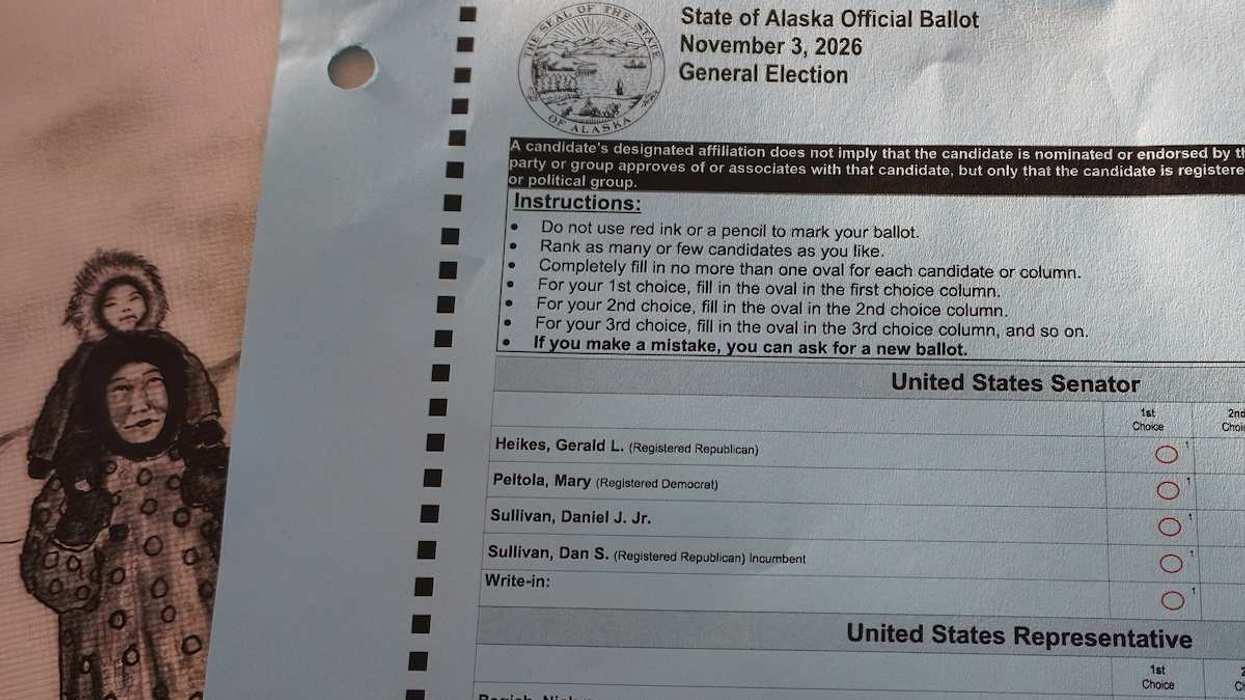
Americans vote tomorrow in midterm elections that could hand Democrats control of Congress. For more than a year, the party has been favored to win the House. But recent polls over the last few months show that the Senate, once considered out of reach, is within reach for Democrats as well.
Republicans currently hold 53 seats, meaning Democrats need a net gain of four to take control and overcome any potential tie-breaking vote by Vice President JD Vance. That’s a remarkable turnaround from their bruising 2024 losses, especially given the states at the center of the Senate battle – Alaska, Kansas, Texas, Ohio, and Iowa – were ones Republicans easily won in Senate and presidential contests in recent years.
But Republicans have faced a tough political environment. The president’s party typically loses ground in midterm elections, and Republicans face additional global headwinds that have shaped voters’ attitudes. We’re breaking down the three main issues that could help decide tomorrow’s elections: the cost of living, Israel, and AI.
Cost of living
Rising costs of living have become an issue around the world, with sweeping protests in Europe and Asia, and topping voters’ concerns ahead of the midterms. Since the US and Israel went to war with Iran in February, Tehran’s chokehold on the Strait of Hormuz has sent fuel costs soaring. Before the war began in February, a gallon of gas cost around $3 on average in the US. Today? $4.20. Moody’s estimates the war has cost the average American household an additional $2,000.
The economy has long ranked as a top issue for American voters, and something Donald Trump himself campaigned on in 2025. In fact, by ad spending, affordability is the single biggest issue in the midterms, with all parties spending a combined $801 million on affordability-related ads, according to analysis from AdInsight.
But polls show voters in large part blame Trump and the war for the rising costs, creating an uphill battle for Republicans in contests across the country. As a result, Republicans in at least 12 competitive races have tried to distance themselves from the president on Iran – calling for an end to the conflict or voting to curb Trump’s war powers. Democrats, meanwhile, have capitalized on this, using ads and other messaging to clearly link rising costs to the president’s war in voters’ minds. Now, 39% of voters trust Democrats to handle cost-of-living concerns, while just 25% trust Republicans to do so.
Meanwhile, Trump has tried to assuage voters’ cost-of-living concerns with plans to import ground beef and reduce costs at home, and convince European leaders to release diesel stockpiles to lower global fuel prices. But the efforts haven’t had a significant impact on polling, and it may be too little, too late.
Israel
In the three years since the October 7, 2023, Hamas attacks and the war in Gaza, Americans on both sides of the aisle have grown increasingly critical of Israel. What was once a bipartisan consensus on supporting the Jewish state has become a major dividing line inside the Democratic Party. In 2022, nearly 35% of Democrats had a favorable view of the Israeli government. Now, that number is as low as 16%. For Democratic candidates, support for Israel has become a political “litmus test,” as Lincoln Mitchell, a political science professor at Columbia University, explained to GZERO this summer.
In many competitive primaries, younger, more progressive voters have pushed back against the party’s traditionally pro-Israel establishment. Nowhere has that divide been clearer than in Michigan, where progressive Democrat Abdul El-Sayed defeated centrist, establishment-backed Rep. Haley Stevens in a bitter Senate primary. El-Sayed, who has called Israel’s actions in Gaza a “genocide” and demanded an end to US military aid, won despite a record $30 million in spending against him by AIPAC, the most powerful pro-Israel lobbying organization, and its affiliated groups.
The issue poses an electoral dilemma for Democrats on Tuesday. While taking a harder line on Israel may energize young progressive voters, candidates also risk alienating more moderate Democrats and pro-Israel constituents. Republicans in government, meanwhile, largely remain supportive of Israel. This could come to a head in Michigan. In a major twist this weekend, Stevens endorsed Republican candidate Mike Rogers because of El-Sayed’s views on Israel, potentially drawing votes away from El-Sayed among moderate Democrats in the state.
AI
The rapid expansion of AI and data centers has sparked public backlash in Europe and North America, particularly in the US. Seventy-one percent of voters oppose building data centers in their area, with many concerned they might drive up energy costs. The concern has driven ballot initiatives across the country: according to one analysis, voters will weigh in on 40 data center-related measures, many of which propose bans or moratoriums on construction. In Ohio, for example, half of the data center-related measures ask voters if they’d like to halt development.
Voters also fear AI’s impact on the workforce: 52% now say they are more concerned than excited about the technology, up from 37% in 2021. It will also likely be on voters’ minds as they head to the polls, with 30% considering the issue “extremely important” and 23% considering it “very important.”
The president, meanwhile, remains a vocal proponent of the technology. He has rejected calls for binding AI regulation, instead calling for “self-regulation” overseen by a “smart president.” In August, he posted to his social platform Truth Social that “the only reason that communities throughout the U.S.A. should not want Data Centers is if they want to end up being backward and poor.”
Several Republicans have sought to put daylight between themselves and the Trump administration, particularly when it comes to data centers. In Ohio, Vivek Ramaswamy, who is running for governor, proposed requiring data centers to cover rising energy costs. In Colorado, Rep. Gabe Evans, who is running for re-election, introduced bipartisan legislation – the Ratepayers Protection Act – that would prevent costs of data centers from being passed on in energy bills to communities. And in Tennessee, Rep. Tim Burchett, also running for re-election, publicly rebuked Trump’s data center comments, saying, “I guess I’m backward and poor.”
But confidence in both Democrats and Republicans to handle AI is low: 39% of voters say neither party can be trusted to do a good job.