
Skip to content
Search

Latest Stories

Middle East

GZERO news and analysis about the Middle East

Presented by

Podcast: Lebanon Post-Blast: Rage in the Streets of Beirut

Podcast: Lebanon Post-Blast: Rage in the Streets of Beirut

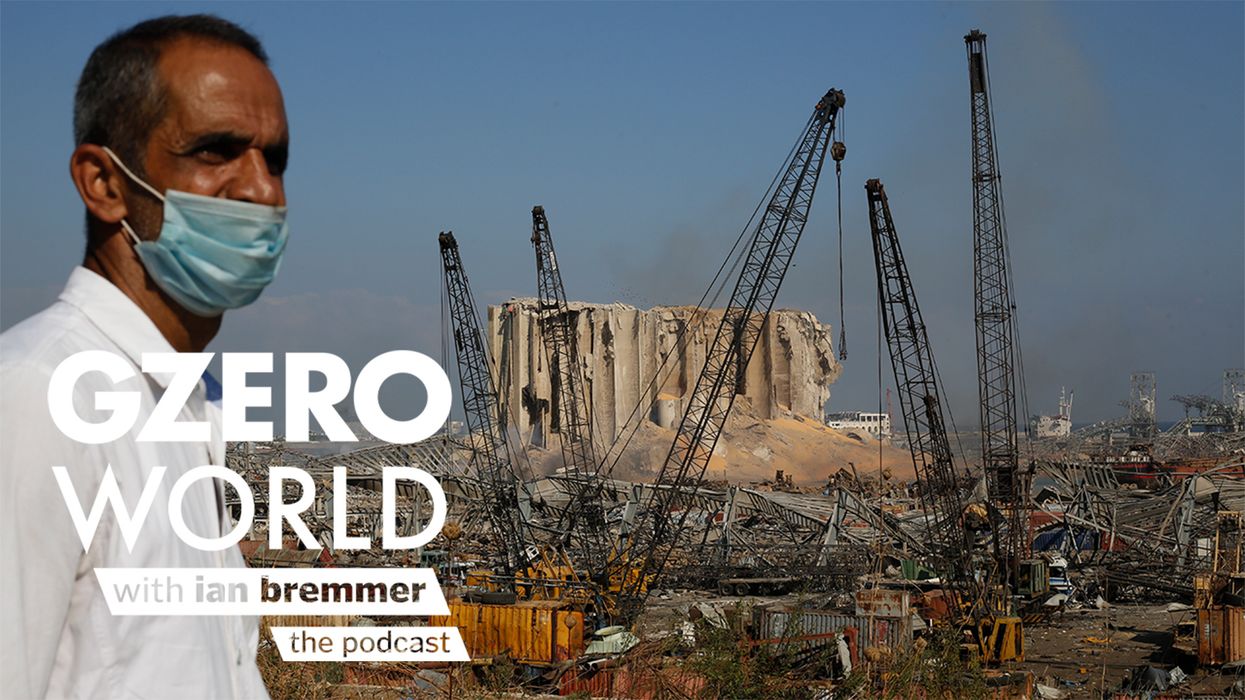
Listen: It was a blast heard around the world, an explosion so big it literally sent shockwaves through the streets of Beirut. More than 200 were killed, thousands injured, and hundreds of thousands left homeless. On this GZERO World podcast, Ian Bremmer examines the aftermath and fallout of the catastrophe in Lebanon, a nation that was already aflame in political turmoil. Ian Bremmer talks to acclaimed journalist Kim Ghattas, author of Black Wave: Saudi Arabia, Iran, and the Forty-Year Rivalry That Unraveled Culture, Religion, and Collective Memory in the Middle East, about the road ahead for Lebanon and how this moment could impact the region.

Transcript

Listen: It was a blast heard around the world, an explosion so big it literally sent shockwaves through the streets of Beirut. More than 200 were killed, thousands injured, and hundreds of thousands left homeless. On this GZERO World podcast, Ian Bremmer examines the aftermath and fallout of the catastrophe in Lebanon, a nation that was already aflame in political turmoil. Ian Bremmer talks to acclaimed journalist Kim Ghattas, author of Black Wave: Saudi Arabia, Iran, and the Forty-Year Rivalry That Unraveled Culture, Religion, and Collective Memory in the Middle East, about the road ahead for Lebanon and how this moment could impact the region.

Subscribe to the GZERO World Podcast on Apple Podcasts, Spotify, Stitcher, or your preferred podcast platform to receive new episodes as soon as they're published.


Next Page

More from GZERO World Podcast

Iran conflict spirals, with no end in sight

The supreme leader is dead, the conflict is spreading, and US President Donald Trump still isn’t clear on who he wants to run Iran. With the fighting spreading to multiple fronts and Iran seeking a new leader, here’s what else you need to know about the conflict right now.

First and foremost, the Islamic Republic confirmed on Sunday that Supreme Leader Ali Khamenei is dead. Strikes on Saturday, believed to be from Israel, destroyed his compound. A three-person council will run the 90-million-strong country until a successor is named. Trump told ABC News on Sunday that the attack took out the leading contenders to replace Khamenei.

Keep reading...Show less

Supreme Leader Ali Khamenei is dead, the conflict is spreading, and US President Donald Trump still isn’t clear on who he wants to run Iran.... More >

How the Iran conflict could disrupt the world’s oil supply

Shipping in the world’s most crucial oil chokepoint has nearly ground to a halt after at least four tankers were targeted in Iran’s retaliation to US and Israeli strikes on Saturday. Tehran also hit oil facilities in Saudi Arabia and Qatar on Monday, raising the prospects that conflict cripples the global flow of oil.
Keep reading...Show less

Shipping in the world’s most crucial oil chokepoint has nearly ground to a halt after at least four tankers were targeted in Iran’s retaliation to US and Israeli strikes on Saturday.... More >

Almost everyone in Iran “just waiting for Ayatollah Khamenei to die”

Who comes next in Iran’s leadership succession? Karim Sadjadpour says “almost everyone” inside both Iranian society and the regime is waiting for 86-year-old Ayatollah Khamenei to die. Even elements of the Revolutionary Guards know “this status quo is not tenable,” but fear of surveillance and repression makes any internal coup too risky —for now.

That raises a bigger question: does Khamenei’s looming succession make external military action more tempting or more dangerous? Sadjadpour calls it a “51-49” decision. “Military attack is a gamble,” he warns.

For many in Iran, it’s a waiting game for how long Ayatollah Khamenei has left to live.... More >

The US and Israel struck Iran. What happens next?

The US and Israel struck several sites in coordinated attacks across Iran this morning. The total number of casualties across Iran is also unknown, though one of the missiles hit a girls’ school in Iran, reportedly killing 53 people. The country is under a near-total internet blackout.

In response, Tehran has launched airstrikes at Israel, as well as US bases throughout the region, including in Bahrain, Kuwait, Qatar, and the United Arab Emirates. Though many of the strikes have been intercepted, shrapnel has caused some damage. One Iranian missile that was likely intended to hit Israel landed instead in Syria, killing four.

Ian Bremmer gives his analysis of the situation, which he calls a “war of regime change.” The United States is “a uniquely powerful global actor militarily, and now has a president who feels pretty unconstrained in using that military directly for political outcomes of his choosing,” Ian explains. “That clearly can cause a lot of disruption.”

What happens next? The fighting could escalate into a larger conflict. The US and Israel are reportedly planning several days of intensive strikes, with the Israeli Defense Forces calling up 70,000 reservists. There are also questions now as to whether Iran’s retaliatory strikes on US bases in several Middle East states prompt more countries to get involved.

But the most pressing question at this time is about Supreme Leader Ali Khamenei. As of the moment of this publication, his whereabouts and condition are unknown following the strike on his compound. Iran’s foreign minister said Khamenei is alive “as far as I know,” but there are reports that several senior regime leaders have been killed. In a video posted on social media on Saturday, US President Donald Trump urged Iranian citizens to topple the regime.

“When we are finished, take over your government,” Trump said. “This will be, probably, your only chance for generations.”

The United Nations Security Council is set to hold an emergency session at 4 pm ET today, after requests from Iran, Bahrain, France, and other countries. Iran’s foreign minister argued that the United States had violated international law in attacking Iran.

What happens if Khamenei is killed? The death of the 86-year-old would be a huge shock to the country’s political system, Eurasia Group’s Iran expert Greg Brew told us earlier this month. However, it wouldn’t necessarily lead to a long-term shift in the regime.

“Overall, however, it may not change much – at least not at first,” said Brew. “The rest of the leadership would manage a transition to a new supreme leader, and much of the Islamic Republic would probably continue to function as it has done for years. In the medium-term, however, Khamenei’s disappearance would trigger changes within the system, as the military and Islamic Revolutionary Guard Corps assume more power over decision-making while the clerics – including Khamenei’s replacement – take a back seat.”

Reza Pahlavi, the exiled son of the former Iranian shah, has been saying for months that the Iranian people want him to return to the country and lead it. Whether this is a realistic option is unclear.

Back up: Why is Trump doing this? In his video, Trump described Iran, as well as its Middle East proxies, as a major threat to the United States, saying they are the “number one state sponsor of terror.” He reiterated that he cannot let the Islamic Republic have a nuclear weapon. The US leader added that he was heeding calls from the Iranian people who wanted to see Khamenei’s regime fall.

Trump, who had been threatening strikes against Iran since and rapidly expanding the US military presence in the region, may also be seizing an opportune moment to destroy one of the US’s greatest foes. The Islamic Republic is weaker than ever: its economy has been decimated by sanctions and mismanagement, its air defenses have been depleted from last summer’s 12-day war with Israel and the US, its own people have been in open revolt against the regime, and its regional proxies – such as Hamas and Hezbollah – are battered and bruised.

One concern for Trump is whether these strikes will repel the isolationist portion of the MAGA coalition. The US president acknowledged that “the lives of courageous American heroes may be lost,” but tried to mollify any potential opposition by saying, “We’re doing this not for now, we’re doing this for the future.” Nonetheless, opposition is already emerging: Sen. Rand Paul, a Republican from Kentucky, criticized this morning’s strikes, saying Trump didn’t have the approval from Congress needed to initiate a war.

What’s the reaction been in the Middle East? Several US allies in the Gulf, including Saudi Arabia, Qatar, and Oman, had been urging Washington not to strike Iran, fearful that it would spark a regional war. Tehran’s reserves of close-range ballistic missiles, which cannot reach Israel but can get to the US bases in the Gulf, add another layer of concern for countries in the region.

After the Islamic Republic fired at some of those bases today, there are questions over whether those countries will now get involved in this conflict. Thus far, the focus of these Gulf states has been on shooting down missiles fired in their direction, rather than in any offensive moves.

The US and Israel struck several sites in coordinated attacks across Iran this morning. The total number of casualties across Iran is also unknown, though one of the missiles hit a girls’ school in... More >

GZERO Podcasts

The US and Israel have launched a series of strikes against Iran at a moment when the Islamic Regime is at its weakest. Ian Bremmer spoke with Iran expert Karim Sadjadpour in Munich earlier this... More >

Listen: What does global energy transition look like in a time of major geopolitical change, including rebalancing of trade? In this special episode of "Energized: The Future of Energy,” host JJ... More >

Creating artificial human retinas in zero gravity. Mining rare minerals on the moon. There seems to be no limit to what could be possible if we continue to take our more important industries to... More >

Indian Prime Minister Narendra Modi and Canadian Prime Minister Mark Carney struck a series of deals during a meeting in New Delhi on Monday, including a 10-year nuclear energy deal under which... More >

"We are coming out of a period of uncertainty," says David Bailin, Chief Investment Officer at Citi Global Wealth. In the latest Living Beyond Borders podcast, Bailin and Ian Bremmer discuss what we... More >

In this episode of The Ripple Effect: Investing in Life Sciences, host Dan Riskin speaks with Patrick Horber, President of Novartis International, and David Gluckman, Vice Chairman of Investment... More >