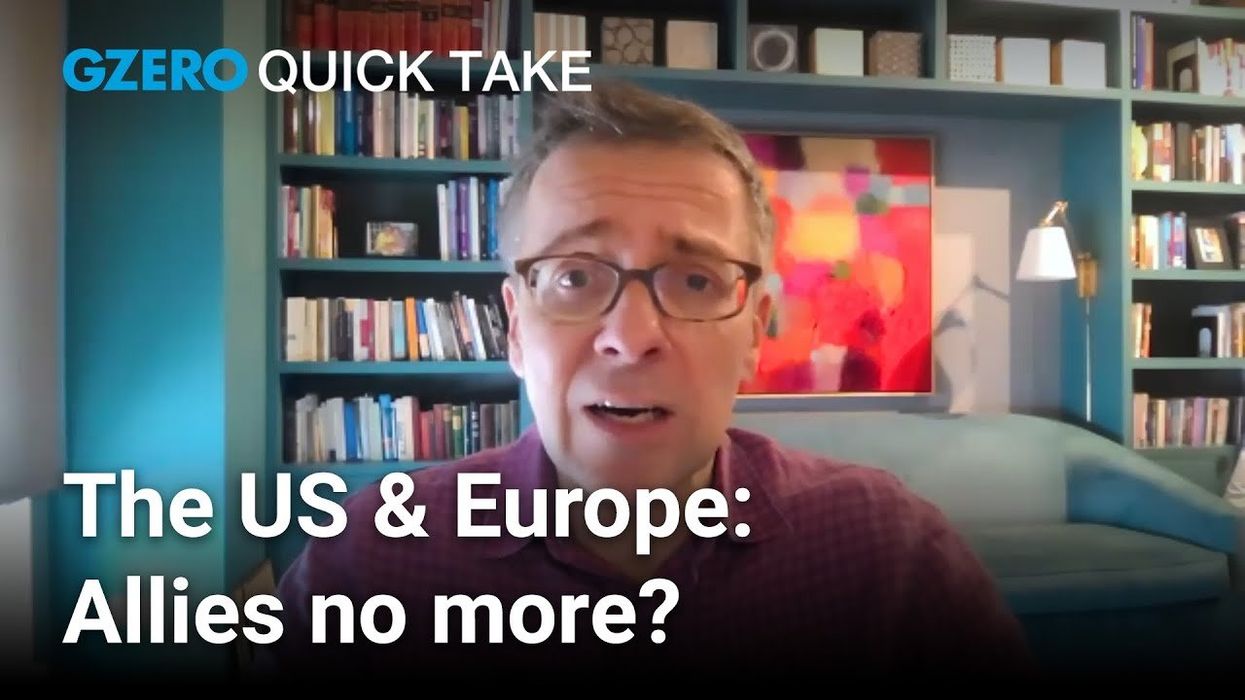
Is Europe in trouble as the US pulls away?
March 24, 2025
Ian Bremmer, political scientist and president of Eurasia Group and GZERO Media, shares insights on global political events.
Presented by

Ian Bremmer's Quick Take: I want to talk about the transatlantic relationship. The US relationship with Europe. Because of all of the geopolitics in the world, this is the one that I think has been impacted in a permanent and structural way in the first two months of the Trump administration. I wouldn't say that, for example, look at the Middle East and US relations with Israel, the Saudis, the Emiratis, the rest of the Gulf States, frankly, all very comfortable with Trump. If there's a significant change, I would say it's incrementally more engaged, and in terms of worldview than under the Biden administration. Japan, South Korea, Australia, India, you look at Asia relations and certainly Trump and the US on trade worrying them, making them sort of react in a more defensive posture. Seeing how much, how more quickly, they can get something to the US that will lead to trying to diffuse potential conflict there. But not radically different from the way they thought about the United States in 2017 in the first Trump term.
Mexico, Canada, Panama, here you've got countries that are facing very significant challenges from the United States, but also ultimately understand that they have no other options. Now, in Canada, that's a bigger fight because there are elections coming up at the end of April. But after those elections are over, I certainly expect that they will move quickly to try to ensure that ongoing relations are functional and stable. That's already true for the Mexican government with a president who has 85% approval, can do pretty much everything necessary to ensure that US-Mexico relations aren't dramatically impacted by everything Trump is demanding. So that's everywhere else.
But in Europe, that's just not the case. Three different reasons why the Europeans are facing a much more permanent impact. The first is on the trade side, like everybody else, and trade is well within the European Union's competency. They understand that they have leverage. If the Americans are going to hit them with significant tariffs, they're going to hit back with the same numbers. But that doesn't mean it's going to be relatively difficult and take a long time to resolve it, as opposed to places that are much weaker where they just fold quickly to the United States. Okay, fair enough. But still, that's not all that dramatically different from first term. Second point is there's a war going on in Ukraine, and the United States has made it very clear that they want to engage, to re-engage with Putin, who is Europe's principal enemy. And they're going to do that irrespective of how much the Europeans oppose it, and they're not going to take any European input in those conversations.
Trump would like a rapprochement with Russia to include a Ukrainian ceasefire. But if that doesn't happen, he is oriented towards blaming the Ukrainians for it, towards taking Kremlin talking points on Ukraine not really being a country, and then on moving to ensure that US-Russia relations are functional again. All of that is deeply concerning, is existentially concerning, particularly for a bunch of European countries that are on the front lines spending a lot more in defense, not because the Americans are telling them to, but because they're worried about Russia themselves, feel like they have to be more independent. Then finally, because Europe is the supranational political experiment that relies most on common values and rule of law, and the United States under Trump is undoing that component of the US-led order specifically.
I wouldn't necessarily say that about collective security or existing alliances and willingness to provide some sort of defense umbrella, but I would certainly say that in terms of rule of law and territorial integrity. And here, the fact that the United States no longer really cares about territorial integrity, is prepared to tell Denmark, "Hey, you're not a good ally. You're not defending Greenland. We're interested in moving forward ourselves, and we don't care how you've treated us historically. We're going to send our leaders and we're going to cut our own deal inside your territory." That's exactly the way the Germans felt when JD Vance said that he wanted to engage directly with the Alternatives für Deutschland, who the Germans consider to be a neo-Nazi party.
Everything that's core to the Europeans in their statehood and in the EU, the United States under Trump is on the other side of that, and it's increasingly conflictual. It's directly adversarial. And so I would say number one, the Europeans are aware of these problems. Number two, they're taking them late, but nonetheless finally very seriously. And so they understand that the Europeans are going to have to create an independent strategy for their own self-defense, for their national security, for their political stability, for their democracies, and they have to do that outside of the United States. In fact, they have to do that and defend themselves against the United States.
Now that reality doesn't mean they're going to be successful. And indeed, the more summits I see on Ukraine, frankly the less I have been convinced that the Europeans will be able to do enough, quick enough to really help Ukraine dramatically cut a better deal with the Russian Federation that is very uninterested in doing anything that is sustainable for the Ukrainians long term. It makes me worry that the EU longer term is not fit for purpose in an environment where the principle, the most powerful actors don't care about rule of law. The United States, China, and for Europe, Russia right on their borders. So for all of those reasons, I mean, the European markets have gone up recently. European growth expectations have gone up because the Germans and others are planning on spending a lot more, that's short-term. Long-term here. I worry that the Europeans are in an awful lot of trouble. So something we'll be focusing on very closely going forward over the coming weeks and months. I hope you all are well, and I'll talk to you all real soon.


Keep up with what’s going on around the world - and why it matters.