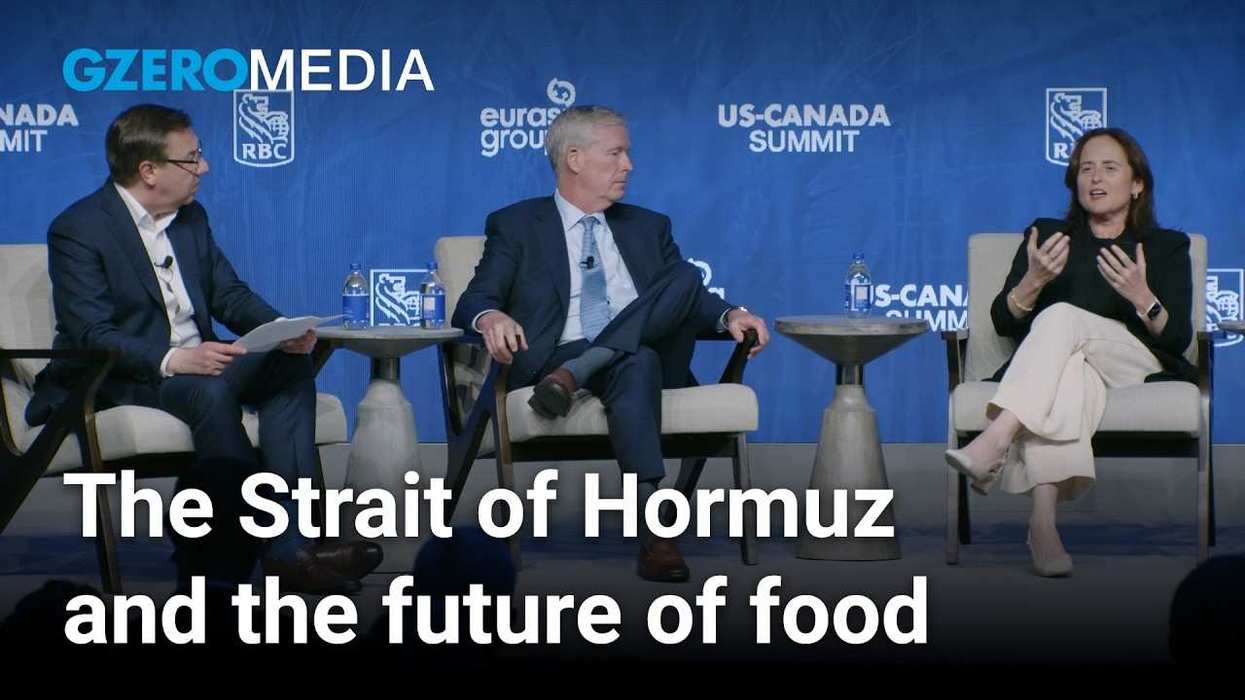
How will the Strait of Hormuz's closure impact food supply?
June 26, 2026
Global Stage LIVE from United Nations WATCH REPLAY
Explore GZERO’s past virtual conversations, featuring global experts on the world's urgent issues.
Presented by
The Strait of Hormuz may be the world's most important oil chokepoint, but its closure is sending shockwaves through something even more fundamental: the global food supply.
At the 2026 US-Canada Summit in Toronto, hosted by Eurasia Group and RBC, GZERO's Tony Maciulis sat down with Alzbeta Klein, CEO and Director General of the International Fertilizer Association, as part of a larger panel discussing food insecurity, to trace the chain of consequences that begins with blocked fertilizer shipments in the strait and impacts the global food supply months from now.
Klein breaks down several overlapping transmission mechanisms already in motion. Early strikes on LNG plants in Qatar cut gas supplies to India, Bangladesh, and Pakistan, forcing those countries to curtail nitrogen fertilizer production while simultaneously driving up gas prices in Europe, where plants have scaled back output. The result: less nitrogen reaching farmers globally, at higher prices, with no compensating rise in commodity prices to offset the cost. The response from farmers is already visible across the globe. Australia has announced a roughly 20% reduction in wheat planting, shifting toward soybeans that require less nitrogen. Klein warns this substitution effect playing out across farming economies worldwide means a meaningful harvest shortfall is already locked in, roughly six to nine months down the line impacting the global food supply.






Keep up with what’s going on around the world - and why it matters.