Four days after major media outlets called the US presidential election race in Joe Biden's favor, Donald Trump and the GOP leadership haven't conceded the president's defeat. Trump insists that the election was stolen from him.
The votes that put Biden ahead, he says, were either cast or counted illegally. And though he has provided no evidence to support these claims so far, his lawyers are pursuing his legal right to try. Meanwhile, Attorney General William Barr, departing from the Justice Department's established tradition of staying out of electoral politics, has authorized his department to look into allegations of fraud. Republican Senate Majority leader Mitch McConnell has refused to recognize Biden as president-elect and supports the President's right to go to court.
Does Trump even have a case? Almost certainly not. In an election involving close to 150 million people there will always be individual incidents of misplaced ballots, uncounted votes, or even small-scale electoral fraud. Some of that will come to light in the next few days and weeks.
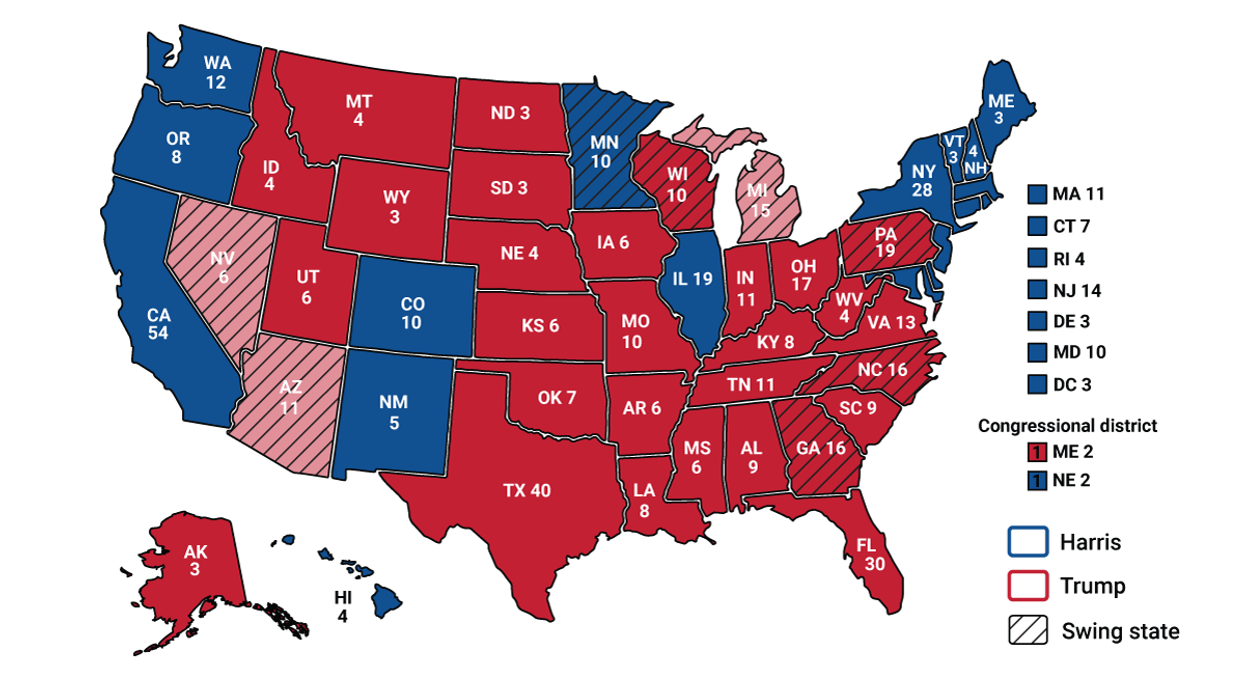
But there's also basic math: what the Trump team needs to prove is not that one dead person in Nevada voted for Biden or that thirteen votes were lost in Pennsylvania, or that election workers misread a handful of ballots in Arizona. Trump's lawyers need to prove that there was enough voter fraud or counting errors to overturn Biden's lead in half a dozen battleground states where the Biden/Harris margin of victory runs to thousands or even tens of thousands of votes. That would mean widespread malfeasance or mistakes in multiple states.
Just in the key states that Trump is focusing on – Arizona, Michigan, Nevada, Pennsylvania, and Wisconsin – Biden's total margin of victory is about 300,000 votes. That's a lot of dead people and lost ballots. By historical standards, the chances of proving fraud on this level are next to zero. Even some ordinarily staunch defenders of Trump don't think it's likely.
Given all that, why is Trump doing this – and why might the GOP be going along with it?
Trump hates to lose. The president has said so many times. The word "loser" figures prominently among his favorite forms of personal insult. Donald Trump's personal brand is built on the principle of fighting to the bitter end. It's what he does and who he is.
It's also an effective political strategy. A losing legal argument can still be a winning political one. The politics of grievance against a "rigged" system are also at the very core of Trump's political appeal. The narrative of a stolen election that – irrespective of court findings – casts doubt on the legitimacy of Biden's presidency will sustain his immense political influence over the Republican Party in the coming years. Nearly three-quarters of GOP voters already say the election was not free or fair. That's an astounding figure in a country that has long regarded itself as a beacon of democracy.
And for the Republican party? For one thing, supporting Trump's right to legal remedy relieves senior Republicans -- who still fear Trump's political wrath -- of the political burden of breaking the bad news to Trump, by forcing judges to do it for them. Second, in the immediate term, nurturing a sense of grievance and anger about Biden's win can help to get GOP voters to the polls in January in Georgia, where two crucial runoff elections will determine majority control of the Senate.
When might all of this end? The election will be officially decided when the electoral college casts votes in mid-December. Court cases will likely be resolved before then. The inauguration of Joe Biden and Kamala Harris would then go ahead on January 20, 2021.
But the powerful political narrative of a stolen election, on the other hand, will persist. That's because President Trump is highly unlikely to renounce it, no matter what happens in court, and because tens of millions of Americans will believe him.