Over the last decade, we’ve gotten used to seeing some of the world’s largest companies weighing in on hot-button social and political issues.
Following George Floyd’s murder by a Minneapolis police officer, large numbers of big multinationals expressed support for the Black Lives Matter movement. Nike drew ire from conservatives who demanded Colin Kaepernick be blacklisted over his protest of racial injustice. Last April, Republicans vowed retribution against Major League Baseball over its decision to move its All-Star game from Atlanta to Denver in protest of Georgia’s restrictive new voting law. And in the summer, Heineken sparked a boycott when it came out in favor of the highly controversial *checks notes* Covid vaccines.
Most recently, you’ll remember how in the aftermath of Jan. 6, many major corporations and industry groups issued statements condemning the insurrection and pledging to suspend donations to the “Sedition Caucus,” the 147 Republican members of Congress who had voted to overturn the 2020 presidential election.
Want to understand the world a little better? Subscribe to GZERO Daily by Ian Bremmer for free and get new posts delivered to your inbox every week.
(Sure enough, that didn’t last. According to a watchdog group, many companies have since reneged on their promise.)
The initial reaction to Jan. 6—which featured brands like AXE, the deodorant maker, voicing support for the peaceful transition of power—is a bellwether of a much bigger trend in American life: extreme polarization making it harder and harder for companies to keep politics out of business.
As Red vs. Blue divisions have grown to become a matter not just of disagreement but of personal enmity, it’s gotten much more difficult for corporates to steer clear of the nation’s culture wars. Why? Because Americans are demanding that the companies they buy from and work for take a strong stance—the “correct” stance—on social and political issues they care about.
Part of this phenomenon is a natural outgrowth of our country’s growing polarization, which has spilled out the realm of electoral politics and infected all aspects of everyday life. Yet some of it is also due to a generational shift. Millennials and Gen Zers pose a triple threat to brands: many are woke, expect corporates to align with them on values, and know how to leverage their voices and their pocketbooks to punish them when they don’t. They are able to get away with it in large part thanks to the amplifying power of social media and, in recent times, to their newfound bargaining power brought about by the Great Resignation.
For most companies, taking sides in political debates is risky, a double-edged sword. Because our country is so divided on everything, speaking up often means alienating a non-negligible proportion of your consumers, employees, and investors. Americans of both parties (that’s right, it’s not just woke lefties) are eager to cancel brands they disagree with on issues that have nothing to do with the goods and services these companies provide. According to a recent study, 64% of consumers will buy or boycott a brand solely because of its position on a social or political issue.
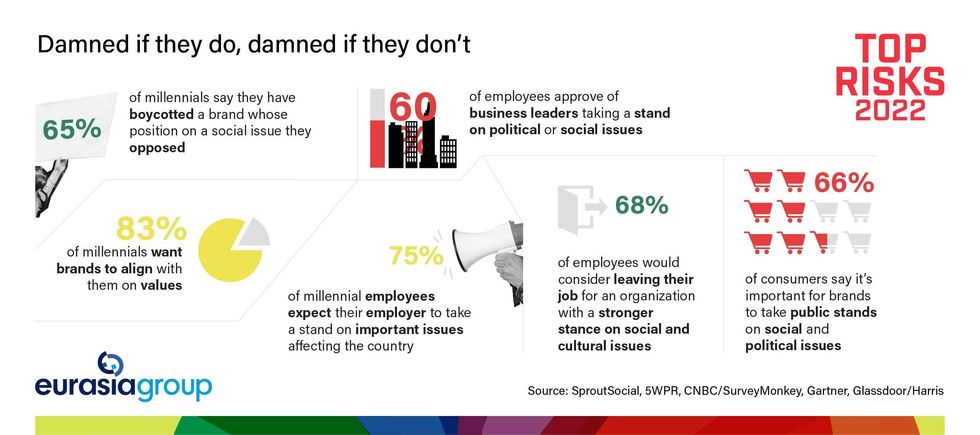 Damned if they do, damned if they don'tSproutSocial, 5WPR, CNVC/SurveyMonkey, Gartner, Glassdoor/Harris
But not taking sides is often riskier, because neutrality is viewed as complicity. If a company takes a stand against abortion bans, it’ll face fury from conservatives. If it comes out in favor of abortion bans, it’ll invite backlash from liberals and progressives. But if it doesn’t take a stand at all, it could take flak from everyone. The blowback can be severe even for companies that put forth certain stances but fail to back them up with credible action (aka virtue signaling).
The upshot? Politics has become so toxic and so insidious that no matter how brands position themselves on a given issue, they are angering a big chunk of their consumers and employees.
This year features a particularly mined calendar, full of ready-made flashpoints like the Beijing Winter Olympics and the US midterm elections. The abortion law in Texas, the voting law in Georgia, the bathroom bill in North Carolina, the transgender law in Arkansas—these are issues where Americans will be looking at corporates and asking where they stand.
They’d better have an answer.
🔔 And if you haven't already, don't forget to subscribe to my free newsletter, GZERO Daily by Ian Bremmer, to get new posts delivered to your inbox.