Can AI help doctors act more human?
June 04, 2024
Global Stage LIVE from United Nations WATCH REPLAY
GZERO AI is our weekly video series intended to help you keep up and make sense of the latest news on the AI revolution.
Presented by
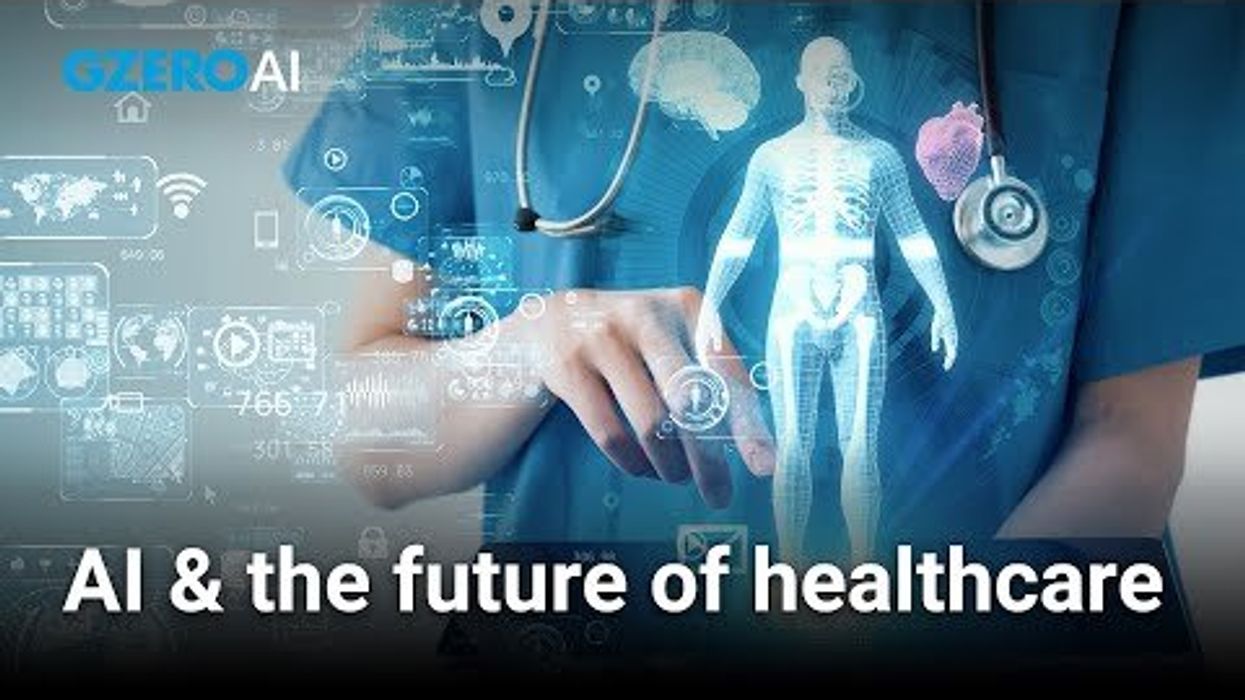
In this episode of GZERO AI, Taylor Owen, host of the Machines Like Us podcast, explores the rather surprising role artificial intelligence could play in the healthcare industry's efforts to reconnect with humanity. Doctors have become busier and are spending less time with their patients, but AI has been touted as a solution to enable them to foster more human connections.
So, if there's one sector of our economy and our society that could use some real transformation, it's our healthcare system. No matter where you live around the world, no matter what your healthcare financial model is, it is almost certainly letting you down in some way. And at the core of this is the relationship between a doctor and a patient.
As doctors have become busier and they've been tasked with more and more responsibilities, they are spending less time with us, their patients. In the US, the average doctor's appointment is only 7 minutes long. In South Korea, it's 2 minutes. And in the US, one of the consequences of this is that there are 12 million significant misdiagnoses each year, 800,000 of which result in death or disability.
Cardiologist, medical researcher, and author, Eric Topol, says, "Medicine has become inhuman." Paradoxically, though, Topol thinks AI could make it more human. In its most basic form, this means bringing AI into the patient-doctor conversation. This could mean AI transcribing our conversations and allowing a doctor to pay attention to us, rather than typing on a computer screen. It also opens up the range of capacities that they could be assisted with by AI. This could be making our future appointments, following up on our treatment plans, or perhaps more powerfully, helping with diagnoses itself. A doctor has very limited views into our current condition. And AI might have far greater visibility. Just take radiology scans. Topol says an AI could add superhuman eyes to the doctor's capacity. When a radiology scan is ordered, the radiologist is typically told to look for one specific thing, but an AI could look for everything, and would have access to potentially rich and detailed views of our health history. Retina scans are another example. An AI can detect everything from diabetes, to kidney disease, to potentially Alzheimer's, just by looking in our eyes.
Another powerful potential here is in forecasting the future. The healthcare profession is not just about diagnosing our current conditions but should be about helping protect us from potential future conditions. And an AI can help process reams of data about our body, our health history, our family history, our genetics, and potentially predict what we are most susceptible to in the future. So, could we potentially use AI 20 years before someone evolves into a condition, such as Alzheimer's, and to help develop treatment and medical and lifestyle adjustment plans accordingly? The potential really is there.
And one thing seems overwhelmingly clear, that this is going to utterly transform what it means to be a doctor. Doctors will not have to memorize things and repeat by rote conditions from a textbook, as we currently train them. But instead, we might screen doctors for their human relationships, for their emotional intelligence, and for their empathy. As Topol says, this might ultimately mean a shift in the system from curing to healing.
I'm Taylor Owen, and thanks for watching.


Keep up with what’s going on around the world - and why it matters.