GZERO Summit on geotech: US-China tech Cold War or “stable tension”?
December 10, 2020
Explore GZERO’s past virtual conversations, featuring global experts on the world's urgent issues.
Presented by
Just a decade ago, China's rise — accomplished on the back of globalization — was welcomed by most of the world. That has changed over the past five years, especially in the realm of technology.
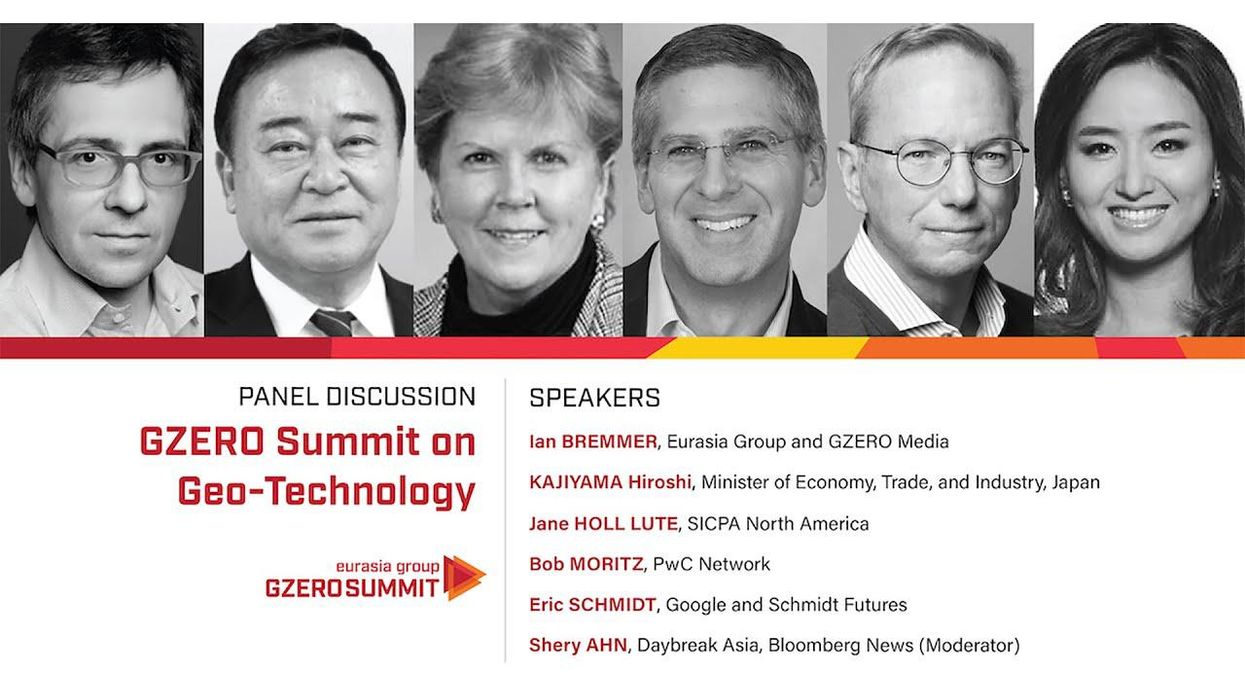
Now, China and the US, the world's two largest economies, are fighting what many are calling a "new Cold War" on tech, Eurasia Group President Ian Bremmer said during the panel discussion on geotech at the 2020 GZERO Summit in Japan.
Bremmer believes that this conflict won't end globalization but it is a confrontation that could dramatically change the trajectory of globalization as many countries are forced to pick sides on issues like artificial intelligence, data, or 5G.
One of these countries, for instance, is Japan, China's neighbor and a staunch US ally that is immensely worried about the growing tech confrontation between Beijing and Washington. For Japan, the coming "digital protectionism" is a huge threat, noted Hiroshi Kajiyama, the Japanese minister of economy, trade, and industry.
Former Google CEO Eric Schmidt prefers to call the US-China competition to lead global tech a "stable tension" in which both sides are racing to create global platforms. It's not a war because there still is some cooperation, but without trust because China plays by different rules.
Western players, including America, are used to playing by the rules set by institutions, but those matter much less than they used to in the era of cyber-awakening, when people have become empowered do do anything by the internet, suggested Jane Holl Lute, president and CEO of SIPCA North America.
For Bob Moritz, global chairman of the PwC Network, what Schmidt refers to as a "stable tension" is becoming increasingly volatile and often feels like it's approximating a Cold War, but at the end of the day companies around the world, and especially in China and the US, simply need to find ways to achieve digital transformation as Americans and Chinese battle it out in tech.
To do so, he said, firms must leverage the power of tech, innovation, and skills.
In the US-China tech rivalry, one major difference is strategy, or the lack of one. Bremmer said that China knows exactly what it wants to do on tech, while in the US everyone is angry about some aspect of Big Tech (size, profits, news on social media) but there's no single national strategy, which makes it harder for the US to compete with China.
As the "stable tension" continues over the next decade or two, Schmidt predicts that the power of new tech will favor a small number of players in the US and China, hollowing out the middle class of nations in favor of large, highly organized initiatives supported by big countries and economies. That geopolitical order will soon become unstable because the current system was set up to reflect a post-war liberal international order that doesn't call the shots anymore, Bremmer noted.
G-zero, he warned, cannot exist much longer before something breaks.
Watch the above video to learn more insights from our panelists on our vulnerability to cyber attacks, the promise of cyber deterrence, the US-China decoupling, how to fix US Big Tech, and why Europe can't create global tech platforms.






Keep up with what’s going on around the world - and why it matters.