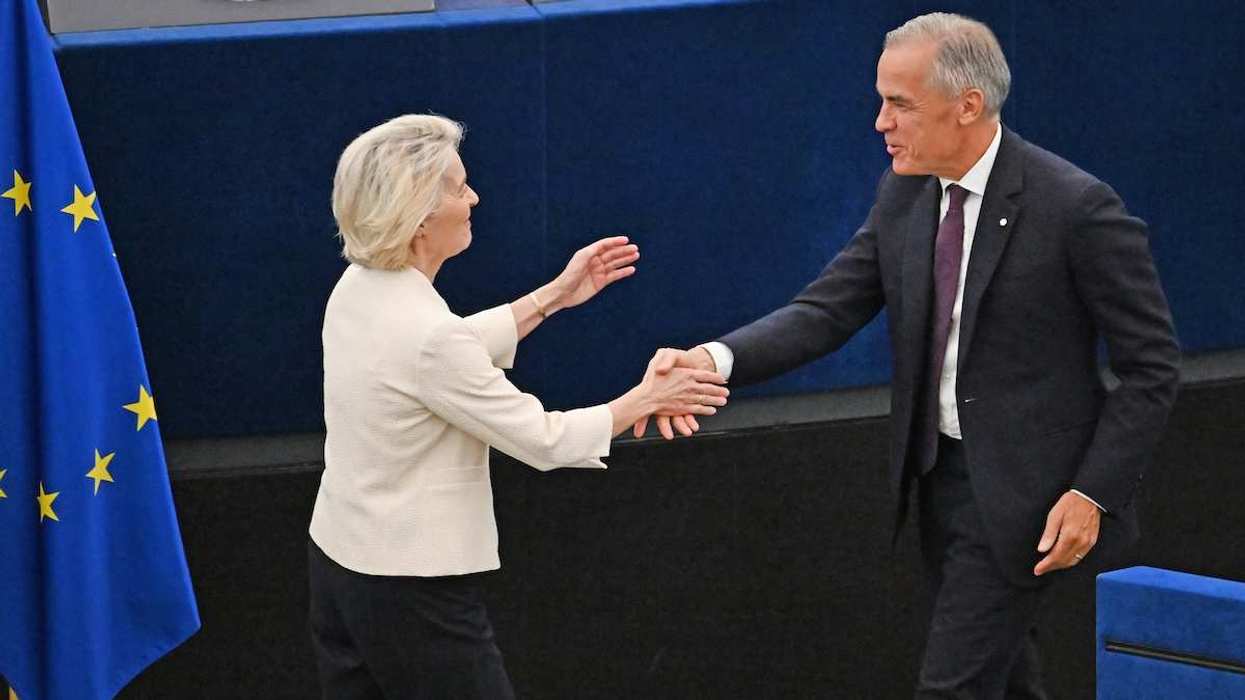
Toronto was the place to be this Tuesday for the second annual US-Canada Summit, co-hosted by Eurasia Group and BMO. The event featured a cross-border who’s who of speakers, including former Ambassador to Canada David Jacobson, Under Secretary for Policy at the US Department of Homeland Security Robert Silvers, Delaware Sen. Chris Coons, Illinois Gov. JB Pritzker, and Alaska Gov. Mike Dunleavy. Canadian political heavyweights included the premiers of Ontario and Saskatchewan, Doug Ford and Scott Moe, as well as federal cabinet ministers Mélanie Joly and Anita Anand. UN Climate Envoy and former governor of the Bank of England Mark Carney gave the closing keynote, and both the US and Canadian Ambassadors, David Cohen and Kirsten Hillman, shared the stage. A full list of speakers can be viewed here.
This year’s themes were the economy and security north and south of the 49th parallel. A major focus was the shift from global to regional blocs in international trade. While Eurasia Group President Ian Bremmer reassured the crowd that “Globalization is not falling apart. We are not heading to a Cold War here,” the Chairman of Cynosure Group and former Vice Chair of the Federal Reserve Randal Quarles took a more skeptical view. “If you’re a 55-year-old furniture maker from Hickory, North Carolina, globalization is never going to be better for you,” he said. The hollowing out of the working class and its impact on politics featured prominently, from the possibility of a second Trump administration to the recent right-wing victories in European Parliamentary elections.
Geopolitical tensions were also on the menu. Speakers touched on the wars in Ukraine and Israel, with Joly underscoring that US President Joe Biden’s proposal is “fundamental” to resolving the latter conflict. China loomed large in the conversation, with Silvers discussing how the US Department of Homeland Security is securing America’s ports by engaging Japanese firm Mitsui to replace Chinese cranes currently dominating port infrastructure. Ford emphasized that “China has the nickel market cornered. You know where the last safe haven is? Here in Ontario.” The Ontario premier concluded his presentation in his trademark style by giving the crowd his phone number (and no, we’re not going to publish it here).
Several speakers emphasized the need for energy security, including securing the supply chain for critical minerals necessary to build EVs. According to Dunleavy, as the world order shifts from a globalist to a regionalist perspective, North America can prosper by securing both its domestic supply and transformation. Moe emphasized that “If we get our energy security, we’ll have our food security, we’ll have our national security. But it starts with energy security.”
Finally, speakers discussed the post-COVID employment landscape and the impact of AI. Jonas Prising, chairman and CEO of ManpowerGroup, said that remote work is here to stay for the world’s knowledge workers. Eurasia Group released a new survey, which found that when asked about job automation, 17% of respondents believe almost all or most of their work could be done by machines, 28% say some of it, and 31% think not very much or almost none. The remaining 24% reported that they do not have a job.
Carney concluded the conference by underscoring the need for an inclusive economy and the importance of a growth mindset, particularly in Canada. “We need to build an economy for all Canadians. We can’t redistribute what we don’t have. We have less to spend because we’ve become less productive.”
Keeping the trains running on time was GZERO Publisher Evan Solomon, who served as event MC while Eurasia Group Advisors Gerald Butts and John Baird and Director Shari Freidman moderated several panels. And in true Canadian form, hockey was a running theme for the day, starting with BMO CEO Darryl White citing the Gordie Howe Bridge as a testament to the strength of the Canada-US trade relationship, and finishing up with Carney wishing the Oilers good luck in the Stanley Cup finals. Based on the way they played last night, they’ll be needing it.