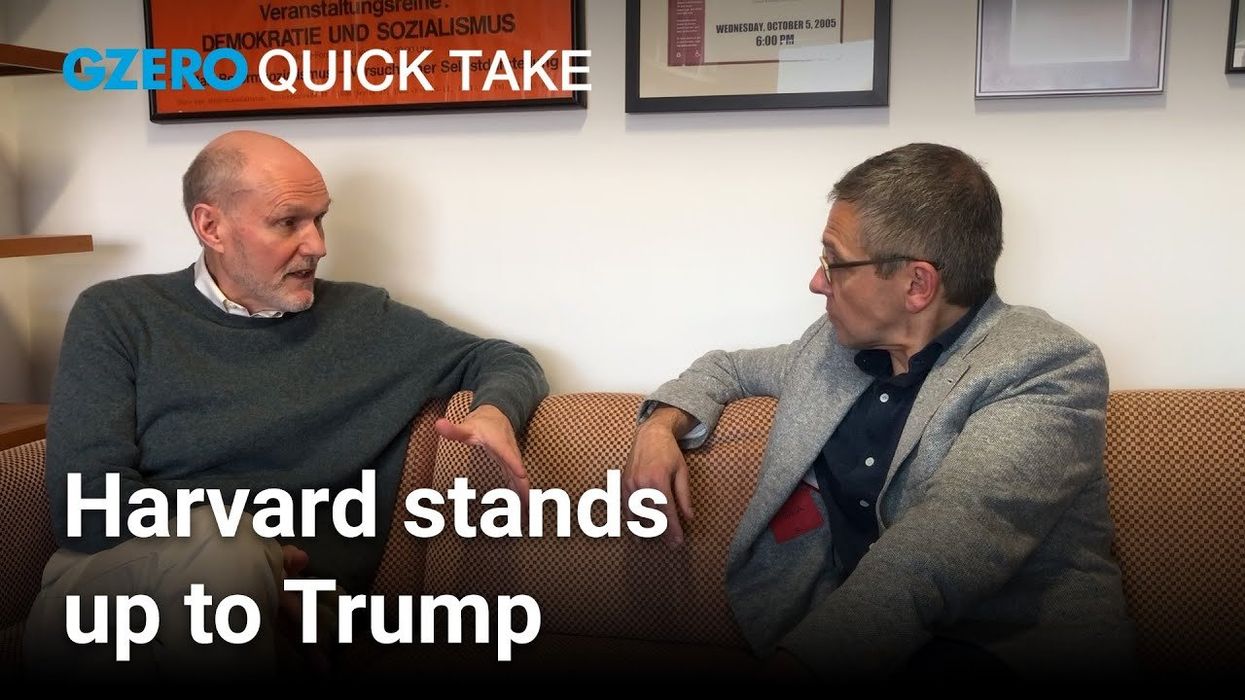
Inside the Harvard-Trump showdown
April 21, 2025
Global Stage LIVE from United Nations WATCH REPLAY
Ian Bremmer, political scientist and president of Eurasia Group and GZERO Media, shares insights on global political events.
Presented by

Ian Bremmer's Quick Take: Hey everybody. Ian Bremmer here and a Quick Take to kick off your week. I'm here at the Kennedy School at Harvard University, with my buddy Steve Walt.
Stephen Walt: Nice to see you, Ian.
Ian Bremmer:
And kind of ground zero for a lot of things happening geopolitically right now. How does it feel to be an independent variable?
Stephen Walt:
It feels better than it felt two or three weeks ago when many people at the university were worried whether we were going to actually bend the knee, cave in, give the administration what it wanted, do pretty much what Columbia did. And when the administration, perhaps mistakenly, sent that letter last week or so, and the president responded appropriately, I think there was a huge collective sigh of relief in the Harvard community. And the response that Harvard has gotten now, including from people who don't like Harvard, that someone finally stood up and said, "This is unacceptable," has been quite gratifying.
Ian Bremmer:
Harvard, huge endowment, not a poor campus, lots of influence in Boston community and around the world, but we're talking about billions of dollars of funding a year. We're talking maybe about not providing green cards for international students, lifeblood of the Kennedy School. What's at stake here, do you think?
Stephen Walt:
What's at stake is the presence of independent centers of thought in a free society. I mean, ultimately this is an attempt by the administration to bring Harvard, as the world's most prominent private university, under its control. If you read the letter carefully, they were basically wanting to have control over who got hired, control over what got taught, control over content of curriculum, control over admissions, in a variety of different ways. At which point the university is no longer independent. It has to get up every morning, say to itself, "Gee, what does the president think of what we're doing here?" And that means you don't have independent thought.
So two big problems. One is of course this is going to reduce scientific and technological progress in the United States in a whole series of areas.
Ian Bremmer:
Because that's so much of what the funding is actually going for.
Stephen Walt:
That's exactly right. Particularly medical research in particular. But it's also important in a free society you have a wide range of opinions, people who can challenge what's going on, and can challenge it from the right, challenge it from the left. One of my colleagues is one of the people who discovered the China shock, that a bunch of American jobs had gone to China due to previous economic policies. Something that of course Trump has played on, etc. So the point is you want lots of different ideas in a free society. You don't want the government to be able to control what people can teach, control what people can think, because how you get big mistakes. That's how you get Mao's Great Leap Forward because no one could criticize him, no one could challenge it, no one could even report what was happening. So there's actually more at stake than just scientific research here. It's also independent thought. Again, from across the political spectrum.
Ian Bremmer:
Does it feel like a resist moment on Harvard campus right now? Is that the kind of emotion that comes with it?
Stephen Walt:
This isn't a sort of let's go to the mattresses moment. The university did not want to have this fight. I think they were negotiating in good faith to see if they could come to an accommodation that would satisfy some of the concerns, including some legitimate concerns about whether or not a wide enough range of viewpoints was being expressed on campus. So I think they were negotiating in good faith.
The one advantage in the government's letter was it was so extreme that we had really no choice at this point. And I think the university now is going to go about its business. It's going to continue to teach. It's going to continue to do the research we want to do. It's going to have to do it with fewer resources. And I think we're all aware of the fact that there's going to have to be some costs paid by the faculty, unfortunately by our students and staff as well. And I think we're willing to do that.
Ian Bremmer:
And Harvard is well-known, has been ever since I was a kid, as the leading higher education facility in the United States and in the world. Also has gotten itself part of the political tribal fighting going on and we saw the former president basically ousted under that pressure in part. What do you think Harvard needs to do to be seen not just as the place that you want to go to university, but also as a place that is above the political fray?
Stephen Walt:
Well, because universities are islands of thought they're never going to be completely separate from the political fray. But I strongly believe in institutional neutrality, that the university should not be taking public positions on political issues that do not directly affect the university. So yes, we do have a public position on say, student visas. That's important for us. But we don't necessarily have a public position and shouldn't have a public position on the war in Ukraine or what to do about the Middle East or whether affirmative action was a good thing or not. Gay marriage maybe would be one that you'd say. It's not something where the university takes position. Individual faculty can say what they want and should, and they can disagree and they will, and they do. But the president of the university, the board of trustees, et cetera, they don't take a particular institutional position. I very much agree with that.
That doesn't mean the university won't be political and it won't be politicized as well. I think first of all, we need to reaffirm that, that our business is doing independent research and doing teaching, that we are open to a wide range of opinions, that we care about rigor and honesty and research. We can disagree. You can even be wrong. Scholars are wrong all the time. But they can't be dishonest. So we have very high standards and we're not advancing a particular agenda other than the pursuit of truth for the benefit of society as a whole.
Ian Bremmer:
So broader point before we close this down. State of democracy in the United States right now. What worries you most and where do you see the most structural strength and resilience?
Stephen Walt:
What worries me the most is the inability of a set of institutions that I would've thought 20 years ago were pretty rock solid to impede what looks to me like an authoritarian grab for power.
Ian Bremmer:
Are you talking about the judiciary?
Stephen Walt:
I'm talking about in part the judiciary.
Ian Bremmer:
Or Congress?
Stephen Walt:
And Congress and the fact that they've been willing to essentially suspend most of their checks and balances roles in recent years.
I am encouraged, unfortunately, by the degree to which opinion seems to be shifting as to whether or not the direction of the Trump administration is the right course for the country.
Ian Bremmer:
Specifically on trade at this point?
Stephen Walt:
Trade, one, economic effects.
Ian Bremmer:
Yeah.
Stephen Walt:
I think people are starting to be uncomfortable with the idea that we're gutting the engine of scientific progress that has driven American technological and scientific leadership for decades. That that's going to have consequences sooner rather than later. And I think people are nervous, not everybody, but people are nervous about turning what have been some of our closest friends in the world into adversaries or enemies. I mean, when you pick a fight with Canada, the greatest bit of geopolitical good fortune the United States ever had, having Canada as a neighbor. When you turn them into an adversary, that's not going to end well.
Ian Bremmer:
Steve Walt, always good to see you, my friend.
Stephen Walt:
Nice to see you. Take care.


Keep up with what’s going on around the world - and why it matters.