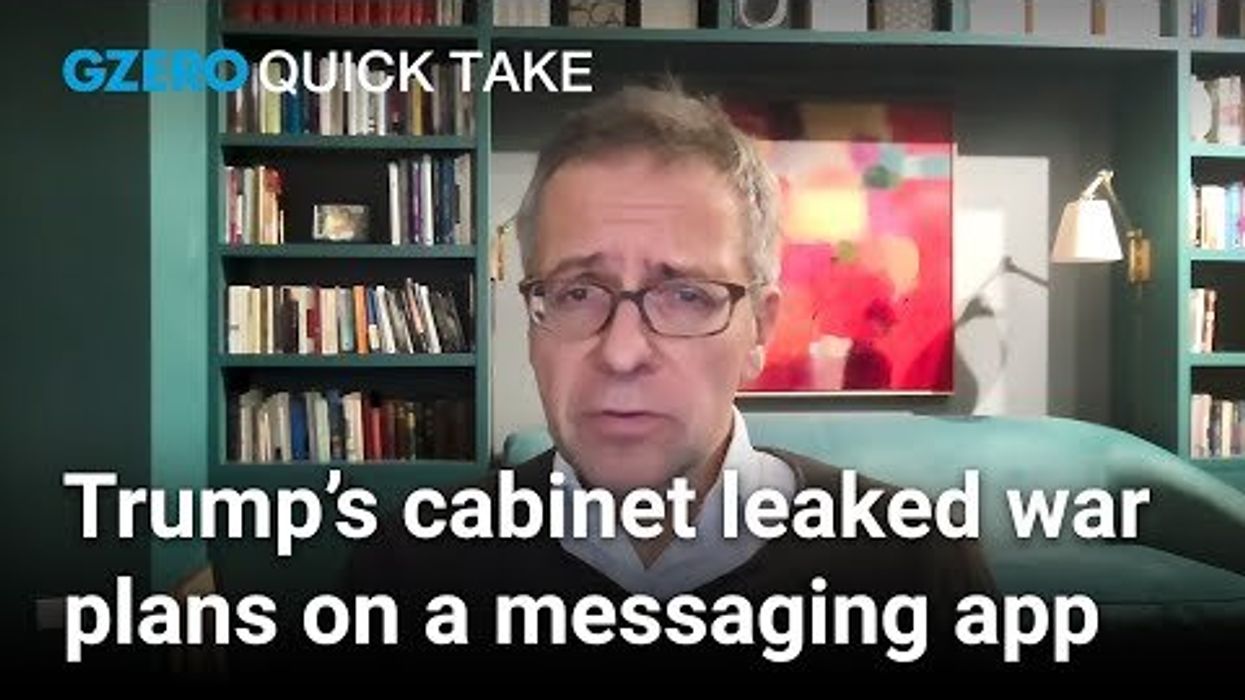
What Trump team's war plans leak revealed
March 25, 2025
Global Stage LIVE from United Nations WATCH REPLAY
Ian Bremmer, political scientist and president of Eurasia Group and GZERO Media, shares insights on global political events.
Presented by

Ian Bremmer's Quick Take: Hi everybody. Ian Bremmer here, and a Quick Take on this extraordinary story in The Atlantic. Jeffrey Goldberg, editor-in-chief of this magazine, invited into a Signal chat, the Signal app, by the national security advisor, Michael Waltz, with all of the major national security related principles in the Trump administration, to discuss imminent attacks by the United States on the Houthis in Yemen, the single biggest war fighting that the Trump administration has been involved in the first two months of their term. A lot to think about here, a few points I think worth mentioning.
The first point, it's pretty clear this should not have happened. A discussion of this sort, classified, involving direct war preparation, should not have been happening on Signal, but clearly everyone in the conversation was aware and okay with that. So, I don't think you blame singularly Mike Waltz for the fact that he was the guy that happened to bring the outsider inadvertently in. This collective responsibility, everyone, this is the way the Trump administration is handling these sensitive national security conversations, that is what needs to be looked into and rectified going forward. Mike definitely made a mistake here, and what seems almost certainly to be the case is that he thought he was including the US trade representative, Jamieson Greer, JG, same initials as Jeffrey Goldberg - and The Atlantic editor-in-chief, and he's the only obvious person, Greer, that otherwise wasn't on this broader conversation. So, I would bet my bottom dollar that is the way this happened. And I think all the people that are calling for Mike Waltz to be fired, I certainly wouldn't let him go for that. The issue is the broader lack of operational security around war decisions and fighting.
Now, as to the actual content of the conversations, frankly, I found all of the people involved to be pretty reasonable, especially in the context of how generally unprepared President Trump himself is on matters of national security. So, the fact that Vice President JD Vance was worried about the inconsistency of going to war for something that he doesn't think is a clear and direct US interest, that the US economy would be limited in terms of the impact of it, and this isn't really an American issue in the way that Trump defines American issues and war, that strikes me as not disloyal, but indeed the reality that Vance is aware of the fact that Trump doesn't know a lot of these details. But he doesn't want to bring it to Trump individually. Why not? Because he's going to get his head handed to him if he brings bad news to Trump unless everybody is on board, and of course, everybody isn't on board. There's some reasonable discussion around that, including with the defense secretary, Pete Hegseth, and then finally Stephen Miller, deputy chief of staff and head of policy in the White House, is the one that cuts it off because, why? He's the guy that is saying, "Trump says he wants it, we're going to do it." In other words, you've got to be completely loyal to Trump, that's it. And that's exactly what we've seen from this second administration, what Trump wants, Trump gets.
Now, another interesting point here is that the Europeans are not considered allies by this group across the board. Should be clear from anybody that has seen Vance in Munich, anyone that has seen the recent interview between the US Special Envoy Witkoff and Tucker Carlson, a number of other places where that's happened. But the point is that the entire Trump cabinet is basically saying, "We shouldn't be helping the Europeans, and if we have to help the Europeans, and Lord knows we shouldn't, we have to ensure that they directly pay for American help, American assistance." This is not collective security. This is completely transactional. Also, you got a lot of that about el-Sisi in Egypt, someone that Trump has been very supportive of, and indeed the US provides more support to Egypt than any other country militarily in the world except Israel. So the last few months you would've thought that Egypt would've been an exception there. From what we've seen from the cabinet, apparently not. Certainly a concern in terms of what Egypt is and is not willing to do on the ground in Gaza for Trump. That relationship seems pretty dicey.
Final point here, Jeffrey Goldberg deserves credit. I know that Elon in particular likes to say a lot that the public is now the media, but it turns out that well-trained journalists have standards and those standards are important. I have had my disagreements with what Goldberg has had to say. Some of his positions over the years, support for the Iraq War, for example, lots of other things, but in terms of his professionalism, as soon as he realized that he had been invited into something that was an authentic conversation about actual war plans and fighting, he got out and he told Waltz that he had been mistakenly invited. He made the public aware of what was going on without divulging any of the direct war plans or outing intelligence, active intelligence member that was part of it, all of those things, it was absolutely the right thing to do. He's now getting smeared by Hegseth, the secretary of defense, who was clearly embarrassed by his own mistake and his participation and culpability in all of this. He personally won't take responsibility as we so frequently see with our political leaders and never should have gotten confirmed, in my view and in the view of many Republican senators who weren't willing to go out publicly because of course they were fearful for their own careers. But Jeff Goldberg has done the right thing in terms of his career and I commend him for it.
That's it for me. I'll talk to y'all real soon.



Keep up with what’s going on around the world - and why it matters.