Skip to content
Search

Latest Stories

News

What We're Watching: A nail-biter for the Senate, the losers' future, Trump's baseless claims

People stand next to a screen displaying a U.S. flag in Times Square during the 2020 U.S. presidential election in New York City, New York, U.S. November 4, 2020.
Make us preferred on Google

Control of the US Senate: For months, the Democrats expressed cautious optimism about retaking the Senate, which they will need in order to pass key legislation on healthcare, immigration, and climate change. A strong show in the Senate races would also give Democrats a good chance of regaining full control of the federal government — the House of Representatives, Senate, and the presidency — for the first time in a decade. While the Democrats picked up a coveted seat in the battleground state of Arizona, results remain in flux in closely watched races in Georgia, North Carolina, and Maine. Meanwhile, Democratic losses in Alabama, South Carolina, and Texas mean that even if they do squeak out control of the Senate for the first time since 2014, it will be with an extremely slim majority. This means that even if Joe Biden does win the presidency, he will have a hard time getting his legislative agenda through a Senate with a heavy Republican presence. At the time of this writing, Republicans and Democrats are at 47 seats a piece, with six spots still up in the air. More results will trickle out in the hours and days ahead, but either way, it's clear that the US Senate race did not amount to the "blue wave" (53 seats) that Democrats had been hoping for.


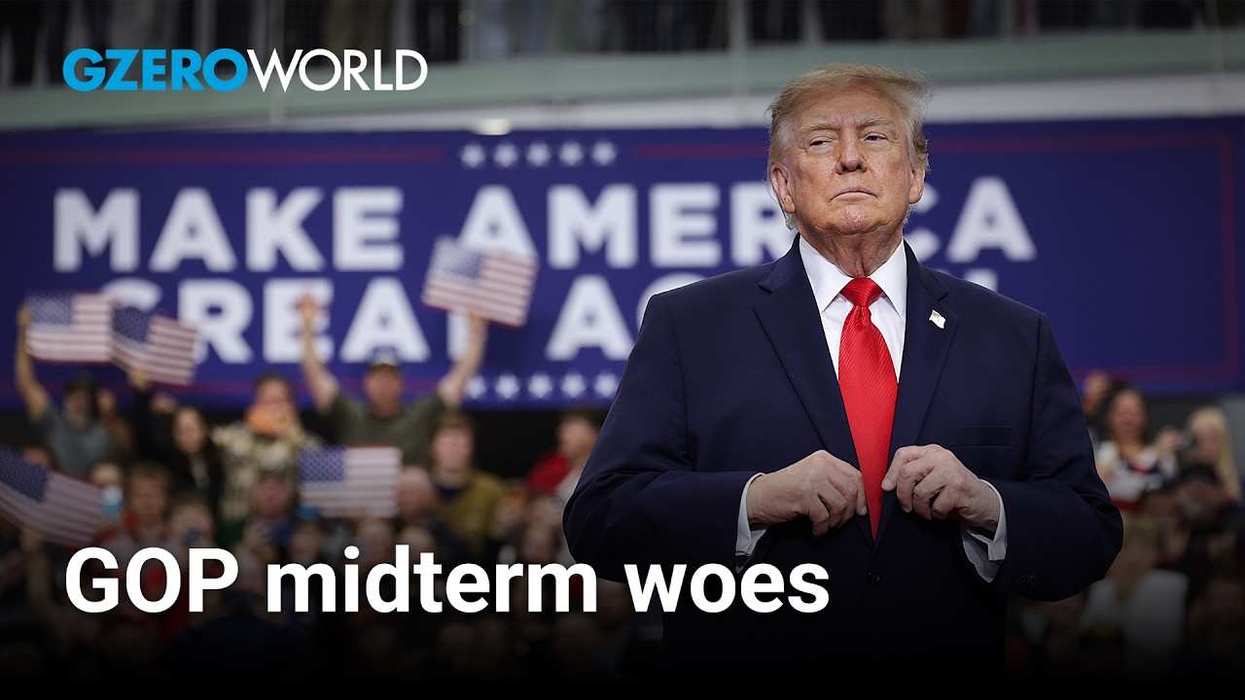
The future of the losing party: The losing party in the US election always faces a bit of an existential reckoning about what it did wrong and how to become more competitive next time around. How might that look this year? The stakes don't seem equal. Even if Trump loses by a hair, his better-than-expected performance shows that his brand of conservative populist nationalism is very popular — he is on track to get more popular votes than in 2016 — and it will continue to exercise broad influence over Republican politics, with 2024 hopefuls such as senators Tom Cotton or Josh Hawley, and former UN ambassador Nikki Haley waiting for Trump's blessing to throw their hats in the ring. On the other hand, a shock Biden defeat will be crushing for the Democrats, who will have failed to unseat the president despite having spent four years training their fire on his erratic and divisive leadership, and more recently his mismanagement of the pandemic. The Dems are already increasingly split between centrist moderates and the activist progressive wing of the party. Given the realities of the electoral college, which forces Democrats to win votes in several large battleground states, will they double down on centrism but with a stronger candidate, or will they opt for a progressive populist who can dent some of Trump's appeal among working-class voters and turn out a large base of their own (like many believe Bernie Sanders could have done)? Either way, if Biden loses the Democratic Party is in for some major existential angst.


What We're Ignoring:

Trump's "victory" speech: With some incomplete battleground results going his way, President Trump broke US election night tradition by prematurely and unilaterally declaring victory and calling for "all voting to stop." He claimed wins in Georgia and North Carolina while millions of votes are still being counted there, and said that he's "on track" to win Pennsylvania even though the Keystone State's final tally may not be known until Friday. He also claimed, without evidence, that many of his voters had been disenfranchised, and vowed to take any contested result all the way to the Supreme Court, where after the confirmation of Justice Amy Coney Barrett conservatives now hold an ample 6-3 majority. We're ignoring Trump's speech because there is no legal basis for the Supreme Court to stop counting votes that were already cast according to the rules set by each state (which even his buddy, former New Jersey governor Chris Christie, recognized when criticizing Trump's move).

More For You

Right-wing populism goes Down Under

One Nation leader Senator Pauline Hanson in the Senate chamber at Parliament House in Canberra, Wednesday, June 17, 2020.

AAP Image/Mick Tsikas
For nearly thirty years, Pauline Hanson has occupied the fringes of Australian politics. The outspoken founder and leader of the far-right, populist One Nation party has built a career railing against immigration and multiculturalism. Despite years of headlines for her political stunts and controversial quotes, her movement never broke into the [...]
​U.S. and Saudi flags flutter along a highway of Riyadh

U.S. and Saudi flags flutter along a highway of Riyadh, as pictured through the glass of a car, ahead of the arrival of U.S. President Donald Trump to Riyadh, Saudi Arabia May 12, 2025.

REUTERS/Hamad I Mohammed/File Photo
Trump adds Israel caveat to Saudi nuclear dealThe US president on Thursday said that the US-Saudi nuclear deal struck this week would be contingent on the Kingdom joining the Abraham Accords, a Trump-brokered 2020 pact that normalized ties between Israel and several powerful Arab countries. Saudi Arabia has in the past said it would only do that [...]
Explosions take place on the deck of the Greek-flagged oil tanker

Explosions take place on the deck of the Greek-flagged oil tanker Sounion on the Red Sea, in this handout picture released August 29, 2024.

Houthi Military Media/Handout via REUTERS
The Iran war expanded to a new front this week. The Houthis, an Iran-backed militia which controls most of Yemen, said they attacked two Saudi oil tankers in the Red Sea today as part of a blockade on shipping to and from Saudi Arabia through the Bab el-Mandeb Strait. [...]
Ebola death toll continues to rise
Will Fitzpatrick
The Ebola outbreak, caused by a rare strain of the Bundibugyo virus, has ballooned into the fastest outbreak of the virus in history. The World Health Organization said this week that 80% of the confirmed cases are coming from unknown chains of transmission, meaning that the cases are likely emerging in communities where people aren’t receiving [...]