Meet Israel's new government
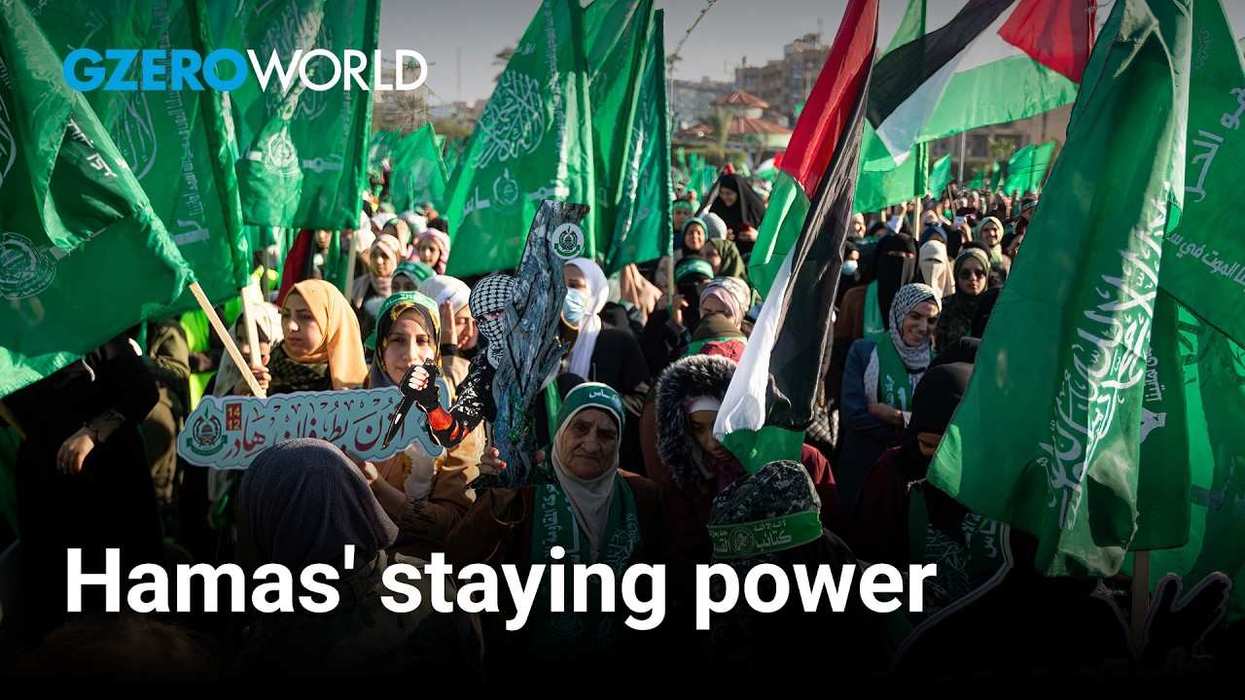
When Israel’s new government is sworn in on Thursday, it will be the most right-wing coalition in Israel’s history. Led by Benjamin “Bibi” Netanyahu, whose right-wing Likud Party reaped the most votes in last month’s race, the bloc is made up of two ultra-Orthodox parties as well as right-wing and far-right parties. To get coalition partners on side, Netanyahu made several overtures to Religious Zionism, a far-right alliance that finished third in the polls, including agreeing in principle to annex the disputed West Bank and applying Israeli sovereignty to the settlements. Still, Bibi, a fluent politician, hedged his bets, saying that the timing and implementation of such a policy would depend on the PM’s judgement. What’s more, the coalition agreement includes 1.6 billion shekels ($450 million) annually for development and building roads in the West Bank, while also plans for legislation allowing business providers to refuse service based on their religious beliefs – broadly seen as a measure to legalize discrimination against the LGBTQ community. Bezalel Smotrich, the ultra-nationalist head of Religious Zionism and incoming finance minister, penned an op-ed in the Wall Street Journal titled “Israel’s New Government Isn’t What You’ve Heard” in which he pushed back against claims that the new government will undermine the independent judiciary, but many Israelis are worried.
Lula’s decision on demonstrations
Tensions are running high ahead of Sunday’s presidential inauguration in Brazil. In a number of Brazilian cities, protesters who claim this year’s election was stolen from outgoing President Jair Bolsonaro have camped outside military headquarters in hopes of persuading the army to overturn the result. Luiz Inácio Lula da Silva, the incoming president, has so far said little about this problem, but after police detonated a bomb and arrested a suspect connected to one of these camps in Brasilia ahead of Lula’s inauguration on Sunday, anger has approached the boiling point. Flavio Dino, who will serve as Lula’s justice minister, has warned that these camps have become “incubators of terrorism.” Security concerns ahead of Lula being sworn in are high, and Dino is reportedly considering ordering police to break up the camps. We’ll be watching to see if this can be done peacefully and how the protesters will change tactics if they’re forced to disperse.
US to require COVID tests for travelers from China
The CDC announced on Wednesday that the US will require travelers from China, Hong Kong, and Macau to record negative COVID tests before entering the country starting on Jan. 5. Washington joins a growing list of countries – Japan, Italy, Malaysia, and India – in enforcing such travel restrictions as Beijing clumsily transitions away from its zero-COVID policy, resulting in millions of infections and fears of new mutations (no!). Still, it’s hard to know what’s really going on inside China given the Chinese Communist Party’s predilection for secrecy. While official state data claim 62,592 symptomatic COVID cases were recorded in the first 20 days of December, a leaked memo from China’s National Health Commission seen by the Financial Times and Bloomberg claims that as many as a whopping 250 million Chinese residents contracted COVID in that period. (Beijing previously said it would stop gathering data on asymptomatic cases.) President Xi Jinping, for his part, does not take kindly to being embarrassed – particularly by Washington. How will he respond?
The curious case of George Santos
There’s been a lot of attention in recent weeks on George Santos, a GOP Congressman-elect who wrestled an open House seat from a Democratic incumbent in Long Island, New York, in last month’s midterms. Now, the district attorney in Nassau County says she is opening an investigation into claims that Santos’ “numerous fabrications” misled voters. Indeed, Santos’ unraveling in recent weeks has been astonishing. He referred to a business acumen developed during his time at Goldman Sachs. He claimed his mother survived the 9/11 attacks as a financial executive at the World Trade Center and that he was tossed out of a prestigious New York high school after his parents fell on hard times. Santos backtracked on claims about being Jewish after journalists dug into his family history (later clarifying that he was raised Catholic, Santos says he feels “Jew-ish”). He’s reportedly never worked at Goldman Sachs, and he allegedly lied about his education, including about graduating from college, and his mother’s work. Republicans winning a number of seats in New York state, a longtime Democratic stronghold, was a decisive factor in helping the GOP secure a very narrow victory in the House. Meanwhile, GOP House leader Kevin McCarthy, who is looking for votes wherever he can find them to become House speaker next week, has stayed mum on the Santos case.