Mikhail Gorbachev, the final general secretary of the Communist Party of the Soviet Union, died on Tuesday at the age of 91.
He was an extraordinary and truly world-changing leader. Ultimately, and tragically, he was a failed one as well.
Arguably, Gorbachev was the leader that made the greatest impact on my professional life. My first trip outside of the United States was to the Soviet Union back in 1986. Gorbachev had just risen to power the year before, and at the time it wasn't at all clear that he was going to be a great reformer.
In his early days, he was mostly focused on anti-alcohol and anti-corruption campaigns, on trying to improve Soviet society. But he also worked hard to concentrate more power in his hands in the Politburo, where there was a serious power struggle going on. (In fact, Gorbachev’s early days had a fair amount in common with Xi Jinping, but that's really where the comparison ends.)
The Chernobyl disaster hit just a couple months before I showed up in the Soviet Union and therefore at the beginning of Gorbachev's rule. This was an enormous tragedy inside the Soviet Union, but it was a catalytic one: it proved to Gorbachev that the Soviet political and economic system was increasingly sclerotic and bankrupt, and he set out to change it through three unprecedented structural reforms.
Want to understand the world a little better? Subscribe to GZERO Daily by Ian Bremmer for free and get new posts delivered to your inbox every week.
First, glasnost: political openness. In other words, free speech. Second, perestroika: economic opening. In other words, capitalism. And third, khozraschot: accountability. In other words, economic decentralization and political federalism. Gorbachev was also very much an anti-imperialist. He recognized that Soviets were massively overspending on the military and wanted to stop that, so he ended the disastrous war in Afghanistan.
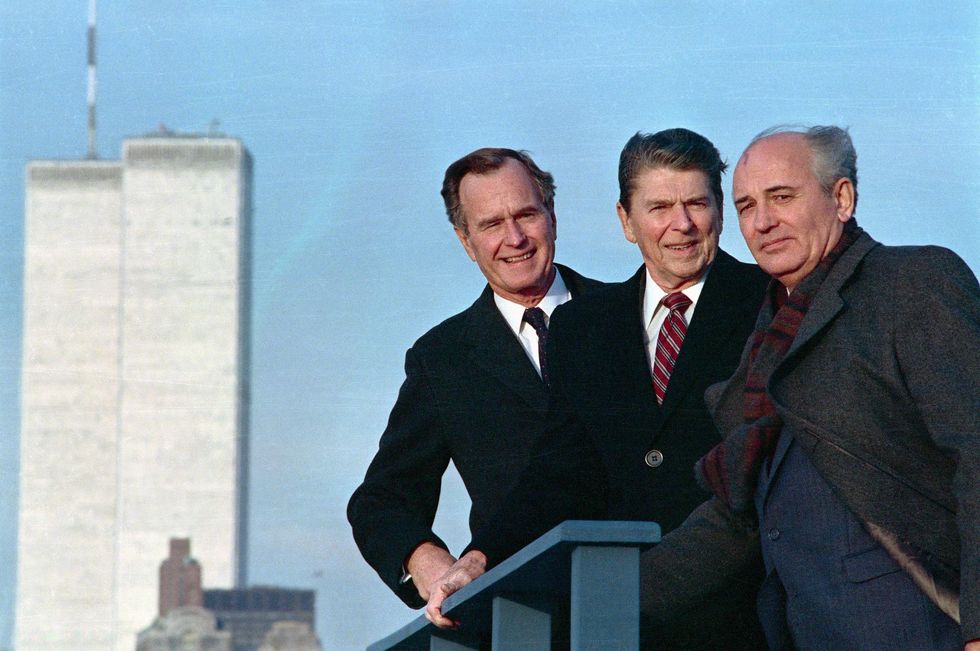 Gorbachev poses with U.S. President Ronald Reagan and Vice President George H. W. Bush in New York. More hopeful times...
In short order, all of these reforms reverberated across the Soviet empire and unleashed the yearning of millions trapped behind the Iron Curtain to be free. The first political uprisings happened in Eastern Bloc countries, and Gorbachev chose not to use military force to stop them from abandoning communism and leaving the bloc. That of course led to the fall of the Berlin Wall and the independence of all these Central and Eastern European countries that are now in NATO and the European Union. This precipitated demands for independence across the 15 republics that made up the Soviet Union, starting in the Baltics, then Ukraine, then Central Asia, and finally Russia proper, followed by a failed military coup in August of 1991. Gorbachev accepted the peaceful end of the Soviet empire on Christmas Day, four months later.
Perhaps the truest tragedy for a statesman is to outlive their legacy, and nothing could be truer for Mikhail Gorbachev.
Vladimir Putin, the president—and now dictator—of Russia, has said that he views the Soviet collapse as “the greatest geopolitical tragedy of the 20th century.” He has devoted his time in office to reviving the Russian empire, centralizing power in his hands, and repressing economic and political freedoms.
Russia today is precisely the opposite of everything Gorbachev had hoped it would be. We, and Russians especially, are all the worst for that.
Mikhail Gorbachev, rest in peace.
🔔 And if you haven't already, don't forget to subscribe to my free newsletter, GZERO Daily by Ian Bremmer, to get new posts delivered to your inbox.