After a year of relative calm, clashes between Israel and Hamas erupted Monday, putting the two sides on the brink of full-blown war.
Flare-ups between the Israeli military and Hamas militants in the Gaza Strip seem to be cyclical. But there are a few developments that make this latest round of tit-for-tat strikes somewhat atypical.
What's different this time?
Targeting Israel's hubs. In the past, Hamas and Palestinian Islamic Jihad (PIJ) militants in Gaza have restricted rocket fire mostly to southern Israel. On Monday, however, they upped the ante, firing dozens of rockets into the heart of Jerusalem. In response, Israel's army launched a broad military campaign in the Gaza Strip, killing several Hamas and PIJ commanders.
Then on Tuesday night, in an unprecedented move, Hamas and PIJ fired hundreds of rockets into Tel Aviv and central Israel, sending millions running for cover in bomb shelters, and prompting Israel to shutter its international airport. So far, 43 Palestinians, including 13 children, have been killed in Israeli strikes on the Gaza Strip, while at least six Israelis have been killed and dozens more injured.
Outside players.
Gulf states. This is the biggest Israeli-Palestinian escalation since 2014, when conflict lasted for 50 days. But this time, clashes come just months after Israel has signed normalization agreements with Arab states, including the UAE, Bahrain, Sudan, and Morocco. While the UAE — which has welcomed thousands of Israeli tourists in recent months as a result of normalization — has called on Israel to stop the violence and respect "the Holy al-Aqsa Mosque," for now its government has shown no willingness to play an active role in brokering negotiations.
A test for Biden. Recent events also pose a conundrum for US President Joe Biden, a longtime "friend" of Israel who is also focused on placating the progressive wing of his party, which is more supportive than other US lawmakers of Palestinian rights.
Progressive Democrats like Congresswoman Alexandria Ocasio-Cortez and Senator Elizabeth Warren have called on Biden to intervene in the Israeli-Palestinian crisis, which Biden has made clear isn't a top foreign-policy priority. Moreover, Biden likely doesn't want to do — or say —anything that will provoke the Israelis as his administration tries to revive the Iran nuclear deal, which the Israeli government opposes. But now that the situation is escalating so quickly, Washington may be compelled to get more involved.
The backstory.
Elections matter. Hamas warned last month that it would wreak havoc if the Palestinian Authority (PA), which governs in the West Bank, cancelled this month's parliamentary vote, the first Palestinian elections since 2006. Nonetheless, PA President Mahmoud Abbas, fearing a massive electoral loss to Hamas, proceeded to postpone the vote indefinitely. Hamas is fuming.
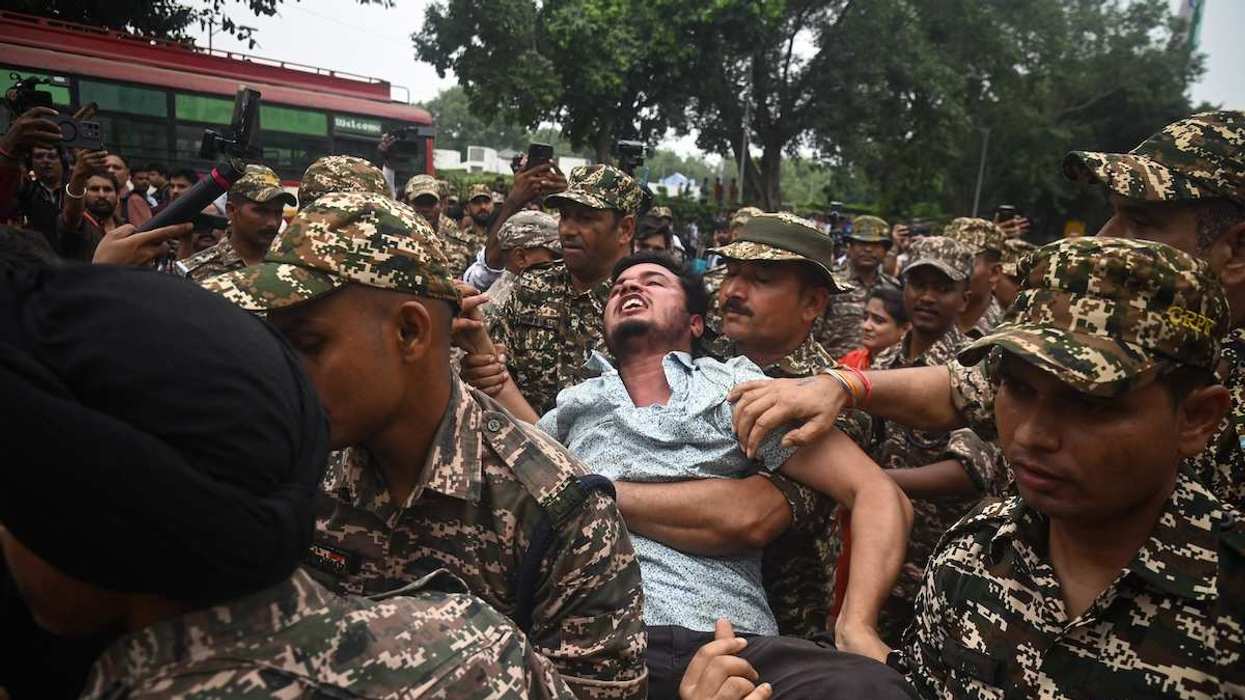
This follows mass unrest in Jerusalem in recent weeks. A high-profile court case over the potential eviction of several Palestinian families from East Jerusalem's Sheikh Jarrah neighborhood fueled riots and clashes between Palestinians and Israeli police. Jerusalem-based police courted more trouble when they blocked access to a plaza in Jerusalem's Old City that serves as a town-square for Arab residents during Ramadan. Tensions peaked when Israeli police used heavy-handed tactics to crack down on Palestinians protesting at the Al-Aqsa Mosque compound.
Hamas, casting itself as the real "protector" of Jerusalem to garner political support, used the violence in Jerusalem as a pretext to launch a barrage of rockets into Israel. Hamas does have a solid base of support given that 37 percent of Palestinians said recently that "armed struggle" is the best way to end the occupation, compared to 36 percent who favored negotiations. In striking Jerusalem, "Hamas is trying to embarrass and punish Abbas for cancelling parliamentary polls that it was slated to benefit from," says Moran Stern, an academic at Georgetown University.
Arab-Israeli communities are fired up. For Israel, however, the longer-term danger comes from within its own Arab-Israeli sector, which constitutes approximately 20 percent of the total Israeli population. In recent weeks, Arab communities inside Israel have taken a more active role in protests, which have turned unprecedentedly violent. (A state of emergency has now been declared in the integrated Arab-Jewish city of Lod.) This development startled many politicians who tout co-existence between Israeli Arabs and Jews as a model for broader Israeli-Palestinian peace.
Asked about this development, Moran Stern said: "As tensions rose in Sheikh Jarrah, Hamas has been trying to mobilize Arab communities, especially in East Jerusalem. It also hoped to mobilize supporters in the West Bank, President Abbas's stronghold. It seems the initial plan was to fuel events in those areas while keeping a safe distance so as not to give Israel an excuse to attack its assets in Gaza directly." But Stern notes that as things escalated, this has obviously changed. "The willingness of Hamas and Palestinian Islamic Jihad to escalate by launching massive rocket attacks all the way to Tel Aviv surprised intelligence analysts." Still, Hamas' approach seems to have worked: Arab-Israelis are now angry and activated.
Next steps. Still mired in political chaos, Israel does not have a functioning government to lead the way, while President Abbas has also been missing in action in recent days. Meanwhile, both Israel and Hamas are now upping their rhetoric. The risk of an escalation of deadly violence continues to rise.