Site Navigation
Latest Stories
Sign up for GZERO Daily.
Quick Take
Ian Bremmer, political scientist and president of Eurasia Group and GZERO Media, shares insights on global political events.
Presented by

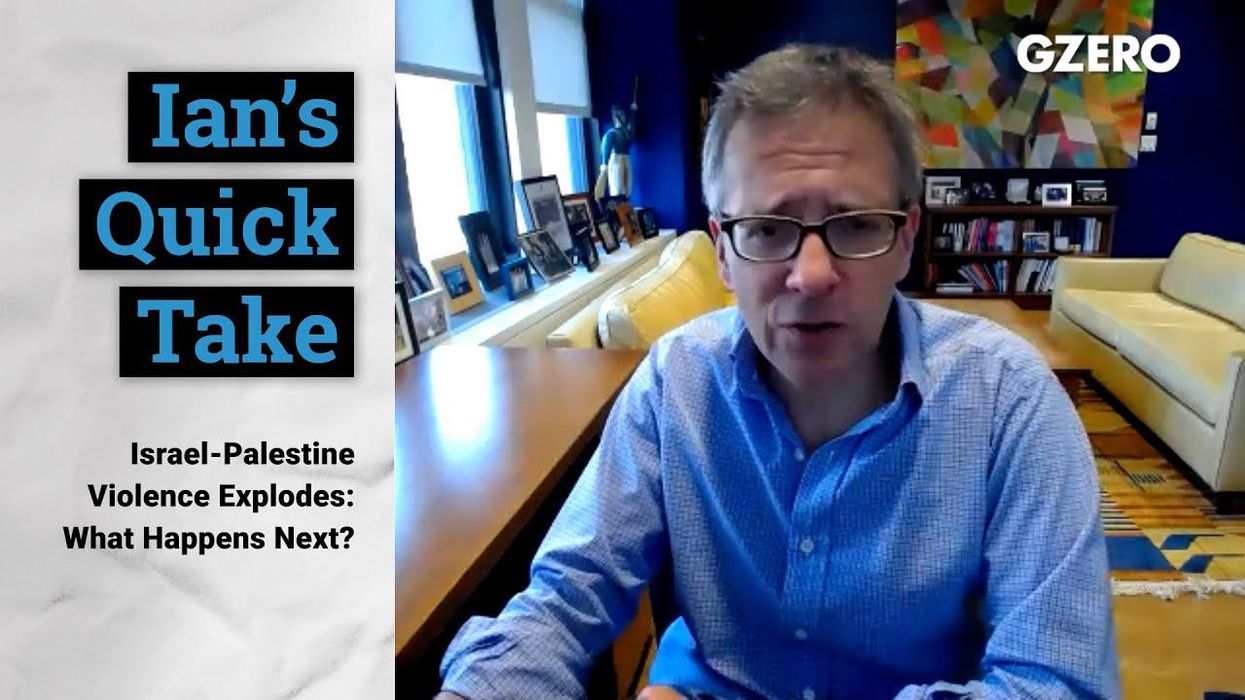
Ian Bremmer's Quick Take:
Hi, everybody. Ian Bremmer here. Happy week to you. I thought we would do a quick take as we often do talk a little bit today about the latest in the fighting between the Israelis and the Palestinians, still going on. Thousands now of Hamas' rockets raining down on Israel, hundreds of Israeli air sorties, also tanks and artillery hitting Gaza, as well as some violence locally in the West Bank and a fair amount across Israel Proper between Arabs and Israeli Jews living in the country.
I'm pretty optimistic at this point, if you can even use that word, that this is not going to escalate further in the near term. In other words, this doesn't become a ground war. A couple of reasons. First, the Israeli defense forces over the weekend put out a statement showing how much they had already done to degrade Hamas' military capabilities. And historically, they don't do that until they're ready to show success and wrap up their military operations in relatively short order. So that implies a quick pivot, at least to opening negotiations with the Palestinians as to a ceasefire.
I'd be really surprised if this goes much more than the end of this week. Certainly not additional weeks or months, and very unlikely to see a ground war. Secondly, there is more international pressure now, more outcry, particularly from the media following the Israeli strike on this building, mixed use building with the Israeli say. Hamas operatives using the building, though proof hasn't yet been provided to the US government on that. Also, headquarters for Al-Jazeera Associated Press and other international media organizations. Almost an hour of warning was given so everyone could evacuate. Nobody died, but clearly the international media response is this is a huge story and helps to shift the narrative against the Israelis to a greater degree.
Having said all of that, the United States continues to provide an awful lot of support to tolerate the Israelis continuing with the military strikes that they're doing. First point because the major proximate escalation did come from Hamas when they started to launch all of these rockets across Israel Proper, something that they hadn't done outside of war historically. And secondly, because the US considers Israel to be by far its strongest ally in the region. And we've now seen the Biden administration in addition to calling out the Palestinians and supporting repeatedly the Israelis to have the right to self-defense. So there's no question that the US isn't trying to act as an honest broker here, but also the fact that the US has singularly blocked three United Nations Security Council resolutions calling for a ceasefire, all of the other Security Council permanent members supporting it, the Americans blocking it. The Americans of course like the other permanent members have a veto.
I think that if you had asked a lot of people, both Democrats and Republicans, ex ante, this is going to happen. This is the kind of explosion of violence we're going to see in Israel-Palestine, will they Biden administration block a cease fire call? I mean, clearly Trump would have, if he was in power. I think the answer for most people would have been no. And indeed, you're seeing the level of alignment and actual policy between the Biden administration and the Trump administration on Israel-Palestine is really very high and that is I think something that isn't well appreciated and doesn't necessarily play well, given just how politically divided the country and the media is right now, but is nonetheless bearing out in the way we're seeing diplomacy work.
I would argue that while we can get to a ceasefire in relatively limited amount of time, you still have a situation where there are no elections for the Palestinians, where Hamas has become only more popular, especially in Gaza. You've got already 40,000 additional Palestinians displaced from their homes, living in an incredibly difficult environment and the level of radicalization will grow.
And you also have, and here's the part that's most challenging, you have growing extremism and radicalization among fringe groups of Jews and Arabs living in Israel itself. And that's something that the Israelis are going to have a hard time putting a lid on. Problems in Gaza as ugly and unfortunate as it is, a couple of things worth mentioning. First of all, the Americans, the Europeans, the West learn so much more about what's happening among the Palestinians than we do in Syria or Yemen or Venezuela, because you just don't have the media there in large presence and you do on the ground in the occupied territories. So I'm not trying to in any way minimize the suffering that the Palestinians are going through, but I do think it's interesting and notable that there is a more balanced discussion going on the pro-Israel side and the pro-Palestinian side than you would normally get.
I mean, look at what's happened in Ethiopia recently and the incredible human rights abuses with the fight going on recently with the Tigray just got virtually no presence at all in the international media. The plight of the Palestinians, even though not much happens as a consequence does get a lot more focus. But in Gaza itself, if you look at the ability of the Israelis to build a wall that you can't actually get across, very unlike US and Mexico, that is massively well defended with defense forces that will shoot on site if someone tries to breach it, you've got sensors underneath the ground preventing member of Palestinians in the occupied territory from digging tunnels to get into Israel proper.
You have Iron Dome, which means that the number of Israeli casualties is so much lower than the Palestinians, despite the fact that all of these rockets get launched, and you have an incredible emergency response system, including Israelis with the infrastructure that's filled well with bomb shelters. So the ability to protect themselves is just so much greater. So an ongoing level of violence and rocket strikes and the rest, if Hamas' military and leadership has been degraded, is something that the Israelis are capable of tolerating to a much greater degree. On the other hand, greater radicalization among Israeli Jews and Arabs leading to more violence inside the country, that's something that could actually create domestic demands for political response.
And let's keep in mind, even though we are farther and farther away from a two-state solution and more land in the occupied territories has been taken by Israeli settlers. And there's no interest in Israel right now to really engage in negotiations even. There's not an effective Palestinian government to have negotiations with Hamas itself, which was elected in the last elections, which from a decade ago in Gaza doesn't even recognize the right of Israel to exist. So clearly, the Israelis aren't going to negotiate with them. But the fact is that there's been a move to the right of the entire Israeli political spectrum so much that there is no longer political support for a party to say we have to have a two-state solution or else there's an existential threat to Israel.
No one believes that in Israel anymore. So the way you get votes among progressives in Israel is to talk about better social safety net for the people in Israel itself. But it's not for treatment of the Palestinians, the occupied territories. And that's been even more true with the normalization of Israel relations of the countries in the region. When it comes to Israeli, Arabs, and Jews living inside the country. If you start seeing a lot more hate crimes and you see much, much more extremism inside the state itself, I think then the potential that that could have more political impact on the Israeli political spectrum is real. And that's probably the thing to watch most carefully as you think about what the longer-term implications of this explosion of violence, the worst we've seen in almost a decade is likely to be.
I don't think it's going to matter much geopolitically. I mean, there'll be people in the US that will say, how can you possibly do a deal with Iran now? Iran has been supporting Hamas. I don't think it's going to stop the US from getting back into the JCPOA, the Iranian nuclear deal. I don't think it breaks the Abraham Accords and the normalization of Israeli relations with a number of countries across the region. But I do think it could have an impact on domestic Israeli politics longer term, and that's what we need to watch in my view most carefully.
So anyway, that's it for me. That's a quick take for today. Everybody be safe, avoid fewer people, and I'll talk to you real soon.
More from Quick Take
GZERO Series
GZERO World with Ian Bremmer

Puppet Regime
Quick Take

ask ian
Ian Explains
GZERO Reports
GZERO Europe

The Debrief

GZERO Daily: our free newsletter about global politics
Keep up with what’s going on around the world - and why it matters.