Skip to content
Search

Latest Stories

Living Beyond Borders Articles

Most of the world prefers not to choose

French President Emmanuel Macron and China’s President Xi Jinping gesture during a press conference in Beijing.

French President Emmanuel Macron and China’s President Xi Jinping gesture during a press conference in Beijing.

Blondet Eliot/ABACA via Reuters Connect

As the US-China rivalry deepens, many countries – including close US allies – have made it clear that they don’t want to be forced to choose between the world’s two largest economies. They are engaging in an increasingly delicate dance to try and maintain constructive relations with both.


This tricky balancing act has been particularly hard for European heavyweights, like Germany and France, that share values and many interests with Washington, but also benefit greatly from economic integration with China.

While France’s Emmanuel Macron has taken a more combative approach, saying recently that it would be “a trap for Europe” to get embroiled in crises “that aren’t ours,” German Chancellor Olaf Scholz vigorously defended a recent trip to Beijing with a host of German business leaders, writing that “we don’t want to decouple from China.” (It’s no wonder that Berlin won't roll over on this issue considering that German exports to China have tripled since 2000.)

And what about countries in the Global South that are being wooed by both the US and China? Many countries across South America, Africa, and Central and South Asia benefit from loans and infrastructure investment under Beijing’s Belt and Road Initiative but also rely on the US for security guarantees and aid. Since Beijing expanded its Belt and Road Initiative to Latin America in 2017, the US has tried to warn that it is a Trojan Horse aimed at increasing China’s regional clout, but Argentina, Chile, Ecuador, and others have still tried to play both sides.

For now, this approach seems to be working, but if tensions over Taiwan ratchet up, it could get harder for US allies to continue fence-sitting.

More For You

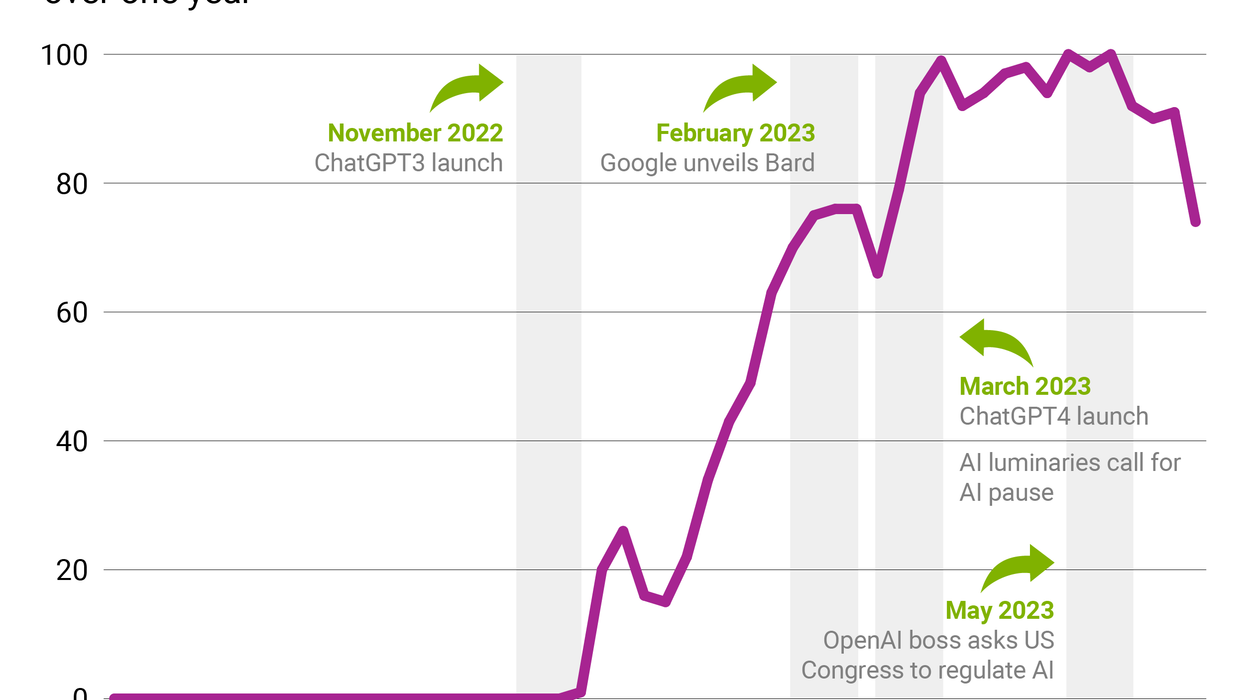
The Graphic Truth: ChatGPT breaks the internet
GZERO Media
Since ChatGPT, OpenAI's artificial intelligence chatbot, burst onto the scene late last year, AI seems to be everywhere – so much so that it’s become an integral part of our conversations, business dealings, academics, campaign ads, and everything in between.While being faced with constant reminders of AI’s looming threat or promise, most people [...]
An image of a robots.

An image of a robots.

GZERO Media
Whether artificial intelligence will ultimately be good or bad for humanity is an open debate. But there’s another, more immediate issue that often gets lost in the scrum: Even if AI eventually creates more jobs and opportunities than it destroys, what happens to the actual people who lose their jobs on the way to that happier future? And how [...]
AI (Artificial Intelligence) letters and robot hand.

AI (Artificial Intelligence) letters and robot hand.

Reuters
The emergence of AI has amplified the problem of disinformation that has proliferated since the 2016 US presidential election, and regulation is often touted as a way to address this worsening issue. But even if governments do find a way to effectively regulate AI – and that’s a big if – that doesn’t address the widespread demand for conspiracy [...]
A demonstration of robotic arms performing surgery controlled by a doctor that operates remotely using a 5G network in Barcelona, Spain.

A demonstration of robotic arms performing surgery controlled by a doctor that operates remotely using a 5G network in Barcelona, Spain.

Reuters
In years to come, experts tell us that artificial intelligence will alter societies and change individual lives on a scale greater than changes brought about by the creation of the World Wide Web. In the process, AI will create challenges and risks that deserve careful consideration. But headlines that warn of catastrophe are hiding the [...]