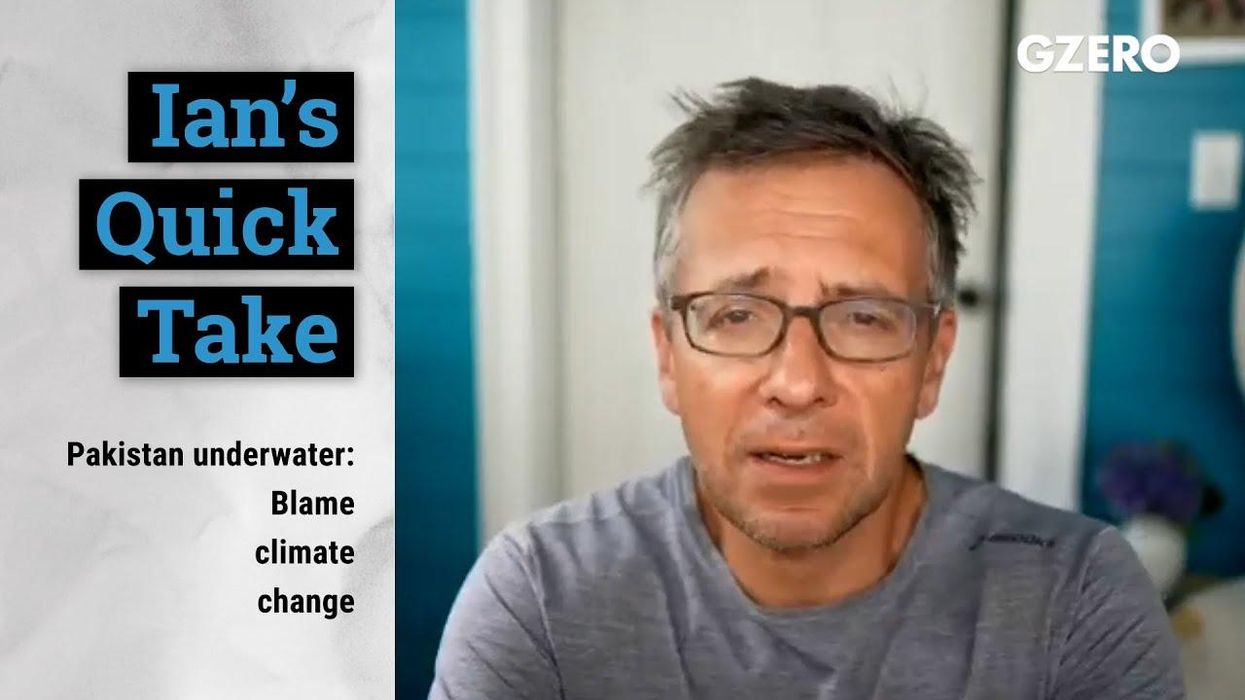
Pakistan underwater: Blame climate change
August 29, 2022
Ian Bremmer, political scientist and president of Eurasia Group and GZERO Media, shares insights on global political events.
Presented by

Ian Bremmer's Quick Take: Hi everybody, Ian Bremmer here, and we're closing down the summer, so this will be your last Quick Take before I head back to New York City. And I thought I would talk a little bit about these disastrous, calamitous floods that are happening in Pakistan right now.
Pakistan can't catch a break, their economy is in free fall, given huge mismanagement internally, a lot of corruption, and getting hit by, of course, the inflation and the supply chain challenges that countries all over the world are facing. On top of that, massive political instability, given the ouster of the former prime minister. Big demonstrations across the country, especially now that he is facing potential incarceration from the court, that has claimed that he has made statements that amount to a promotion of terrorism, and so a massively divided country. And now you have over 1000 dead and over 10 million Pakistanis displaced from unprecedented levels of flooding.
I have to say, as I was writing about this a little bit online, I was a little surprised to see the level of online trafficking of fake news. Some circles, particularly in the United States, saying it's just weather. There are monsoons, there are floods that happen all of the time. That is of course true, and it's particularly true in South and Southeast Asia. Monsoon season is an annual occurrence, it's generally not when you want to show up in these countries, for example, we all know that, we've seen it. But glacial melting is unprecedented. And that is directly the consequence of global warming. Ice levels around the world are at record lows and they continue to be at record lows every year. You've got 7,000 glaciers in Pakistan, that's the largest number of glaciers outside the Arctic and Antarctic, outside the polar regions in the world. And so as they melt in unprecedented fashion, river levels are getting a lot higher.
I mean, I guess the good news longer-term is that once the glaciers melt away completely, that will stop the bad news is it's going to mean extreme droughts hitting South Asia, and a lot more fighting, for example, geopolitically between India and China. So take the good with the bad. But as a consequence, even with the same levels of rain, you would be seeing greater levels of flooding. And also the highest level rains are hitting areas they've never hit before, again, as climate patterns change, given the warming in the atmosphere. And so the preparations the governments have made, in Pakistan they're never that great, are inadequate. Pakistan, of course, citizens are extremely upset about all of this. The government's very upset, they have themselves a very low carbon footprint, as does pretty much all of South Asia, India, Bangladesh, but they're getting hit among the hardest. You'll remember in the spring, or at least in my spring, India was having their highest temperatures ever. And that meant outdoor labor for a billion people was banned after 10:00 AM because it just wasn't safe for people to be outside, it had a big productivity hit for the country. And of course, that's going to get worse too. These are some of the poorest and most populated areas of the world.
The good news, and I do think it is truly good news, after decades of climate denialism, is that globally, the science is essentially accepted. We have 195 governments around the world, left-wing, right-wing, democratic, authoritarian, doesn't matter, that are a part of the Intergovernmental Panel on Climate Change under the aegis of the United Nations. They all agree on the basic science, they all agree that climate change is manmade, it is not just coming from cyclical changes in global weather patterns. We all agree there's 1.2 degrees centigrade of warming so far that's coming largely from record levels, again, human-induced, in carbon in the atmosphere now standing at 415 parts per million and going up every year. Ditto, record methane levels also impacted by record levels of deforestation.
And of course, the impact of all of that on extreme weather conditions, on rising sea levels, on reduction in biodiversity, on increase in extinctions. And even in the United States, where there used to be a severe political split between left and right, you don't really see that anymore. You see it among older Americans still, but among younger Americans, especially under 30, everyone pretty much accepts the basic science of climate change. And they're increasingly angry about it because of course it means that the world that young people will experience in the next 20, 30 years will be a lot more expensive, will be a lot more challenging to live in, a lot more difficult to travel around, than those that what we're experiencing now, that we're experienced 20, 30, 40 years ago. It is also true that as a consequence of all of this there's a massive amount of money that's being spent on transitions.
And by the way, yes, this is to renewables, so it's to solar and it's to wind and it's to electric vehicles, but it's also to nuclear power, which I guess is not technically speaking a renewable, though it clearly isn't a fossil fuel. And also from critically, from high carbon intensity to lower carbon intensity among fossil fuels. So for example, the United States right now has a per capita carbon emission levels that are roughly where they were in the 1940s. And that's a pretty good story. And it's largely a pretty good story because the United States has moved away from coal, almost completely towards gas, which is much lower in carbon emissions. The US is way behind the Europeans in terms of renewable energy, although the US is picking up on that front as well. And also part of the reason the Americans are paying so much attention, isn't just because of concerns of climate change, but also because most people in the US don't want the Chinese to become the supreme player in renewable energy in the next 30, 40, 50 years. And they're investing massively in solar and wind and nuclear and EVs and supply chain for all of those things. And if the Americans don't do it, then the US is gold in terms of fracking, but when suddenly everyone is moving to new energy sources that are cheaper, more efficient, more decentralized, the US will be behind the curve. And so that's driving a lot of investment as well.
The action is coming, there's no question. And it's coming around the world and you saw this with the most recent misnamed Inflation Reduction Act, which is not going to reduce inflation, but is going to bring carbon levels in the United States, emission levels, much closer to the 50% reduction that's expected, that's pledged by 2030. I guess it gets you to 42%, which is actually not horrible. But still, we're looking at a path to 2.5 degrees of warming rather than the 1.5 that everyone, including my friend, Antonio Guterres and John Kerry and others are saying is absolutely essential. It's extremely unlikely that that is possible or plausible given where we are presently headed. And that means double the level of climate change, double the level of warming that the world is presently experiencing, and the greater it gets, of course, the bigger the impact. And that means that much more, I mean, these once-in-1,000-year storms, and you keep hearing people use that term, and they happen all the time, they should stop using the term frankly, because when you have new climate, you're going to have new one-in-1,000-year storms. And you should be changing that terminology, frankly, every year because the climate is no longer stable.
So anyway, that's where we are. And so I'm glad that we can talk about something where there is a basic global consensus, there's not much of that these days. But given how big a challenge it is, it's kind of rewarding that we've finally gotten there. And there's a lot more work to do. Talk to you all real soon, and I'll see you all from New York. Be good.
For more of Ian Bremmer's weekly analyses, subscribe to his GZERO World newsletter at ianbremmer.bulletin.com



Keep up with what’s going on around the world - and why it matters.