VIDEOSGZERO World with Ian BremmerQuick TakePUPPET REGIMEIan ExplainsGZERO ReportsAsk IanGlobal Stage
Site Navigation
Search
Human content,
AI powered search.
Latest Stories
Sign up for GZERO Daily.
Get our latest updates and insights delivered to your inbox.
Global Stage: Live from Davos
WATCH
Economy
Global economy news and analysis from GZERO Media
Presented by
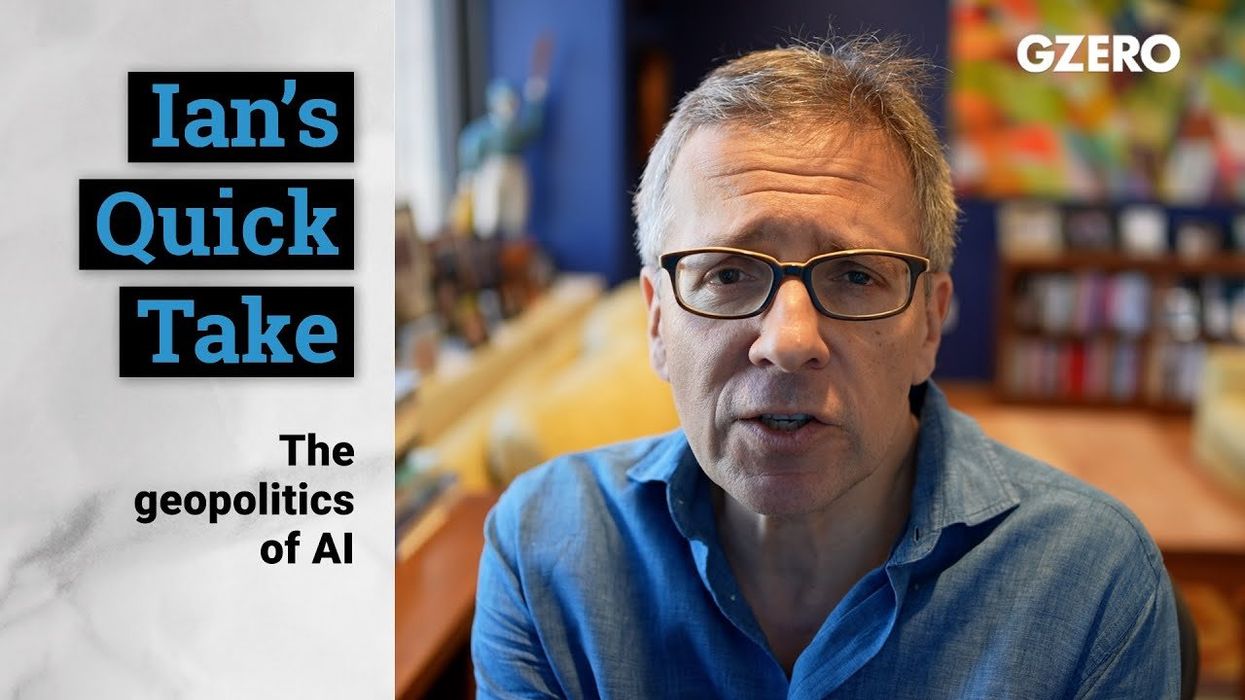
Ian Bremmer's Quick Take: Hi, everybody. Ian Bremmer here. A happy Monday to you. And a Quick Take today on artificial intelligence and how we think about it geopolitically. I'm an enthusiast, I want to be clear. I am more excited about AI as a new development to drive growth and productivity for 8 billion of us on this planet than anything I have seen since the internet, maybe since we invented the semiconductor. It's extraordinary how much that will apply human ingenuity faster and more broadly to challenges that exist today and those we don't even know about yet. But I'm not concerned about the upside in the sense that a huge amount of money is being devoted towards those companies. The people that run them are working as fast as they humanly can to get better and to unlock those opportunities and to also beat their competitors, get there faster. I'm worried about what happens that is more challenging, that we're not spending the resources on the consequences that will be more upsetting for populations from artificial intelligence. The ones that will require some level of government and other intervention or else. And I see four of them.
First is disinformation. We know that AI bots can be very confident and they're also frequently very wrong. And if you can no longer discern an AI bot from a human being in text and very soon in audio and in videos, then that means that you can no longer discern truth from falsehood. And that is not good news for democracies. It's actually good news for authoritarian countries that deploy artificial intelligence for their own political stability and benefit. But in a country like the United States or Canada or Europe or Japan, it's much more deeply corrosive. And I think that this is an area that unless we are able to put very clear labeling and restrictions on what is AI and what is not AI, we're going to be in very serious trouble in terms of the erosion of our institutions much faster than anything we've seen through social media or through cable news or through any of the other challenges that we've had in the information space.
Secondly, and relatedly, is proliferation. Proliferation of AI technologies by either bad actors or by tinkerers that don't have the knowledge and are indifferent to the chaos that they may sow. We today are in an environment with about a hundred human beings that have both the knowledge and the technology to deploy a smallpox virus. Don't do that, right? But very soon with AI, those numbers are going way up. And not just in terms of the creation of new dangerous viruses or lethal autonomous drones, but also in their ability to write malware and deploy it to take money from people or to destroy institutions or to undermine an election. All of these things in the hands not just of a small number of governments, but individuals that have a laptop and a little bit of programming skill is going to make it a lot harder to effectively respond. We saw some of this with the cyber, offensive cyber scare, which then of course created a lot of security and big industries around that to respond and lots of costs. That's what we're going to see with AI, but in every field.
Then you have the displacement risk. A lot of people have talked about this. It's a whole bunch of people that no longer have productive jobs because AI replaces them. I'm not particularly worried about this in the macro setting, in the sense that I believe that the number of jobs that will be created, new jobs, many of which we can't even think about right now, as well as the number of existing jobs that become much more productive because they are using AI effectively, will outweigh the jobs that are lost through artificial intelligence. But they're going to happen at the same time. And unless you have policies in place that help retrain and also economically just take care of the people that are displaced in the nearest-term, those people get angrier. Those people become much more supportive of anti-establishment politicians. They become much angrier and feel like their existing political leaders are illegitimate. We've seen this through free trade and hollowing out of middle classes. We've seen it through automation and robotics. It's going to be a lot faster, a lot broader with AI.
And then finally, and the one that I worry about the most and it doesn't get enough attention, is the replacement risk. The fact that so many human beings will replace relationships they have with other human beings. They'll replace them with AI. And they may be doing this knowledgeably, they may be doing this without knowledge. But, I mean, certainly I see how much in early-stage AI bots’ people are developing actual relationships with these things, particularly young people. And we as humans need communities and families and parents that care about us and take care about us to become social adaptable animals.
And when that's happening through artificial intelligence that not only doesn't care about us, but also doesn't have human beings as a principal interest, principle interest is the business model and the human beings are very much subsidiary and not necessarily aligned, that creates a lot of dysfunction. I fear that a level of dehumanization that could come very, very quickly, especially for young people through addictions and antisocial relationships with AI, which we'll then try to fix through AI bots that can do therapy, is a direction that we really don't want to head on this planet. We will be doing real-time experimentation on human beings. And we never do that with a new GMO food. We never do that with a new vaccine, even when we're facing a pandemic. We shouldn't be doing that with our brains, with our persons, with our souls. And I hope that that gets addressed real fast.
So anyway, that's a little bit for me and the geopolitics of AI, something I'm writing about, thinking about a lot these days. And I hope everyone's well, and I'll talk to you all real soon.
Keep reading...Show less
More from Economy
Five forces that shaped 2025
January 28, 2026
What’s Good Wednesdays™, January 28, 2026
January 28, 2026
Two US borders, two different approaches to Trump
January 28, 2026
Walmart’s commitment to US-made products
January 28, 2026
GZERO Europe
Jan 27, 2026
ask ian
Jan 27, 2026
China’s economy is growing, but it’s stuck in a deflationary trap
January 27, 2026
Building community-first AI infrastructure
January 27, 2026
The world economy is resilient, despite tariffs
January 27, 2026
Quick Take
Jan 26, 2026
America’s WHO exit leaves a leadership vacuum
January 26, 2026
Economic Trends Shaping 2026: Trade, AI, Small Business
January 26, 2026
Stubb: Russia is losing in Ukraine
January 26, 2026
Why space tech investment matters
January 25, 2026
Why trust is essential for AI adoption
January 24, 2026
AI in shaping power, politics, and people
January 24, 2026
Europe's wake-up call, with Alexander Stubb and Kristalina Georgieva
January 24, 2026
GZERO World with Ian Bremmer
Jan 23, 2026
The leadership challenge of governing AI
January 23, 2026
Graphic Truth: Ukraine's energy crisis
January 23, 2026
Moldova’s leader considers whether independence is still worth it
January 23, 2026
Rishi Sunak on AI, sovereignty, and hard power
January 23, 2026
You vs. the News: A Weekly News Quiz - January 23, 2026
January 23, 2026
Which countries are leading the way in AI adoption?
January 22, 2026
Graphic Truth: the latest Cuban exodus to US shores
January 22, 2026
What does Trump want from a faltering Cuba?
January 22, 2026
Africa’s AI Future: China or the West?
January 22, 2026
Digital sovereignty in the age of AI
January 22, 2026
The Greenland crisis will test whether Europe can stand up to Trump
January 21, 2026
AI and the new world order: Global Stage live from Davos
January 21, 2026
Puppet Regime
Jan 21, 2026
Has the US-led world order ended?
January 21, 2026
Will Trump ever be satisfied?
January 21, 2026
What’s Good Wednesdays™, January 21, 2026
January 21, 2026
BofA awards $1 billion in stock to non-executive employees
January 21, 2026
Watch our Global Stage live premiere from Davos
January 21, 2026
Walmart’s commitment to US-made products
January 20, 2026
Building community-first AI infrastructure
January 20, 2026
Putin's "Special Military Operation" Bop
January 20, 2026
Hard Numbers: The first year of Trump 2.0
January 20, 2026
A new chapter for Davos: Dialogue, AI, and Global Resilience
January 19, 2026
Trump’s demands put Europe in FAFO territory
January 19, 2026
Trump's foreign policy is reshaping the world order
January 19, 2026
Why Trump is pushing to take Greenland
January 18, 2026
One year into Trump 2.0: How the world has changed
January 18, 2026
Trump's second term–one year in, with Stephen Walt
January 17, 2026
Ian Explains
Jan 16, 2026
Graphic Truth: Denmark’s losses in Afghanistan
January 16, 2026
The strange silence of Vladimir Putin
January 16, 2026
You vs. the News: A Weekly News Quiz - January 16, 2026
January 16, 2026
A tale of two protests
January 15, 2026
Why Trump’s Greenland threats alarm Europe
January 14, 2026
Will Iran’s protests bring down the regime?
January 14, 2026
Crypto goes steady
January 14, 2026
What’s Good Wednesdays™, January 14, 2026
January 14, 2026
Uganda’s “new breed” of leadership gets old
January 14, 2026
Trump targets Fed chair
January 13, 2026
Walmart’s commitment to US-made products
January 13, 2026
Venezuela owes China money. Will Beijing see it?
January 13, 2026
Frank Fukuyama on Venezuela: "This is a nation-building exercise"
January 13, 2026
US response to Iran protests
January 12, 2026
Dispatch from Kyiv, nearly four years into war
January 12, 2026
Economic Trends Shaping 2026: Trade, AI, Small Business
January 12, 2026
Maduro is gone. What happens now?
January 12, 2026
Venezuela after Maduro with Sen. Gallego and Frank Fukuyama
January 10, 2026
GZERO Series
GZERO Daily: our free newsletter about global politics
Keep up with what’s going on around the world - and why it matters.