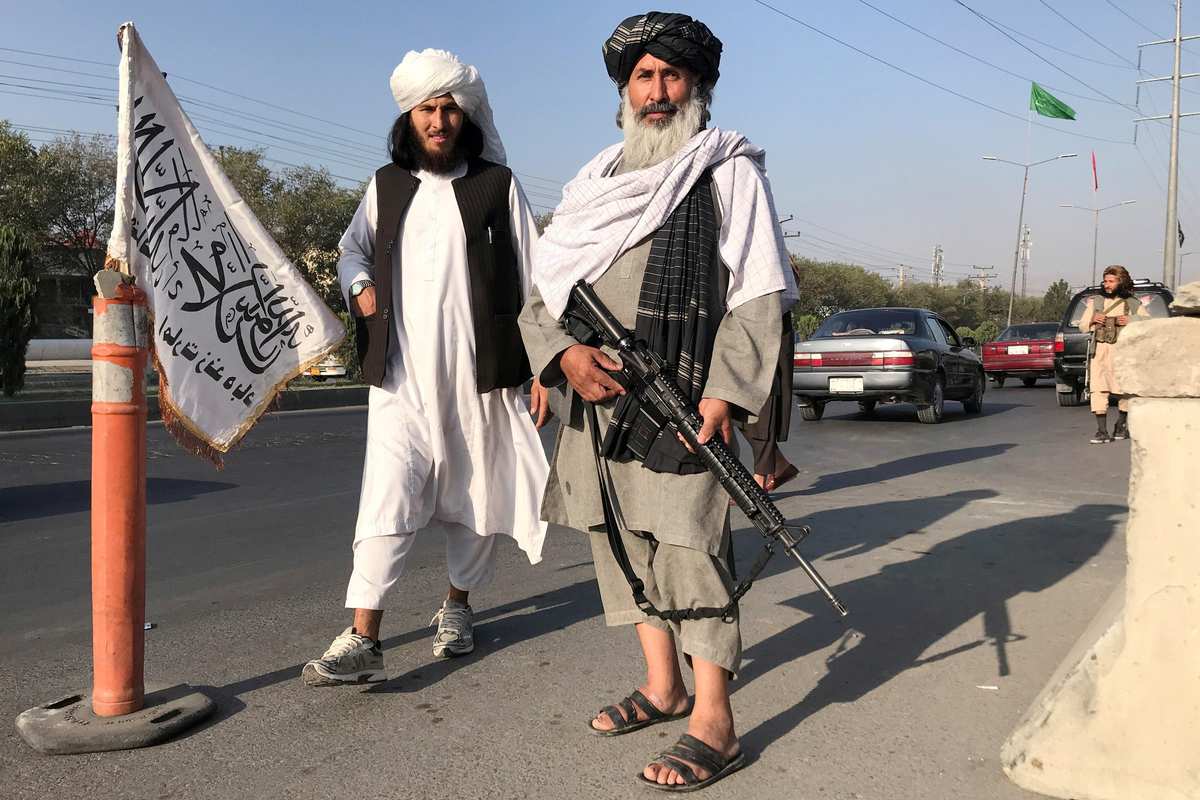

Just hours before the August 31 deadline, US forces have fully withdrawn from Afghanistan after almost 20 years. But the country, now controlled by the same militant group that the American military ousted two decades ago, is nowhere near stable.
Last week's deadly suicide bombings outside Kabul's airport by ISIS-K — the local affiliate of the Islamic State and ideological enemy of the Taliban — have sown fresh doubts about the Taliban's capacity to maintain even basic security once the US is gone.
Major outside players are at odds about how to deal with the Taliban. But they all share a common interest: doing whatever's necessary to prevent further terrorist attacks and a refugee crisis. Let's take a look at a few of them.
The US can't wait to get out, but that doesn't mean Afghanistan is no longer America's problem. For the US, the chaotic withdrawal and the first deaths of American soldiers since the 2020 peace deal with the Taliban are a sobering reminder that it'll have to continue keeping a close eye on the country. After all, ensuring Afghanistan would never be the staging ground for another 9/11 was the whole point of invading it in the first place.
Complicating things further, Afghanistan will soon become a blind spot for US intelligence. With no boots on the ground, it'll be very hard to figure out if ISIS-K or a resurgent al-Qaeda are planning attacks on US interests. Musings about the US sharing intelligence with the Taliban are wishful thinking at best, so an embattled Joe Biden needs a workaround.
If the US wants to stay in the Afghan intel loop, it'll have to rely on friends who are more willing to work with the Taliban. Two important ones are NATO ally Turkey and Qatar, which the Taliban have reportedly asked to help maintain security and run Kabul's airport. Both have yet to respond to the offer, but they'll certainly consider it because they have an interest.
The Turks want to keep Afghanistan as stable as possible to prevent a mass exodus of Afghans that'll end up in Turkey trying to reach Europe, while the Qataris — who hosted the Taliban leadership during the US peace talks — have emerged as an unexpected diplomatic heavyweight in this crisis.
There's also one influential Afghan neighbor with a complicated relationship with the US: Pakistan. The Pakistanis are arguably the country that stands to benefit the most from the military success of the Taliban, the brainchild of Pakistan's intelligence service. But they too want to avoid further mayhem, especially if that means the Pakistani Taliban creating trouble along the shared border, as well as even more Afghan refugees in the country that already hosts the most by far.
US-Pakistan relations have sourced since the 2011 US killing of Osama bin Laden on Pakistani soil and over countless deaths of Pakistani civilians in American drone attacks, leading Islamabad to pivot closer to China (which has come with its own set of problems). Regardless, the Pakistanis have leverage with Uncle Sam because the US will need access to their airspace to launch drone attacks from Qatar on terrorists inside Afghanistan. Islamabad may oblige, perhaps for more billions of dollars worth of US military aid in return.
Two US adversaries that also want a stable Afghanistan are China and Russia. The Chinese have long hinted that they'll recognize the Taliban if they restore some semblance of law and order, because Beijing wants Afghanistan to hop onto its Belt and Road in exchange for access to its mineral riches. Xi Jinping knows the Taliban need money that doesn't come from opium, while the Taliban know Xi needs assurances that Chinese-built infrastructure won't be blown up by ISIS-K or anyone else.
Meanwhile, the Russians, with a long history of jihadist violence on their own soil, are doing their part to help secure Afghanistan's porous borders, hoping the Taliban will return the favor by keeping militants away from the former Soviet republics of Central Asia.
Ultimately, though, it's really up to the Taliban. As the country's de facto rulers, they must prove they can maintain security. But the same way they've learned that taking power is much easier than running a country, the Taliban will soon realize that keeping the peace will be a lot harder than winning the war.