The West is in a cold war with Russia. No matter what happens on the ground in Ukraine, the relationship between Russia and the West is irrevocably broken. Even if we were to see a peace settlement stipulating a full Russian retreat (a massive if), so long as Russian President Vladimir Putin is in power, this genie is not going back in the bottle.
Thankfully, this new cold war does not extend to China. Yet.
Despite its warming ties with Russia, China still has a functional and stable (if deteriorating) relationship with the United States and Europe. Unlike with Russia, there is no significant economic and diplomatic decoupling taking place.
This means that while the war in Ukraine may cause a recession in Europe, put downward pressure on global growth, and make life worse for the world’s poorest, it won’t trigger a fundamental break in the global economy. Russia is just not large enough of an economic player to have a meaningful effect on the trajectory of globalization.
Want to understand the world a little better? Subscribe to GZERO Daily by Ian Bremmer for free and get new posts delivered to your inbox every week.
However, should China decide to throw its full weight behind Russia in its war of aggression against Ukraine, that would unleash the mother of all cold wars: one pitting the U.S., Europe, and their Indo-Pacific allies against both Russia and China.
Given that China is set to be the world’s largest economy as soon as 2030, the decoupling that would ensue would put an end to globalization, as trade and investment flows become fragmented into two separate geopolitical blocs. In fact, that would be much worse than a cold war: it’d be a wholesale bifurcation of the global economy and a truly tectonic shift in the global order.
How likely is this scenario?
We already know the Chinese are strategically aligned with Russia. Putin was welcomed by Xi Jinping in Beijing right before he launched his invasion of Ukraine, and we strongly suspect Xi both knew about it and blessed it (although the Chinese strongly deny it). The prospect of an invasion didn’t stop him from publicly announcing that Russia was China’s best friend on the global stage.
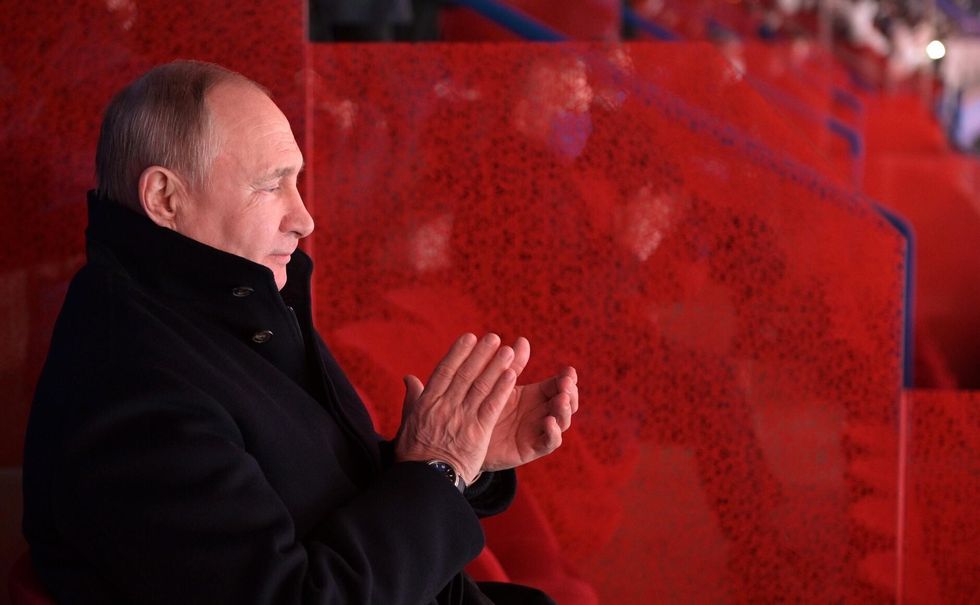 Putin attended the opening ceremony of the Beijing 2022 Winter Games.Kremlin Press Office/Anadolu Agency via Getty Images
That said, it’s very likely that Xi was assured—as Putin himself believed at the time—that the “military operation” would be short, bloodless, and would meet little effective resistance (either from Ukrainians or from the West). Ever since it has become clear that the war could blow back on them economically and geopolitically, the Chinese have staked a more neutral public position, maintaining friendly relations with Ukraine and Russia alike, urging de-escalation, providing humanitarian aid, encouraging peace talks, offering to play a mediating role, and professing support for Ukrainian sovereignty. This has been constructive, even if only marginally so.
At the same time, Chinese actions have been decidedly aligned with Russia. Beijing opposes sanctions and refused to censure Russia’s invasion at the United Nations General Assembly. Chinese state media and social media censors have taken a stridently pro-Russian editorial line, going as far as spreading Russian disinformation about fictional American bioweapons labs in Ukraine, banning pro-Ukrainian messaging, and embedding “journalists” with Russian troops on the ground. And in a telling move, the Chinese ambassador to Russia recently urged a gathering of top Chinese investors in Russia to seize the opportunity to buy up distressed Russian assets and do more business with Russia.
Most worryingly, on March 13 U.S. officials reported that Russia had asked China for economic and military assistance to support its war effort, including surface-to-air missiles, armored vehicles, and drones. According to a leaked diplomatic cable obtained by the Financial Times, Washington believes China is willing to accede to Moscow’s request, although the claim remains disputed. U.S. National Security Advisor Jake Sullivan warned China that there would “absolutely be consequences for large-scale sanctions evasion efforts or support to Russia to backfill them.” Beijing responded by calling the reports “fake news.”The next day, Sullivan and China’s top foreign policy advisor Yang Jiechi met for seven hours in Rome, in what U.S. administration officials described as an “intense” exchange of views. The meeting did not produce any clarity about China’s intentions, although a March 15 statement by Chinese foreign minister Wang Yi seemed to suggest China would not provide direct support to Moscow. “China is not a party to the crisis, nor does it want sanctions to affect China,” Wang said.
Still, given the accuracy of U.S. intelligence warnings over the last couple of months and the potential implications of such a move, the reports can’t be dismissed. A decision by China to provide direct military support to Russia would amount to actively taking Moscow’s side in the war, triggering U.S. and European sanctions and precipitating a long-term geopolitical fracture between China and the West.
At this point, it’s unclear what the Chinese will do.
On the one hand, Xi Jinping has already publicly bet on Putin, shares a long-term strategic interest with him in balancing against U.S. influence, and genuinely believes Russia is justified in fighting back against what he perceives to be Western containment—a containment he also sees reflected in the West’s actions in Asia. That makes it hard for him to climb down too much.
On the other hand, the Chinese government has enough problems to worry about at home to get painted into a corner with an increasingly isolated Russia. They are dealing with slowing economic growth, surging Covid cases, and mounting lockdowns, at a time when Xi Jinping is determined to ensure stability ahead of October’s 20th Party Congress. China has no desire to get embroiled in a cold war that would threaten domestic stability, nor is it interested in a radical decoupling of its economy from the rest of the world’s. That puts a guardrail on the potential for direct engagement.My expectation is that the West won’t end up in a cold war with the Chinese and the Russians together. China will continue to sit on the fence, maintaining normal trade relations with Russia where sanctions allow it while refusing to directly come to Putin’s aid to avoid decisive breaks with the West.
But as long as Beijing refuses to distance itself from its new strategic partner and Russia becomes more and more integrated with China economically, financially, and technologically, the risk of knock-on decoupling will remain elevated. The China-West relationship is therefore likely to get worse for the foreseeable future.
🔔 And if you haven't already, don't forget to subscribe to my free newsletter, GZERO Daily by Ian Bremmer, to get new posts delivered to your inbox.