Search
AI-powered search, human-powered content.
scroll to top arrow or icon

Fighting food waste and empowering women farmers

80% of the world’s food is grown on small farms. By 2050, global demand is expected to rise by 30%.

As the world faces rising food demand, social entrepreneur Nidhi Pant is tackling the challenge of food waste while empowering women farmers. Speaking with GZERO Media’s Tony Maciulis on the sidelines of the 2025 World Bank–IMF Annual Meetings, Pant explains how her organization, Science for Society Technologies (S4S), is helping smallholder farmers process and preserve their produce reducing massive post-harvest losses.


Pant’s journey began in India’s Himalayas, where her family lost 50% of their orange harvest due to poor infrastructure. “I asked myself, how can I use my engineering knowledge to solve this $14 billion problem of food loss in India?” she recalls.

By introducing low-cost dehydrators and women-centered financing models, S4S is turning surplus produce into stable income. “We want to empower women with assets, create positive impact on their bodies, and help them build a voice in their communities,” Pant says.

This conversation is presented by GZERO in partnership with Microsoft. The Global Stage series convenes global leaders for critical discussions on the geopolitical and technological trends shaping our world."
More from Global Stage

Can AI help solve global crises? Live from the AI for Good Global Summit 2026

As artificial intelligence rapidly reshapes the global economy, one question is becoming increasingly urgent: who will actually benefit? Recorded at the 2026 AI for Good Global Summit in Geneva, this special Global Stage conversation brings together leaders from the United Nations, Microsoft, and the scientific community to examine how AI can help tackle some of the world's biggest challenges, from disaster preparedness and climate resilience to humanitarian response and sustainable development.

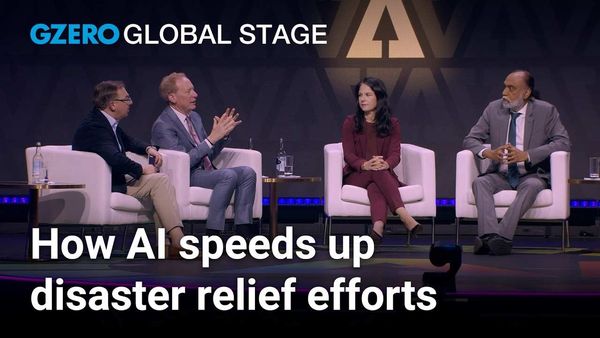
How AI speeds up disaster relief efforts

Artificial intelligence is becoming an increasingly powerful tool for disaster preparedness and emergency response. Speaking at the 2026 AI for Good Global Summit in Geneva, Microsoft Vice Chair and President Brad Smith explains how AI combines predictive modeling, satellite imagery, and public data to help governments identify vulnerable communities before disasters strike and respond more quickly when they do.

Building a safer, more equitable AI future

At the 2026 AI for Good Global Summit in Geneva, ITU Secretary-General Doreen Bogdan-Martin says the future of artificial intelligence depends on putting the right guardrails in place to ensure AI is developed safely, responsibly, and equitably.

The World Bank Group's Sangbu Kim on AI and job skills

More than half of Americans believe their job is vulnerable to AI. The data tells a more complicated and in some ways more hopeful story.

Can AI protect humanitarian aid?

Artificial intelligence is already helping humanitarian organizations identify people in need, improve supply chains, and deliver assistance more efficiently. But it also introduces new risks.

Yoshua Bengio: AI is moving faster than our ability to govern it

Artificial intelligence is advancing at an extraordinary pace, but are governments and society keeping up? In this interview from the 2026 AI for Good Global Summit in Geneva, pioneering AI researcher Yoshua Bengio discusses why today's AI safety debate goes beyond technical questions to broader issues of governance, public understanding, and international cooperation.