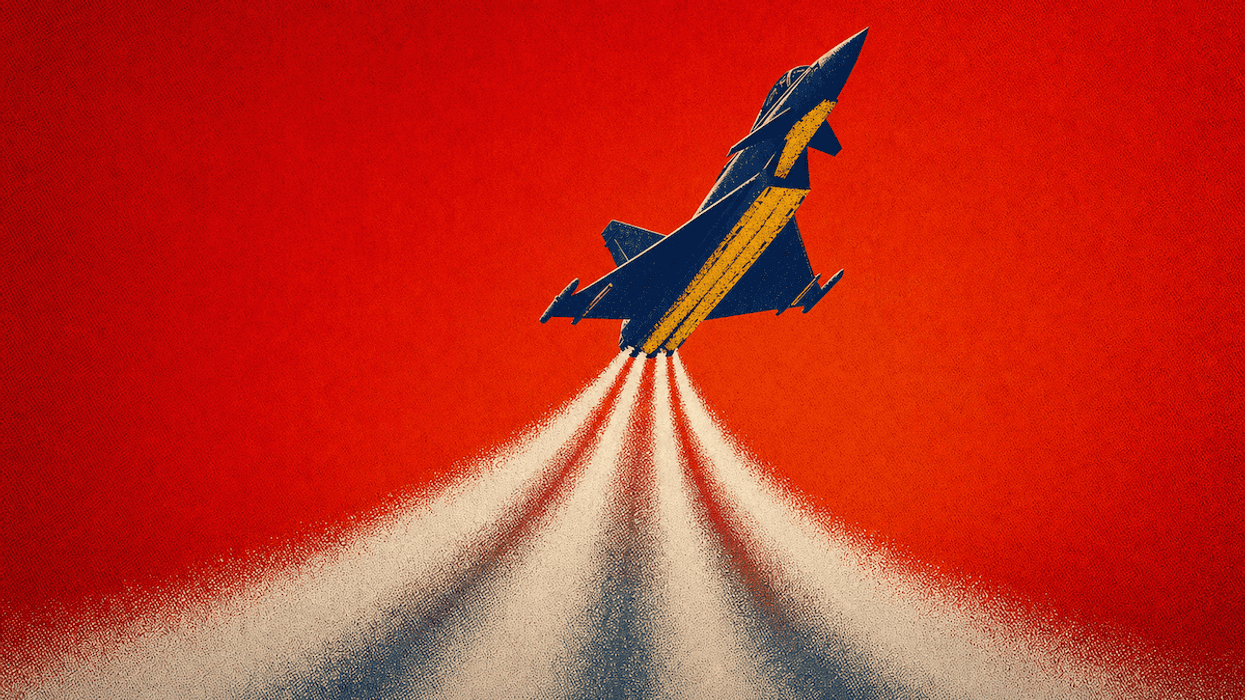
Geopolitics has a new frontier: outer space.
The US made this clear on Tuesday when it became the first country ever to announce that it had deployed a weapon into Earth’s orbit. Washington said the move was meant to prepare for “evolving threats,” but offered few details about the weapon’s capabilities or when it was launched.
The US is hardly alone. China is also reportedly developing out military capabilities in space, including satellites designed to pursue – and even capture – other space spacecraft systems as well as space-based weapons designed to interfere with or destroy targets.
Civilian life is increasingly reliant upon space, too. Satellites underpin GPS systems, mobile connectivity, and electronic banking. Then there are the resources: the moon, Mars, asteroids, and other planets in our solar system contain valuable minerals, including rare earth elements, whose mining and processing China currently dominates on Earth.
With so much at stake, dozens of other countries are keen to join the new space race. There are now 77 space agencies worldwide, although only 16 have launch capacity. Despite the rush to the stars, few international agreements govern behavior in space. One of the most important is the 1967 Outer Space Treaty, ratified by all major spacefaring nations. But it doesn’t clearly address many of today’s challenges, leaving key topics – from new weapons to competition over resources – unresolved.
“A lot of it will depend on who gets there first and how those practices are established by those who get there first,” said Almudena Azcárate Ortega, who leads space law and regulation work at the Secure World Foundation. What happens now, he explained, could determine the norms going forward.
The gaps in space (law). The 1967 treaty was clear about one thing: you can’t put nuclear weapons or weapons of mass destruction in space. But beyond that, many of the rules of the game are open to interpretation. The treaty was designed as a set of guiding principles for space law, according to David Koplow, a Georgetown University professor who specializes in public international law and national security law. The expectation was that subsequent treaties would fill in the details, many of which never materialized.
“There is law in outer space,” Koplow said. “[But] there’s not enough law to provide the sort of certainty that the world needs.”
One major concern is weapons. Here, the 1967 treaty distinguishes between “celestial bodies,” such as the moon, where states are forbidden from establishing military bases or even testing weapons, and the void of space, which is less strictly governed.
There, questions of defense “would be an issue under the general international law of what counts as aggression and what counts as self-defense,” said Koplow. “That’s hard to resolve on Earth. It would be just as hard to resolve on the moon.” While the US deploying a conventional weapon to space does not appear to violate the treaty, China has warned that the move could fuel a space arms race.
How countries should handle resource extraction also remains unanswered. The 1967 treaty bans anyone from “appropriating” or claiming sovereignty over outer space. That means no country can claim part of the moon as theirs, but it’s not obvious how the treaty would consider the sale or use of extracted resources.
One view is that the treaty prohibits appropriating any resources until an international agreement decides who can take what. The other view, endorsed by the US and a number of other countries, is that you can extract and claim ownership of resources from the moon without violating the treaty by claiming sovereignty over the natural satellite.
In October 2020, the US tried to get the international community on board with the Artemis Accords, which loosely set guidelines for moon exploration and resource extraction. Dozens of states joined the accords, including the UK and Canada, but the two other major spacefaring nations, China and Russia, did not sign.
Chokepoints. As more states begin to look beyond our planet, the moon could also become something all too familiar on Earth: a chokepoint. It offers one of the few jumping-off points between Earth and space – an opportunity to refuel before going deeper into the solar system and beyond in search of resources. But as the war in Iran has made clear, control over a chokepoint can let a nation punch well above its weight on the global stage.
For now, neither the US nor China has a clear advantage when it comes to the moon. In April, a 10-day manned Artemis mission flew around the moon and back, setting a record for the furthest humans have traveled in space. The US plans to send an Artemis mission to the moon’s south pole in 2028. In August, China delayed its Chang’e-7 mission to the moon’s south pole just hours before takeoff, pushing it until 2027.
Another possible set of chokepoints is called Lagrange Points: the orbital “parking spots” of space. These are locations where the gravitational pull of the two large celestial bodies creates a point of balance, allowing objects like spacecraft to stay in place – rather than in orbit – without needing much fuel to keep them there. Five such points exist between pairs of large orbiting objects, making them strategically useful for communications, observation, and future lunar operations.
“They are a limited resource,” said Koplow. “It is not yet a scarce resource, but it is potentially the sort of place where there could be competitive activity.”
In 2023, the US House Select Committee on China adopted a resolution to ensure that the US becomes the first country to permanently station assets at “all Lagrange points” to counter what it called the Chinese Communist Party’s “malign ambitions in space.” China has since condemned the US’s pursuit of what it called“space hegemony.”
Nevertheless, 71 states have now signed the Artemis Accords in an effort to establish rules before competition in space intensifies further. But China and Russia remain outside the agreement, while the 1967 treaty leaves some of the most pressing issues of space – weapons, resources, and strategic territory – unanswered. The question now is whether countries can agree on the rules – before they start fighting over it.