Skip to content
Search

Latest Stories

Living Beyond Borders Articles

Regulate AI: Sure, but how?

U.S. President Joe Biden, Governor of California Gavin Newsom and other officials attend a panel on Artificial Intelligence, in San Francisco, California.

U.S. President Joe Biden, Governor of California Gavin Newsom and other officials attend a panel on Artificial Intelligence, in San Francisco, California.

REUTERS/Kevin Lamarque

AI revolutionaries like OpenAI CEO Sam Altman want government regulation, and they want it now – before things get out of hand.


The challenges are many, but they include AI-generated disinformation, harmful biases that wind up baked into AI algorithms, the problems of copyright infringement when AI uses other people’s work as inputs for their own “original” content, and, yes, the “Frankenstein” risks of AI-computers or weapons somehow rebelling against their human masters.

But how to regulate AI is a big question. Broadly, there are three main schools of thought on this. Not surprisingly, they correspond to the world’s three largest economic poles — China, the EU, and the US, each of which has its own unique political and economic circumstances.

China, as an authoritarian government making an aggressive push to be a global AI leader, has adopted strict regulations meant to both boost trust and transparency of Chinese-built AI, while also giving the government ample leeway to police companies and content.

The EU, which is the world’s largest developed market but has few heavyweight tech firms of its own, is taking a “customer-first” approach that strictly polices privacy and transparency while regulating the industry based on categories of risk. That is, an AI judge in a trial deserves much tighter regulation than a program that simply makes you uncannily good psychedelic oil paintings of capybaras.

The US is lagging. Washington wants to minimize the harms that AI can cause, but without stifling the innovative brio of its industry-leading tech giants. This is all the more important since those tech giants are on the front lines of Washington’s broader battle with China for global tech supremacy.

The bigger picture: This isn’t just about what happens in the US, EU, and China. It’s also a three-way race to develop regulatory models that the rest of the world adopts too. So far, Brussels and Beijing are in the lead. Your move, Washington.



More For You

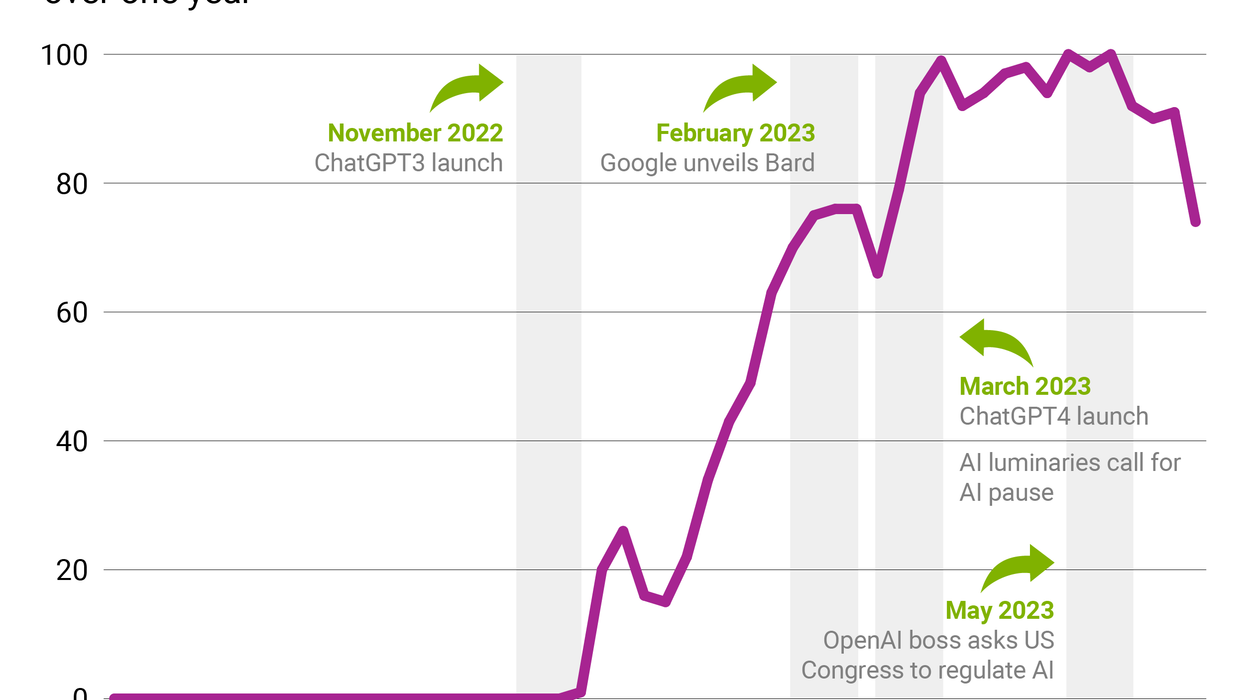
The Graphic Truth: ChatGPT breaks the internet
GZERO Media
Since ChatGPT, OpenAI's artificial intelligence chatbot, burst onto the scene late last year, AI seems to be everywhere – so much so that it’s become an integral part of our conversations, business dealings, academics, campaign ads, and everything in between.While being faced with constant reminders of AI’s looming threat or promise, most people [...]
An image of a robots.

An image of a robots.

GZERO Media
Whether artificial intelligence will ultimately be good or bad for humanity is an open debate. But there’s another, more immediate issue that often gets lost in the scrum: Even if AI eventually creates more jobs and opportunities than it destroys, what happens to the actual people who lose their jobs on the way to that happier future? And how [...]
AI (Artificial Intelligence) letters and robot hand.

AI (Artificial Intelligence) letters and robot hand.

Reuters
The emergence of AI has amplified the problem of disinformation that has proliferated since the 2016 US presidential election, and regulation is often touted as a way to address this worsening issue. But even if governments do find a way to effectively regulate AI – and that’s a big if – that doesn’t address the widespread demand for conspiracy [...]
A demonstration of robotic arms performing surgery controlled by a doctor that operates remotely using a 5G network in Barcelona, Spain.

A demonstration of robotic arms performing surgery controlled by a doctor that operates remotely using a 5G network in Barcelona, Spain.

Reuters
In years to come, experts tell us that artificial intelligence will alter societies and change individual lives on a scale greater than changes brought about by the creation of the World Wide Web. In the process, AI will create challenges and risks that deserve careful consideration. But headlines that warn of catastrophe are hiding the [...]