Site Navigation
Latest Stories
Sign up for GZERO Daily.
Global Stage LIVE from United Nations WATCH REPLAY
Quick Take
Ian Bremmer, political scientist and president of Eurasia Group and GZERO Media, shares insights on global political events.
Presented by

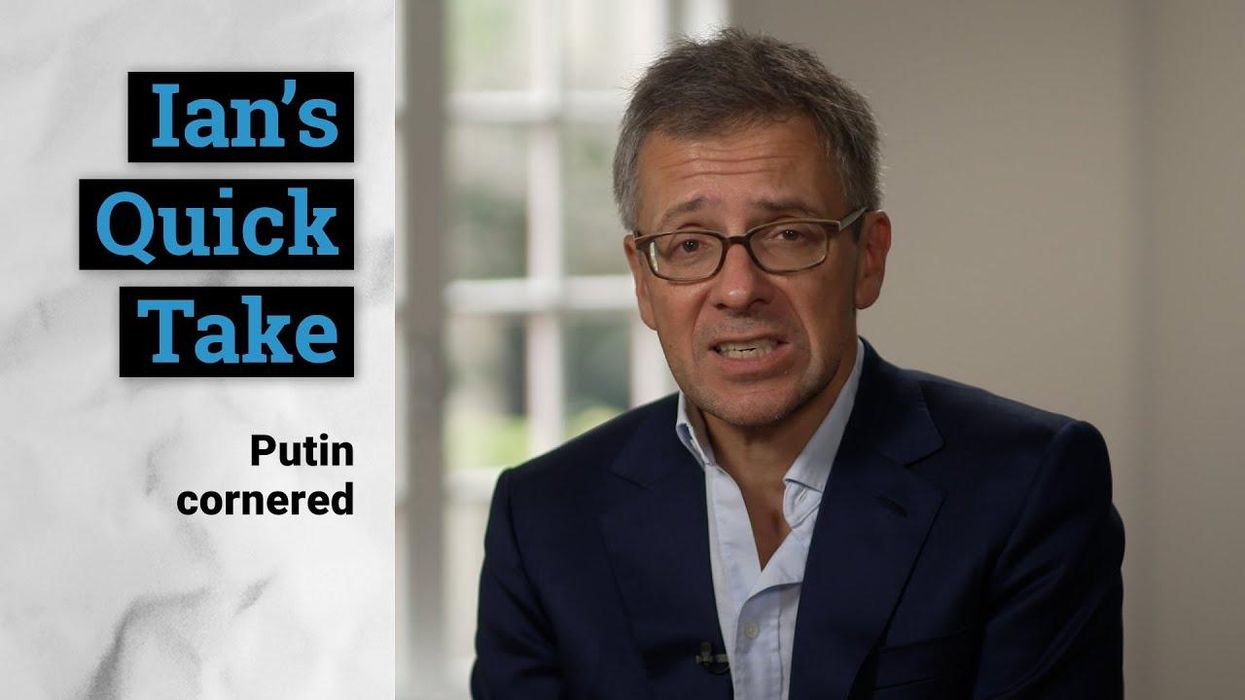
Ian Bremmer's Quick Take: Hi, everybody. Ian Bremmer here. I wanted to talk to you for a couple of minutes about the staggering news that's come out over the last 24 hours from President Putin on the Russian war in Ukraine. He gave a big speech announcing, among other things, referenda for annexation of Ukrainian territory into Russia, a mobilization of Russian civilians to fight in the Ukrainian war, and threatening even nuclear strikes against those that decide to come against attack Russian territory.
I want to take all of this in order to talk about what it means for you briefly. First of all, very important point that Putin has been trying to avoid taking these measures for months now. Remember, it's a special military operation according to Putin. It's not a war. You can get up to 15 years in prison in Russia if you call it a war. He's not been performing well on the ground militarily. They sent in 190,000 troops to begin with back in February. They tried to take Kyiv. They failed. They tried to overthrow Zelensky. They failed. They lost a lot of territory. They then narrowed the scope of military operations to the land bridge from Russia into Crimea and also the extended Donbas.
But they've had major counteroffensives from a Ukraine that has fought courageously and has been strongly supported by the United States and all of NATO. And as a consequence, finally Putin said, "Okay." He's bitten the bullet. And he has indeed ordered this mobilization. We've had well over 1,000 arrests in the last 24 hours in Russia from people that are deeply upset about this mobilization, about how badly the war is going. Russian state media has indeed been honest with the Russian people about the fact they've lost a lot of territory recently. It's the first time we've seen that from Russia's propaganda institutions.
And of course, the international community is angry. And here we're not just talking about the United States and Russia's committed adversaries, but even countries like India and China and Kazakhstan who really think this war is horrible, not just for Russia but for the global order, for energy prices, for food prices, for knock-on relations, for those that are friendly with Russia. Publicly last week, they were very cautious in trying to tell Putin that things are not going well and they really would like to see an end to the war. Privately, they've been much more direct. I've met with delegations from Kazakhstan and India just over the last couple of days, including the president of Kazakhstan, and absolutely the private messages that have been delivered to Putin have been much more sharp than the ones that you've seen on television.
So look, he is increasingly isolated. He's increasingly a rogue on the global stage. But in response to all of that pushback, both from enemies and from friends, the response from Putin has been, "No I'm escalating. I'm doubling down."
Now, 300,000 troops, if he's able to mobilize them, and that is the whisper number. There is no official number that's in the actual mobilization documents, but that is what they seem to be going for in terms of the orders that you're seeing across Russian districts in the Federation. 300,000 is a lot more than the 190,000 they initially started the war with. And it would be roughly a trembling of the Russian troops that are presently fighting on the ground given the deaths and the casualties that they have faced.
It also prevents a stop-loss order. So you no longer, I mean, even if your conscription period is done, your contract is out, until this war's over, with this new special mobilization you are not allowed to leave. So clearly, anger there. But also what that means with a narrower focus of military engagement is that in the course of three to four months, when those troops start showing up after they've been trained, after they've been mobilized in force, the ability of the Ukrainians to continue to fight effectively, at least in the Donbas, will be significantly challenged. So Putin clearly wants to show that he can win with that territory with the goals of his second phase, as he calls it, of the special mobilization.
Having said all of that, the potential for a negotiated settlement is, of course, zero. The fact that the Russians are now physically going to be annexing territories, as these referenda, of course, are jokes. I mean, it's not as if the Ukrainians on the ground are all going to be voting in favor to join Russia. That's not the point. It's just a fig leaf that allows them to formally take Ukrainian territory even more than they've been occupying since 2014.
That will lead to an intensification of sanctions from the United States and its allies cutting off the Russians completely from the G7. This year, that's a contraction of their economy of about 5%. Next year, it's going to get a lot worse. Also means that this winter's going to be hard for Europe. Probably not going to be any gas flows from Russia to Europe. You could easily see a recession of 2% or 3% of the entire European Union and the UK. That is a very serious problem.
Final point, what about the nukes? Putin says he's not bluffing if you hit Russia. What's Russia? Does that include Crimea? Putin would say yes. Once they physically annex the territories that they have these fake referenda in, is that Russia? Putin would say yes. So if the Ukrainians continue to fight there, he's threatening to use nuclear weapons, weapons of mass destruction. Would he actually do that? He says he's not bluffing. Of course, he said that there would be military consequences if Finland and Sweden went ahead and joined NATO. Well, they decided to do it anyway, and so far the consequences have been absolutely zero. Talked to the Finnish foreign minister about that just a day ago. He said, "Yeah, we've seen absolutely nothing." Swedes, same story.
The Ukrainians have hit Crimea already. They have hit even Belgorod, which is in Russia proper. I mean, even before the war, that's Russia. What have the Russians done? They keep bombing, but thankfully no weapons of mass destruction. Do I believe Putin? No. Do I think this is a serious problem in creating Russia as a rogue state on the global stage? Absolutely. This war is getting worse, principally, of course, for the Russians and what's going to happen to their territory over the long term. And as that occurs, the danger for Russia and the world is growing.
For more of Ian Bremmer's weekly analyses, subscribe to his GZERO World newsletter at ianbremmer.bulletin.comMore from Quick Take
GZERO Series
Puppet Regime
Quick Take
ask ian
Ian Explains
GZERO Reports
GZERO Europe
The Debrief

Global Stage

GZERO Daily: our free newsletter about global politics
Keep up with what’s going on around the world - and why it matters.