Site Navigation
Latest Stories
Sign up for GZERO Daily.
Global Stage LIVE from United Nations WATCH REPLAY
Quick Take
Ian Bremmer, political scientist and president of Eurasia Group and GZERO Media, shares insights on global political events.
Presented by

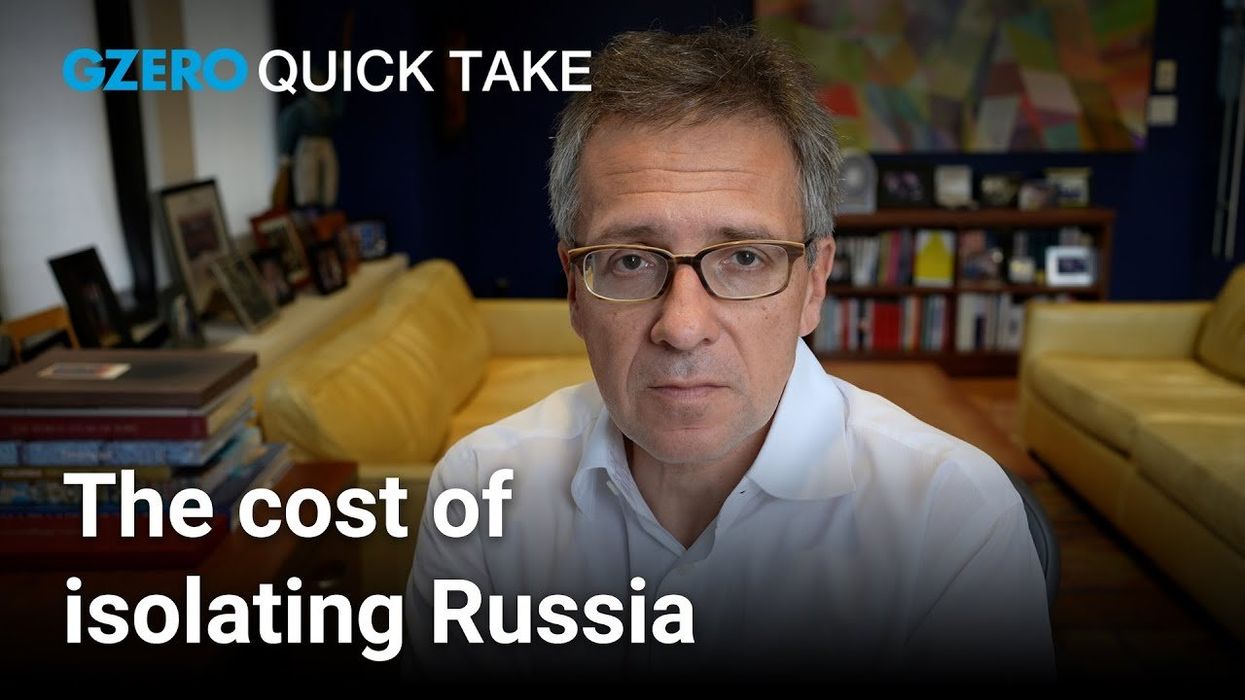
Ian Bremmer's Quick Take: Hi everybody, Ian Bremmer here and a Quick Take to kick off your week. I think it's a good time to talk about Russia. Vladimir Putin, just back from a trip to the Hermit Kingdom. Not many people go there. And those that do frequently don't come back. North Korea. Kim Jong un.
Lots of pomp and showing of very close friendship, engagement, alignment. Kim Jong un said that they're now allies. Putin notedly did not use that terminology, and I'm sure advisedly. So, first time that Putin has been there in decades. And lots of ways to think about it. I mean, on the one hand, you can say that Putin's reduced to traveling to meet the world's worst dictator because there are very few countries in the world that are willing to provide wholehearted support for Russia's illegal invasion into Ukraine. The Iranians will. The North Koreans will. The Syrians and Belarus. And that's kind of about it. And so that doesn't speak very well for Putin being able to get weapons, for example, to continue to fight his war. Even the Chinese won't do that because they're worried about US and other knock on secondary sanctions. So, you know, that's the positive spin that you can put on this from the United States and the NATO position.
But there's a negative spin too, and that is that Russia is increasingly allied with a very dangerous nuclear country with cyber capabilities, history of human trafficking, illegal drug transit and export, and a country that is already maximally sanctioned that benefits from chaos, and that previously their top friend was China who wanted more stability in the global order.
And the Russians certainly don't. So this provides cover for North Koreans to cause more trouble vis-à-vis South Korea and Japan and the rest of the world, and also gives lots of weaponry to the Russians and lots of technology to North Korea, none of which is good, not good for the world at all. And while it's true that Russia is isolated in terms of its war and its war goals, that doesn't mean that it's isolated.
And what I mean by that is the willingness of the United States and Europe to put really tough sanctions on Russia. I mean, the kind of sanctions that would reduce Russia and its ability to fight the war. They're not there. They're not there. They talk tough. But the reality is Russia is the largest country in the world geographically and within that territory. They have an awful lot of very important natural resources. They've got oil, they've got gas, they've got platinum, they've got diamonds, they've got uranium, they've got food, they've got fertilizer. And the United States and Europe, if they were so concerned about the war in Ukraine that they were truly willing to cut that off, they could. But it would cost them.
It would cost them because the world would be in a global recession out of not getting that oil and gas. It would cost them because a lot of the nuclear plants in the West wouldn't have uranium, and the prices would go way up. And they don't want to spend that money. And it would cost them because a lot of people in the Global South would starve, because they wouldn't have access to the food and fertilizer, except at a higher cost that they can't afford to pay. And the West isn't willing to pay that cost to take that risk and to squeeze the Russians that hard. They're willing to make the Russians less profitable in terms of the oil and gas they sell. They're willing to freeze and even increasingly seize hundreds of billions in Russian assets and use that to fund the Ukrainians, because it's better than having to pay for the Ukrainians yourself.
But that's very different from saying we're going to force the Russians to pay a price that they would be unwilling to pay. The price that the Russians are presently paying is at the margins. It isn’t an existential for Putin, and it's certainly a much lower cost than he's willing to exact for continued war on the ground in Ukraine, territorial conquest, and perhaps the ability to remove Zelenskyy in the future and have someone that is more aligned with his sensibilities. That's where we are. And the reality there is that Russia can keep on keeping on as a consequence.
Now, you know, we saw, this peace conference, as it's called, supporting Zelensky with representatives of over 90 countries and over 40 heads of state and heads of government. And it was an impressive display in Switzerland just a couple of weeks ago. But it's also true that behind the scenes, Zelensky really, really, really wanted to have that meeting. And the Americans and many NATO allies were saying, maybe not so fast, because of course, every time you have one of these big global shows of support, you lose a little bit of the urgency and the support you show that there are fewer countries that are willing to support you as much as they were six months before, 12 months before. The Chinese didn't show up, the Indians showed up at a relatively low level. They didn't sign on to the ultimate memorandum. Neither did the Saudis. I mean, you know, this is an issue, right? The fact is that NATO is very strongly supportive of Ukraine and of continuing to allow them to have the types of support to defend themselves and rebuild their country. The Global South is increasingly “let's have a cease fire right now.” And China is “let's have a cease fire right now and we're kind of more in the Russian camp than we are in the West camp or in Ukraine's camp.” And Putin sees that and he sees that over time, if he waits these countries out, the likelihood that he'll end up in a better position than the Ukrainians goes up.
And this is why when you talk to members of NATO and you say, well, what's your position on negotiations? And their public statements are, look, it's it's completely up to the Ukrainians to decide. The reality is that you'll need to pressure the Ukrainians, both with carrots and sticks, to get to a place where you can negotiate, even if the Russians aren't yet ready to do that. And they aren't in reality though Putin says, “sure, I'll negotiate if you move out of the territories that I've illegally annexed, including those that you're presently occupying.” That's a nonstarter. But you have to get the Ukrainian there. You have to prepare them to be there.
And there are a couple of ways you do that, right? One is you give the Ukrainians the support to rebuild their country. You fast track them into the European Union, so they have a shot at better rule of law, improving their democracy, reducing their corruption that gives them a future. And you also give them some harder security guarantees for the parts of their territory that Russia hasn't occupied and hasn't illegally annexed. And if you do all of those things, you're in a better position to get the Ukrainians to the negotiating table.
You provide more cover to Zelensky or the future leaders of Ukraine and the future leaders of Ukraine. And you also make it more compelling multilaterally before you're in a position where Ukraine gets thrown under the bus as they might, for example, if Trump wins, come November, as they might, for example, if Le Pen gets a majority, in the European, in the French Parliament, and then the French are suddenly vetoing European additional gives to Ukraine.
I mean, this is the problem is that a lot of the uncertainty about Ukraine isn't only about what Russia does, isn’t only about Ukrainian capacity, but it's also keeping that multilateral effort, which has been strong and united together. And there have been a couple of almost misses, especially the US, the six months getting them $61 billion, but also coming up with the electoral cycles. And the longer you push that out, the more dangerous it is for Ukraine and ultimately for the NATO alliance. So that's a little bit of the sort of real talk about what's happening in Russia and Ukraine on the back of the news of the past week. As always, what you want to happen is not the same as analysis.
And if it is, it means that your analysis is crap. That is not what we do here. And I hope all of you have a great week. Talk to you soon.
More from Quick Take
GZERO Series
GZERO World with Ian Bremmer
Puppet Regime
Quick Take
ask ian
Ian Explains
GZERO Reports
GZERO Europe
The Debrief

GZERO Daily: our free newsletter about global politics
Keep up with what’s going on around the world - and why it matters.