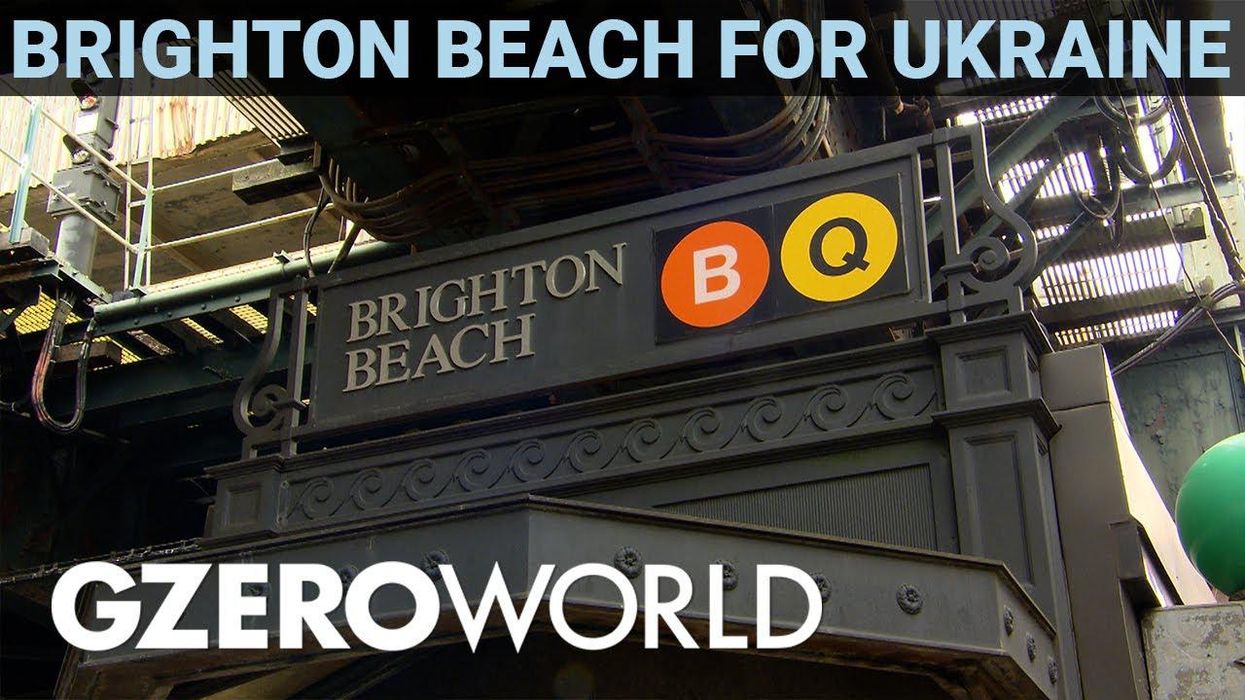
Putin’s war brings big changes to Little Odessa
May 02, 2022
Highlights from the GZERO World with Ian Bremmer weekly television show.
For years, one of the most popular grocery stores in the Brighton Beach section of Brooklyn was called “A Taste of Russia.”
Then, in late February, Russian President Vladimir Putin ordered the invasion of Ukraine. Within a week, the store’s co-owner, Bobby Rakhman, had taken down his sign and replaced it with a new one: “International Food.”
“When the war started,” says Rakhman, who came here from the Soviet Union as a child in the 1970s, “we felt very uncomfortable with the name Taste of Russia. Even though it didn't mean anything political, it made people feel bad that the name Russia was associated with a store located in the midst of, as we call it, ‘Little Odessa’.”
Alex Kliment visits New York's "Little Odessa" for an episode of GZERO World with Ian Bremmer. Watch the video above.
Brighton Beach and the surrounding areas of South Brooklyn are home to tens of thousands of immigrants from the former Soviet Union and their families. The Little Odessa nickname stuck because so many of them, like Rakhman, came originally from the Ukrainian port city of the same name. As the story goes, those early migrants settled down here, next to the sea, because it reminded them of home.
Today, more than a hundred thousand people in South Brooklyn speak Russian, making it one of the largest Russian-speaking communities in America. Along the main drag of Brighton Beach Avenue, signs in Cyrillic are everywhere, advertising pharmacies, grocery shops, bookstores, and restaurants.
But while the language of Pushkin and Gogol has long been a thread that holds this community together, the war has changed how people relate to Russia itself.
It used to be that people here would identify simply as “Russian,” whether they were from Russia itself or other former Soviet states, says Michael Levitis, a Moscow-born local who hosts a popular weekly Russian-language radio show.
“It’s because they spoke Russian and it’s just easier to tell Americans, ‘I’m Russian,’” he says.
“However, now people are very careful to differentiate themselves. They say ‘I’m actually Ukrainian,’ or ‘I’m a Jew from Ukraine,’ or ‘I’m a Jew from Russia.’”
The first big wave of Russian speakers here were Jews fleeing persecution in the Soviet Union in the 1970s. In the years since they’ve been joined by people from across the former USSR. The most recent wave of immigration has come from Central Asian Republics like Uzbekistan and Kazakhstan.
Support for Ukraine has been strong since the war began. Several hundred people showed up to a pro-Ukraine rally on the boardwalk in early March, and there have been a number of community-wide efforts to get food, clothing, and money to the people of Ukraine.
“We feel it's us,” that the war is happening to, “it's not them,” says Lea Kushnirova, a Russian Jew who emigrated to Brighton Beach from Leningrad, today’s St. Petersburg. “It's part of us, and everybody is very disturbed by what’s happened there.”
But despite the outward support for Ukraine, there have been some divisions, says, Levitis, who also runs a large Facebook group for local Russian speakers.
While most people lament the war itself, some are sympathetic to Putin’s reasons for invading, especially among those who get their news primarily from Russian channels.
Some families have even agreed not to talk about the issue over the dinner table, Levitis says, “because people are really getting into raw emotions.”
Rakhman, the grocery store owner, says these days he tries to “stay away from political views or opinions because people have mixed emotions” about the conflict.
There has also been a backlash against businesses that are perceived to be “Russian.” Restaurants associated with Russia have suffered boycotts and vandalism in New York and other parts of the US. The irony, says Levitis, is that many of these businesses are owned by Ukrainians or Russian Jews – precisely the people who now wish to distance themselves from the “Russian” identity.
As the war drags on, these underlying tensions in the community will persist. But one local resident directly affected by the Russian invasion hopes that, on a more basic level, the conflict can push people towards a bigger realization.
“There are a lot of things that people here have to rethink now,” says Maryna Gladyschuk, a local retired nurse from Ukraine whose father and sister are still there.
“Especially in the older community,” she says, “and probably everybody else too. Just to realize how lucky they are to be alive, to have good things, every morning.”
Every week on GZERO World with Ian Bremmer, Ian explains the key global stories of the moment, sits down for an in-depth conversation with the newsmakers and thought leaders shaping our world.
Watch GZERO World on US public television and on GZERO's YouTube channel. GZERO WORLD with Ian Bremmer is a local public television program presented by THIRTEEN PBS.
Funding for GZERO World is provided by:





Keep up with what’s going on around the world - and why it matters.